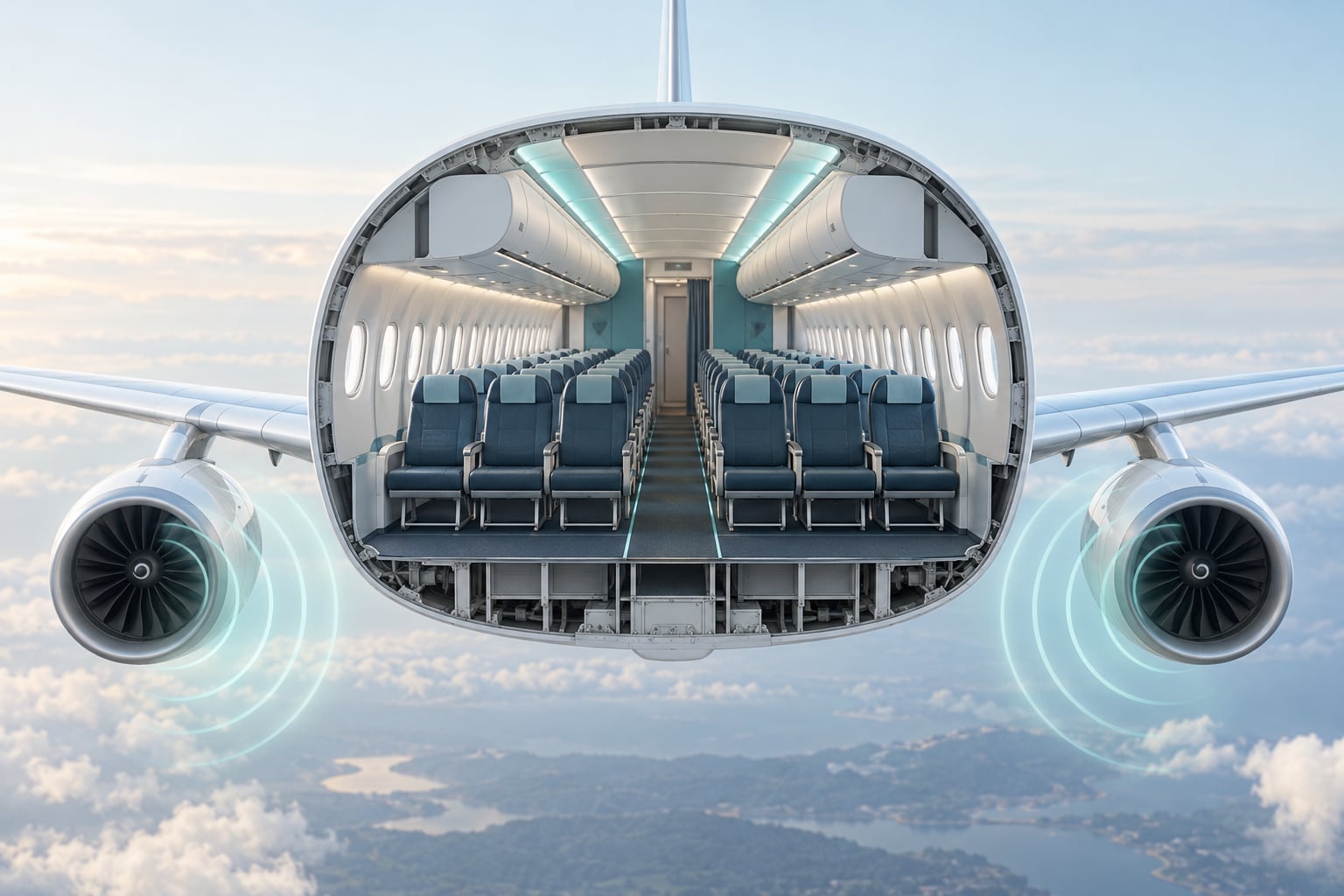
How loud is an airplane cabin? During cruise it usually sits somewhere between 75 and 85 decibels (dBA), and during takeoff and landing it can peak past 105 to 110 dB when the engines run at full thrust. That is roughly as loud as a busy street in cruise, and close to a chainsaw on the runway.
The reason there is no single number is that cabin noise changes with the phase of the flight, the aircraft you are on, and where you are sitting in it. Two people on the same aircraft, one row apart, can report completely different experiences.
Below I break the figures down by flight phase, by aircraft type, and by seat location, then get into what you can actually do about it. Figures are typical ranges rather than hard measurements, because cabin level depends on the specific airframe and the specific flight.
Table of Contents
- How Loud Is an Airplane Cabin on Average?
- What Does a Decibel Level Mean for Flyers?
- Which Parts of an Airplane Flight Are Loudest?
- Why Are Some Aircraft Cabins Louder Than Others?
- Engine type and bypass ratio
- Nacelle design and materials
- Structure-borne vibration
- Galley, lavatory and cabin fittings
- Layout and seat position
- Passengers and announcements
- How Loud Is an Airplane Cabin Compared with Everyday Noise?
- How to Tell If a Flight Will Be Quiet
- Start with the aircraft type
- Then the seat location
- Check the seat map before you pay
- Consider route, time and cabin
- Then read recent passenger reports
- How to Reduce Airplane Cabin Noise
- 1. Pick the seat before you book
- 2. Use earplugs rated 33 dB NRR or higher
- 3. Bring active noise cancelling headphones
- 4. Use the two together when the flight is long
- 5. Set expectations for takeoff and landing
- 6. Sleep on the loud side of the aircraft
- 7. Use the call button with judgement
- Frequently Asked Questions
- How many decibels is an airplane cabin in cruise?
- Is airplane cabin noise dangerous for your hearing?
- Where is the quietest seat on a plane for noise?
- Which airplane has the quietest cabin?
- Is sitting over the wing louder than sitting near the front?
- Do noise cancelling headphones work against engine noise?
How Loud Is an Airplane Cabin on Average?
The honest average for a modern narrowbody in cruise is around 80 dB. Older narrowbodies and regional turboprops sit higher, quieter widebodies sit lower, and anything measured on the ground is louder than the same seat at altitude.
Here is the short version most searchers are after:
- Cruise: 75 to 85 dBA
- Takeoff and landing: 105 to 110 dB or higher at peak
- Private and business jets: roughly 62 dB in the cabin
- Small propeller aircraft: 90 to 100 dB
One passenger-run test found an average cabin reading of 88 dB, which sits above the usual cruise range but within it for a smaller or older aircraft. Measurements taken by passengers vary a lot because phone apps are not calibrated instruments, and because people sample the cabin at different moments.
Cruise is also the phase that lasts. A takeoff roar lasts a few minutes, while a four-hour cruise means four hours at the level that matters most for sleeping, reading and working.
What Does a Decibel Level Mean for Flyers?
A decibel is a measure of sound intensity on a logarithmic scale, which means the numbers rise faster than the actual loudness. Going from 80 dB to 83 dB is a small change in the maths and a noticeable change in the ear.
Two useful anchors: a 3 dB increase is roughly a doubling of sound energy, and a 10 dB increase is commonly perceived as about twice as loud. That is why the difference between an 80 dB cabin and an 85 dB cabin is not trivial, even though the numbers look close.
dBA, or A-weighted decibels, is the scale used for anything meant to mimic human hearing. It discounts very low and very high frequencies the way the ear does. Nearly every cabin figure you see quoted, including the 75 to 85 range, is A-weighted.
For health context, 85 dB is the occupational exposure limit used for an eight-hour workday, and higher levels are allowed only for shorter periods. A long flight at cruise sits close to that threshold for hours, which is why frequent flyers and crew talk about it. A takeoff peak is well past it, but it is brief. If you have tinnitus, hyperacusis or hearing loss, ask your audiologist about travel rather than guessing.
Perceived loudness is not the same as measured loudness either. Duration matters, so does pitch. Much of the cabin hum sits in the low frequencies, where earplugs struggle and where the sound seems to come from inside your own head.
Which Parts of an Airplane Flight Are Loudest?
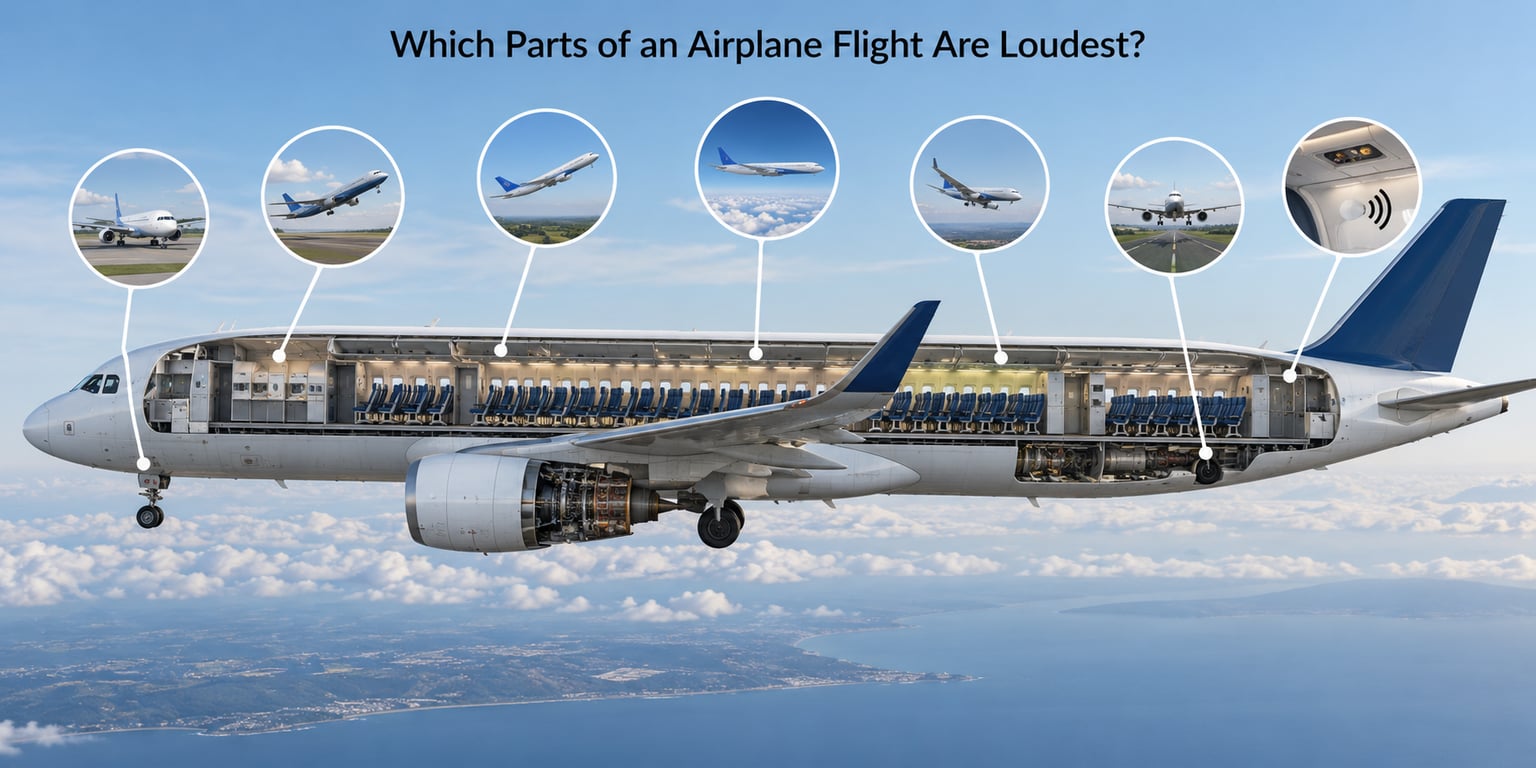
Taxi and takeoff are the loudest parts of any flight. Landing is close behind, and cruise sits in a band that most people adapt to within a few minutes.
| Flight phase | Typical cabin level | What it means for you |
|---|---|---|
| Pushback and taxi | 65 to 80 dB | APU, ground vehicles, jet bridge air, engines idling. Loud and variable, with no steady engine note to mask it. |
| Takeoff | 105 to 110+ dB | Loudest moment of the flight. Conversation stops, loose items rattle, headphones at high volume add nothing. |
| Initial climb | 95 to 105 dB | Still very loud as the aircraft accelerates and climbs at high thrust. |
| Climb to cruise | 85 to 95 dB | Thrust tapers off and the cabin settles quickly toward steady cruise. |
| Cruise | 75 to 85 dB | Steady, broad-spectrum hum. The level you live with for most of the flight. |
| Cabin announcements | Peak around 85 to 90 dB | Designed to cut through engine noise. Hard to miss, unpleasant at close range, and often the moment that wakes light sleepers. |
| Descent | 80 to 90 dB | Thrust increases again, though usually not to takeoff levels. |
| Landing and rollout | 100 to 110 dB | Second loudest phase. Reverse thrust, spoilers and the runway itself all add to it. |
Overnight red-eyes are harder than the numbers suggest. A cabin that measures 80 dB and stays steady is easier to tune out than an 85 dB cabin interrupted by announcements, service and a crying child. Regular flyers will tell you a screaming infant out-perceives the engines as the worst sound on board, and no decibel figure captures that.
Why Are Some Aircraft Cabins Louder Than Others?
Five things drive most of the difference between aircraft: the engines, the airframe, the cabin fittings, the layout, and the people in it.
Engine type and bypass ratio
High-bypass turbofan engines push a large mass of air around a relatively small core, which produces a lower-pitched, lower-velocity exhaust and is much quieter than older low-bypass designs. Modern narrowbody re-enginings such as the A320neo and 737 MAX series exist largely for this reason.
Nacelle design and materials
Serrated chevrons on the nacelle trailing edge smooth the flow where it meets the bypass air, cutting high-frequency whine. Composite fan blades, raked wingtips, better acoustic blankets and fairings around the landing gear all shave decibels off. One widely quoted fleet comparison puts a re-engined A330neo at about 90 dB against roughly 107 dB for the older A330ceo.
Structure-borne vibration
Some of the cabin roar is not airborne at all. It is the airframe shaking, transmitted through floors, seats and sidewalls, and re-radiating as sound inside. This is the low-frequency hum that seems to sit in your chest, and it is the reason bulkhead seats often feel louder than their measured level suggests.
Galley, lavatory and cabin fittings
Near the galley you get cart movement, coffee machines, floor-level service lights and crew footfalls. Lavatory areas add pumps, doors and queues. For a nervous flyer this is a bigger practical annoyance than the engines.
Layout and seat position
This is the part passengers can control, covered in detail below. One twist catches people out: most modern airliners mount engines under the wings, so the front of the cabin is quieter. Older designs such as the MD-80 family mount engines at the tail, which reverses the rule and makes the rear cabin the loudest place on board.
Passengers and announcements
A full cabin in economy is noisier than a half-full one. So are announcements, service, and the scrape of bags in overhead bins during boarding.
Notably, the quietest cabins are now found in places most people do not expect. Frequent-flyer communities repeatedly single out the Embraer E-Jet E2 as the quietest narrowbody in service, with owners describing the engines as around 20 percent quieter than the preceding E175. One forum user tracked a Boeing 737-700 at roughly 75 dB toward the front and 80 dB at the back, which matches the wing-engine pattern exactly.
How Loud Is an Airplane Cabin Compared with Everyday Noise?
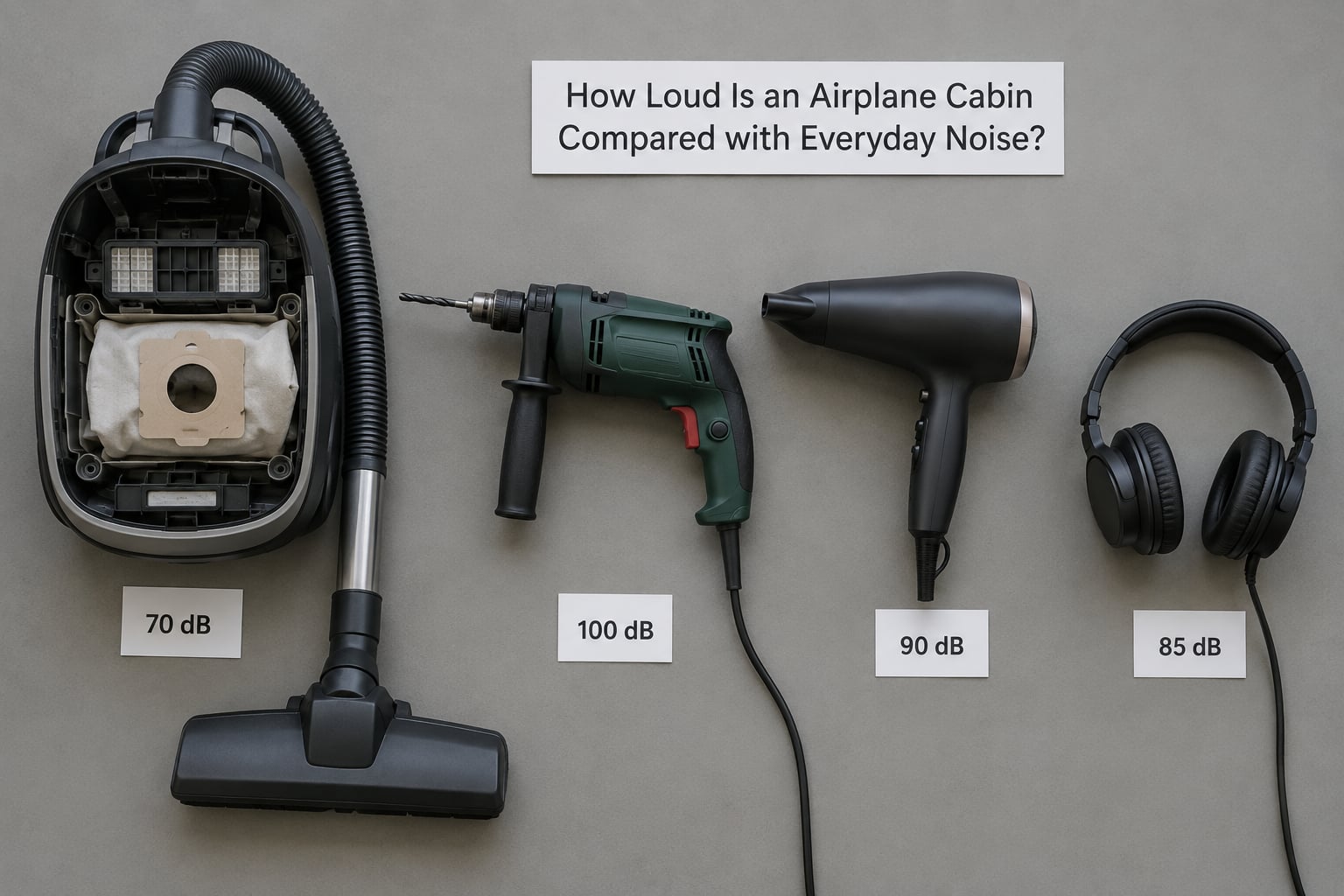
Cruise is louder than a conversation and roughly level with a busy street. Takeoff is louder than a chainsaw. These are approximate references, useful for intuition rather than for measurement.
| Sound | Approximate level | Compared with the cabin |
|---|---|---|
| Quiet office at night | 30 to 40 dB | Far quieter. This is roughly the level needed for unamplified sleep. |
| Normal conversation at one metre | 60 dB | Louder than a cruise cabin in many modern widebodies. |
| Private jet cabin | around 62 dB | About conversational level. |
| Refrigerator hum, quiet street | 50 to 60 dB | Clearly below a narrowbody cruise. |
| Running vacuum cleaner | 70 dB | About a level with a good cruise cabin. |
| Busy city street, crowded restaurant | 80 to 85 dB | The band where most narrowbody cruises sit. |
| Hair dryer, blender, city traffic at the roadside | 85 to 90 dB | Louder than cruise; matches the louder cabins and climb. |
| Small propeller aircraft cabin | 90 to 100 dB | Uncomfortably loud for reading, but survivable. |
| Chainsaw, lawn mower | around 110 dB | About the takeoff and landing peak. |
| Rock concert front of stage | 105 to 115 dB | The only everyday comparison that matches takeoff. |
Everyday comparisons are where the numbers stop being abstract. People tolerate a vacuum cleaner for ten minutes at home. They do not tolerate one for four hours, which is why a 78 dB cabin wears some people out long before 88 dB would.
How to Tell If a Flight Will Be Quiet
You cannot know in advance, but you can make a decent estimate. Work through these in order.
Start with the aircraft type
Newer narrowbody re-enginings and composite widebodies are the quiet end. Older high-density layouts and small turboprops are the loud end. If you are particular about noise, filter by aircraft rather than by airline.
Then the seat location
On a conventional wing-engined airliner, aim for the rows just behind the wing, or far forward. Over the wing itself is the loudest zone for the fan noise. Avoid the rows immediately ahead of and behind the galley and lavatory.
On a row in front of the wing, the loudest thing is often the seat directly ahead of you rather than the engine. Passenger forums consistently say the front seats are less noisy, and the same pattern shows up in per-model noise comparison threads on aviation enthusiast sites.
Check the seat map before you pay
Most airline seat maps show galley and lavatory positions, which is the single most useful piece of information. Seat letters also hint at layout. A window seat behind a bulkhead is a different acoustic world from a middle seat next to one.
The seat number to watch is 11A on a 737 or A320, a commonly asked-about example. On many configurations that row sits right next to a bulkhead adjoining the galley or lavatory, where the airflow changes and service noise carries. Check the specific seat map rather than assuming, because the same number means something different on a different layout.
Consider route, time and cabin
Short hops spend a larger share of the flight in the loud phases, so a 90-minute flight can feel noisier than a five-hour one. Red-eyes add the sleep problem on top. Business and first class usually put fewer people in the space, which cuts the human noise considerably even on the same aircraft.
Then read recent passenger reports
Passengers trust measured data far more than airline marketing, and the pilot and frequent-flyer communities keep the best per-model records. Treat community readings as a rough pattern, not a guaranteed figure for your seat on your flight.
How to Reduce Airplane Cabin Noise
1. Pick the seat before you book
Front of cabin or just behind the wing on a wing-engined jet, away from bulkheads, galleys and lavatories. This is free and it does more than any gadget.
2. Use earplugs rated 33 dB NRR or higher
NRR, the Noise Reduction Rating, is the number on the box. Flyers who use 33 dB plugs regularly report that cabin noise simply disappears. The catch is fit: a foam plug rolled between finger and thumb, placed deep, and held for a few seconds beats a cheap one every time.
Foam plugs also do little against low-frequency rumble, which is why they work so much better against announcements, babies, service carts and the lavatory than against the engines.
3. Bring active noise cancelling headphones
ANC headphones come up again and again as the go-to choice for long flights, and they are very effective against the steady low-frequency engine hum that earplugs miss. They are less good at blocking speech and unpredictable transients.
4. Use the two together when the flight is long
Plugs handle the irregular noise, ANC handles the engine hum. On a red-eye, plugs alone; for a daytime flight with movies, ANC alone; for a long-haul with a sensitive traveller, both.
5. Set expectations for takeoff and landing
Noise cancelling cannot make takeoff quiet. Wear the headphones through the loud phases for comfort rather than volume, and if you want to protect your hearing, the right tool is a properly fitted filter earplug such as an aviation plug, not turning your music up.
6. Sleep on the loud side of the aircraft
Counter-intuitive but true: with under-wing engines the front is quieter. If you are sleeping, the quietest available seat is worth more than the aisle, the legroom or the view. Bring an eye mask and an earplug, and expect to be woken by the announcement anyway.
7. Use the call button with judgement
Flight attendants can be slow to reach a rear seat during cruise and quick to reach a front one. A gentle call button for water or a lavatory break at the right moment removes a reason to stand up and move, which is the biggest avoidable noise you generate yourself.
For travellers with tinnitus, sound sensitivity, autism or a child who finds the rumble hard to cope with, a little preparation makes the difference between a manageable flight and a cancelled one. Talk to an audiologist or a doctor about travel if you have ongoing symptoms.
Frequently Asked Questions
How many decibels is an airplane cabin in cruise?
A modern airliner cabin usually measures 75 to 85 dBA during cruise, with older narrowbodies and regional turboprops nearer the top of that range and quiet widebodies nearer the bottom. Aircraft at cruise flies at roughly 35,000 feet, where the thin air means less cabin noise than the same seat on the ground. Some passenger tests come in above 80, so treat the range as typical rather than fixed.
Is airplane cabin noise dangerous for your hearing?
A short flight will not damage your hearing. Cruise sits near the 85 dB occupational limit used for an eight-hour workday, so a very long flight is a lot of exposure at that level, and takeoff peaks above 105 dB briefly. Most damage comes from repeated or long exposure, not one flight. If you have tinnitus, hearing loss or sound sensitivity, ask an audiologist about flying rather than guessing.
Where is the quietest seat on a plane for noise?
On aircraft with engines under the wings, the quietest seats are at the front of the cabin or in the rows just behind the wing. The loudest zone is directly over the engines. Avoid rows next to the galley and lavatory. Older jets with tail-mounted engines, such as the MD-80 family, reverse this pattern, so the front is the only reliable zone.
Which airplane has the quietest cabin?
The quietest production airliner cabins are the newest widebodies, the Airbus A350 and Boeing 787 generation, thanks to composite airframes and large high-bypass turbofans. Among narrowbodies, the Embraer E-Jet E2 is regularly singled out by frequent flyers, and re-engined A320neo and 737 MAX aircraft are far quieter than their older counterparts. Private and business jets are quieter still, at roughly 62 dB.
Is sitting over the wing louder than sitting near the front?
Yes, generally. The wing section sits closest to the engine nacelles, and you get the low-frequency fan rumble and airflow noise with no cabin structure in the way. Being near the front helps because the engines are further away and the cabin sidewall and floor act as a partial barrier. The difference is usually a few decibels, which is noticeable in a quiet cabin.
Do noise cancelling headphones work against engine noise?
They work well, and that is exactly the kind of noise they are designed for. The steady low-frequency hum of a turbofan is close to what ANC is tuned to cancel, and users in flying communities recommend them repeatedly for long flights. They are less effective against speech, announcements and unexpected noises. For a noisy cabin, earplugs handle the irregular sounds and headphones handle the engines.
So: how loud is an airplane cabin? About 75 to 85 dBA in cruise, and 105 to 110 dB or more during takeoff and landing. If noise bothers you, start with the seat map, pick rows behind the wing or at the front away from the galley, and pack a pair of 33 dB earplugs. That combination handles almost every noise complaint I hear from fellow travellers.