Yes, on some airlines and in some seats. The rule is not one blanket yes or no: an airline may install its own footrests on certain seats, while a personal device is allowed only when that carrier permits passenger comfort devices, only in certain seats, and only if the cabin crew approves it on the day. Most of the confusion comes from mixing those two things together.
So are airplane footrests allowed? Often yes, and quite often quietly tolerated, but never automatically. The device type, the carrier, the aircraft, the seat you are sitting in and the crew member on duty all matter. This guide walks through each one, plus what to do when a flight attendant asks you to put it away.
Policy pages change without notice, so treat the last-updated date on any airline rule you read as the real information. Everything below was checked against published airline guidance in October 2026, with passenger reports used only as illustration of how it plays out in practice.
Table of Contents
- Are Airplane Footrests Allowed?
- The short answer in three parts
- What Is an Airplane Footrest?
- Are Built-In Footrests Allowed on Airplanes?
- Can You Bring a Personal Footrest on a Flight?
- Can toddlers use footrests on a plane?
- Why Do Some Airlines Prohibit Personal Footrests?
- Evacuation routes and seat movement
- Somebody else’s seat
- Takeoff, landing and taxi
- Airline-by-airline footrest rules and where to confirm them
- Are Footrests Allowed on Economy Flights?
- Are Footrests Allowed on Flights to and from the United States?
- What Can You Do If Your Footrest Is Refused?
- How to Check Your Airline’s Footrest Rules Before Flying
- Frequently Asked Questions
- Are inflatable footrests allowed on planes?
- What airlines do not allow foot hammocks?
- Does American Airlines allow foot hammocks?
- Can you use a footrest in an exit row?
- Is there a portable footrest that I can use on an airplane?
- Are footrests allowed during takeoff and landing?
- Conclusion
Are Airplane Footrests Allowed?
Airline-installed footrests are allowed wherever they are fitted. Personal footrests are allowed only on carriers that publish a comfort-device rule, only in the seats that rule names, and only with the cabin crew’s approval on the day. Where no published rule exists, the answer is genuinely undecided until you ask the airline.
That is the honest version, and it is more useful than the confident one-liners floating around, because “airlines allow footrests” hides the three separate questions a flyer actually has: does my carrier permit the device type, is my seat on the list, and will the crew let me keep it when they walk through the cabin.
One more thing worth clearing up early. A footrest being fine at security, or fine in the terminal, tells you nothing about the cabin. Ground staff check that a bag is permitted; the cabin crew check that a device does not obstruct the seat, the walkway or an exit. Those are different tests, and a device can pass one and fail the other.
The short answer in three parts
- Built-in footrests are part of the seat design on some aircraft. No permission needed, but no choice either.
- Personal footrests are permitted on some carriers, in named seats, at the crew’s discretion. Approval is never guaranteed in advance.
- Devices that attach to or hang from the seat in front are the ones most carriers rule out, even when they allow floor-standing cubes.
What Is an Airplane Footrest?
When people say airplane footrest, they usually mean one of five different products, and the rules treat each one very differently. Knowing which one you own is the first step to knowing whether you can use it.
| Device type | What it is | Typical airline treatment |
|---|---|---|
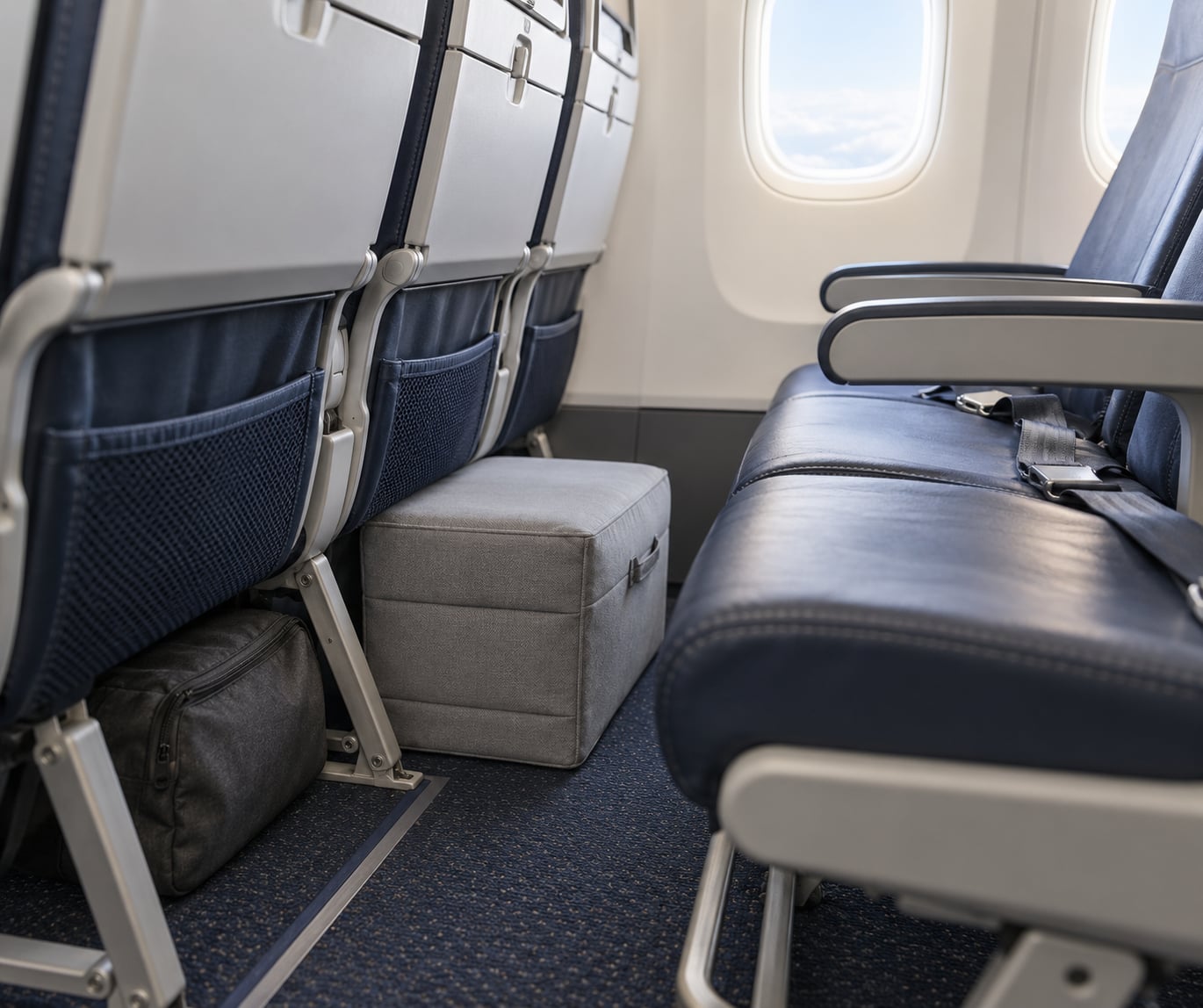
| Footwell cube | Inflatable block that sits on the cabin floor between the seat and the seat in front | The device type most published airline rules name, because it stays in the footwell and stows flat |
| Foot hammock | Strap or sling that hangs from the tray table of the seat in front | Restricted or prohibited on many carriers, since it fixes itself to another passenger’s seat |
| Foam cushion with straps | Memory foam or rigid board that hangs from the seat in front, sometimes height adjustable | Frequently ruled out for the same attachment reason as a hammock |
| Bed box suitcase | Hard-sided cabin bag that converts into a flat sleeping platform across the footwell | Among the most commonly refused items, because it changes the seat’s function and takes floor space |
| Soft bag used as a footrest | A duffel, backpack or rolled blanket placed under the footwell or the seat ahead | Generally tolerated, since it is ordinary luggage used in an ordinary way |
The dividing line is not comfort. It is geometry and attachment. A device that stays entirely within your own leg space and folds flat in seconds is easy to permit. A device that hangs off the seat in front, sits across the aisle or changes the position of your seat is not.
Are Built-In Footrests Allowed on Airplanes?
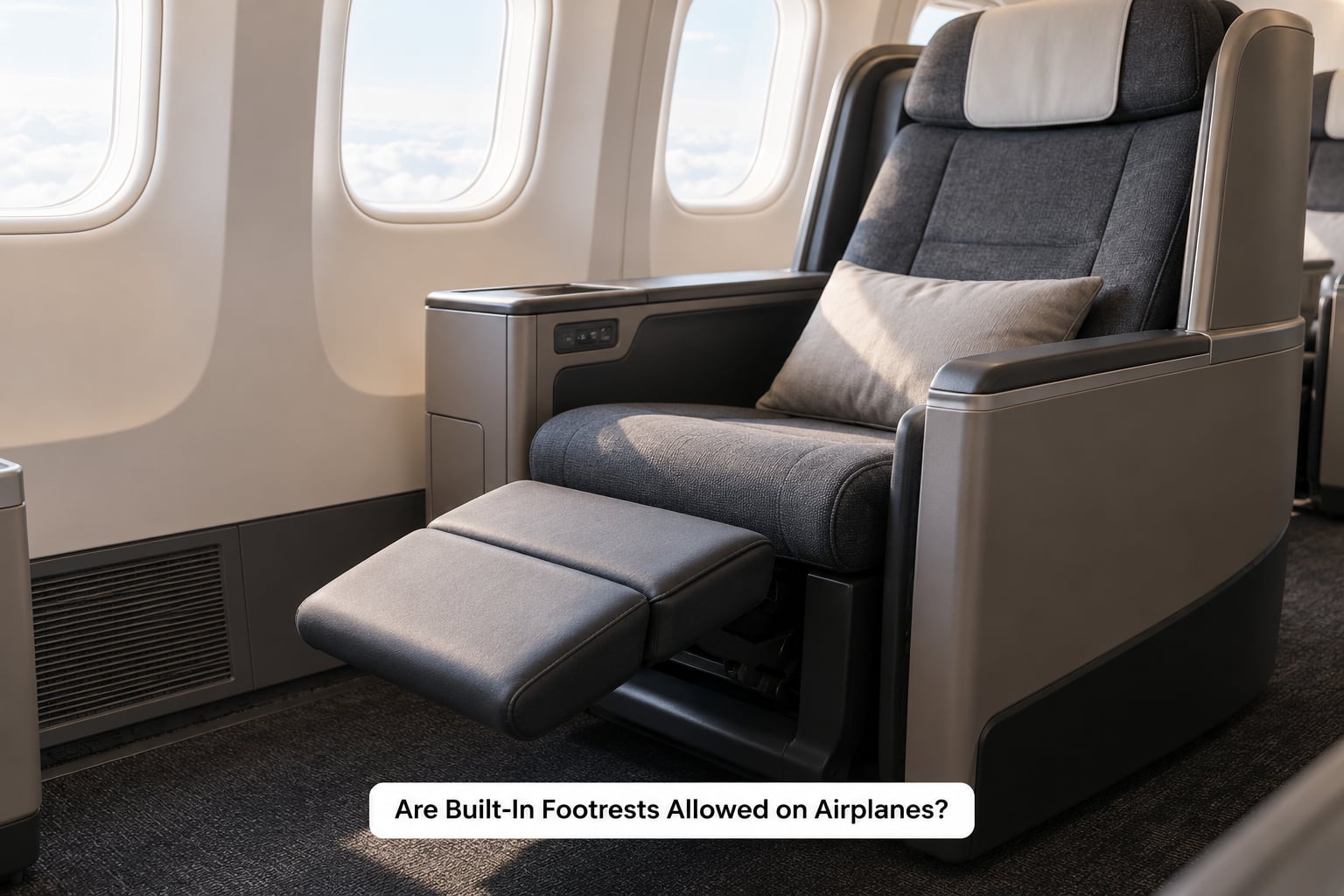
Yes. Aircraft-installed footrests are allowed on every flight where they are fitted, because they are part of the certified seat design rather than something a passenger brought on board. There is no rule to break and no crew approval involved.
Availability is a design choice, not a passenger right. It tends to show up on wide-body aircraft in premium cabins, where a lie-flat or recliner-style seat has a footrest built into the leg rest assembly. Some narrow-body premium economy seats have a simple fixed bar or padded panel. Long-haul narrow-body economy usually has nothing, because the pitch leaves no room for one.
On a seat with a powered leg rest, the footrest moves when the recline cycle runs and is usually locked for taxi, takeoff and landing. That is worth knowing before you promise yourself a flat bed: check whether the seat reclines fully and whether the footrest deploys independently, because plenty of premium seats give you the angle without the footrest.
Can You Bring a Personal Footrest on a Flight?
Often yes, but never on assumption. A personal footrest is treated as a passenger comfort device, and carriers that allow them at all generally require several things: setup only after takeoff, stowage on request, no obstruction of the seat in front, and clearance from the crew.
The most detailed published comfort-device guidance belongs to Jetstar, and it is a useful template for what carriers look at. Its rules cover only inflatable footwell cubes, cap the number per travelling group, exclude specific seats, require a quick-release valve, rule out electric pumps, and insist the cube must not stop the seat belt fastening or the movement of the seat, tray table or entertainment screen. It also limits use to when the seatbelt sign is off. Other carriers use different wording, but the same logic runs through nearly all of them.
On practical matters, most devices fit inside your existing carry-on allowance because they pack down small, and an inflatable cube that deflates folds into a bag rather than adding a counted item. Check your carrier’s size and weight limits anyway, particularly on low-cost carriers where a second bag is a separate charge and a weight fee is common.
Never plan on inflating during taxi or on the ground. Airlines require these devices stowed before takeoff and landing, and inflating at altitude is what turns a permitted device into a refused one.
Can toddlers use footrests on a plane?
Families ask this constantly, and the answer is usually a softer yes than for adults, because a child’s dangling feet are the actual problem being solved. The catch is that the device must still respect the same rules: it cannot be strapped to the seat in front if the carrier rules out hanging devices, and it cannot encroach on the passenger whose feet are already in that space.
A folded blanket or a soft bag under the child’s feet is the lowest-risk option and works in almost any seat. Passengers flying long-haul with young children report using portable devices routinely without incident, but also report crew asking them to remove a device once on flights with tight pitch.
Why Do Some Airlines Prohibit Personal Footrests?
Because the cabin has to stay clear, and a footrest is the kind of object that quietly stops being clear the moment you put it down. The reasoning is mostly about the seat, the walkway and the exit, not about your knees.
Evacuation routes and seat movement
A footrest on the floor occupies the space a passenger is meant to move into if something goes wrong, and it can stop a seat from reclining or sliding forward. Crews are trained on evacuation procedures that assume the floor space in front of you is free, which is why a device that sits in the footwell can be tolerated and one that straps to the seat back often cannot.
Somebody else’s seat
The passenger in front of you paid for their legroom, and a hanging device takes a slice of it. In a full cabin this is a live conflict rather than a technicality, and it is the reason window and middle seats are the realistic places to use a personal footrest while aisle, exit row and bulkhead seats are not.
Takeoff, landing and taxi
Everything loose gets stowed, and an inflatable device is no different. A footwell cube that has to be deflated with a valve, a hammock that has to be unclipped and folded: any of it can be slow, and slow is the problem during a safety phase.
Airline-by-airline footrest rules and where to confirm them
Here is the honest picture across the carriers readers ask about most. Only Jetstar publishes specific, itemised comfort-device rules that this guide could verify. For the rest, the useful move is to check the carrier’s own special-equipment or accessibility page, because blanket bans are sometimes written into general conditions of carriage rather than a comfort page.
| Carrier | Published stance on personal footrests | Where to confirm before you fly |
|---|---|---|
| Jetstar | Most specific published rule found: inflatable footwell cubes only, capped per group, aisle, exit row, bulkhead and business class seats excluded, cabin crew approval, stow on request | In-flight comfort devices help page |
| Delta Air Lines | No blanket published prohibition found; treated as an item to stow on crew instruction | Special items and accessibility page, or customer service |
| Alaska Airlines | No blanket published prohibition found; same crew-instruction approach | Accessibility and special assistance page |
| United Airlines | No published blanket comfort-device rule found; general conditions of carriage apply | Conditions of carriage and customer service |
| American Airlines | No published blanket rule specific to foot hammocks found | Customer service; ask about passenger comfort devices by name |
| JetBlue | No published blanket rule found | Accessibility and special equipment page |
| Southwest Airlines | No published blanket rule found | Customer service; standard open seating reduces the pitch issue in some rows |
| British Airways | No published blanket rule found; crew reports of toddler bed devices being removed are common | Special assistance and accessibility page |
| Qantas | No published blanket rule found | Special services page |
| Emirates | No published blanket rule found | Special assistance and cabin services page |
Where a carrier has not published a rule, crew discretion carries the decision. Traveller reports on r/delta, r/frontierairlines, r/allegiant and the Tripadvisor air travel forums split sharply: plenty of people describe setting a device up after takeoff in a window or middle seat and never hearing about it again, while others describe being asked to remove one, usually for taking the space in front of the passenger behind them or for using a hammock. Treat these as reports of what individuals experienced, not as policy.
Are Footrests Allowed on Economy Flights?
Yes, in the sense that economy is where personal footrests get used most. A built-in footrest is rare in economy, so a portable device is often the only option a passenger has. The restrictions that matter are the seat you are in and how much legroom the row has, not the cabin label.
Seat geometry is the part that surprises people. Aisle seats are excluded almost everywhere, because the device sits where the walkway must stay clear. Exit rows are excluded, because the space beside the door must stay usable. Bulkhead rows are excluded, because there is no seat in front to anchor a device to and the leg area is needed as legroom. Business class is excluded on carriers that publish rules, because a fixed footrest or a lie-flat seat already occupies that space.
| Seat | Can you use a personal footrest? | Why |
|---|---|---|
| Window, narrow-body | Usually, with crew approval | Footwell space is unused and the walkway stays clear |
| Middle, narrow-body | Usually, with crew approval | Same geometry as a window seat, and no aisle traffic nearby |
| Aisle | Rarely permitted | The device encroaches on the walkway required for evacuation |
| Exit row | No | Door area must remain clear and usable |
| Bulkhead | No | No seat in front to attach to, and the space is needed for legroom |
| Premium or business with a fixed footrest | No need for one | The seat already provides the function |
Extra legroom rows are a mixed case. They give you the space a footrest needs, but the same rule about the aisle and about the passenger behind you still applies, and published rules that exclude bulkhead seats may exclude these too.
Are Footrests Allowed on Flights to and from the United States?
There is no single United States rule that covers personal footrests on commercial aircraft. The Department of Transportation does not publish one, and the Federal Aviation Administration’s rules govern the aircraft and the crew’s authority to direct passengers, not the type of object you may keep at your feet. In practice, the operating carrier’s conditions of carriage and the crew’s instructions at the aircraft door are what decide your case.
Two practical consequences follow for US-based travel. First, on a domestic itinerary the operating carrier is usually obvious, so a single message to that airline settles it. Second, on an international or connecting itinerary, a codeshare or a second carrier on a later leg may have a different rule, and your permission on leg one says nothing about leg two. The airline that sells the ticket is often not the airline that flies the segment.
What Can You Do If Your Footrest Is Refused?
Take it down without arguing and ask what the crew would prefer. In my experience the request is rarely about you personally; it is about the seat in front, the aisle, or a phase of flight. Compliance costs you ten minutes, arguing costs you the whole flight.
For the flight itself, these alternatives carry no policy risk:
- Soft bag in the footwell. A duffel or backpack under the seat in front gives you most of the elevation with none of the questions.
- Rolled blanket or spare clothing. Build a stack and rest your feet on it. Folds into your carry-on later.
- Reposition the seat. Slightly lowering the backrest, or moving the seat in front of you if it is empty, often solves the dangling-feet problem on its own.
- Walk during the scheduled break. Circulation matters more than posture on a long flight, and a five-minute walk every couple of hours does more good than any device.
- Pick the seat before you book. An exit row or a bulkhead row gives space without a device, and an extra legroom row does too.
- Go premium on the route. On aircraft with lie-flat or recliner seats, the footrest problem resolves itself.
Keep a polite line ready for the moment a crew member asks. Something like asking whether the issue is the position, the timing, or the device itself tells you which of the three rules you are actually breaking, and often the answer is that you can use it after takeoff or in a different position. That is a five-second conversation, and it usually ends with permission rather than confiscation.
How to Check Your Airline’s Footrest Rules Before Flying
Five minutes of checking beats four hours of guessing. Work through this before you leave, not at the gate.
- Identify the operating carrier for each segment. Look at the actual aircraft operator, not the ticket seller, especially on codeshares and multi-leg international itineraries.
- Search the carrier’s site for special equipment, accessibility or mobility assistance pages. Comfort devices are usually filed there rather than under baggage rules. A published policy page is the only version worth relying on.
- Ask the question with the device named. Say inflatable footwell cube, foot hammock or toddler footrest, not just comfort device, and ask which seats are excluded.
- Get the answer in writing. A message in the app or a reply to an email is a record you can point to if a gate agent or crew member tells you otherwise.
- Confirm the seat you were assigned. Move away from an aisle, exit row or bulkhead seat before you invest in any device, and re-check after a schedule change since aircraft swaps can change the seat map.
If you get no clear written answer, plan as though the device will not be used. That is not pessimism, it is the only assumption that cannot go wrong at 35,000 feet.
Frequently Asked Questions
Are inflatable footrests allowed on planes?
Usually, on some carriers and in some seats. Jetstar publishes the most explicit rules found: inflatable footwell cubes only, capped per travelling group, and not in aisle, exit row, bulkhead or business class seats. Carriers without a published blanket rule leave it to cabin crew, so setup is allowed only after takeoff and only with approval. Inflatable foot hammocks are treated far more harshly than floor-standing cubes.
What airlines do not allow foot hammocks?
No carrier reviewed publishes a blanket ban on foot hammocks specifically, so the accurate answer is carrier by carrier. The general pattern is that devices which hang from or attach to the seat in front are the ones restricted, while floor-standing inflatable cubes are the ones most often permitted. Jetstar is explicit that leg hammocks and hanging devices are not allowed, and crew reports on British Airways and other carriers show similar removals. Ask your own airline before you fly.
Does American Airlines allow foot hammocks?
American Airlines has no published rule specific to foot hammocks, so approval depends on the cabin crew on the day. In practice, hanging devices are the ones that get refused, because they take legroom from the passenger in front and can restrict the seat mechanism. A floor-standing inflatable cube used only after takeoff in a window or middle seat is the lower-risk option. Get confirmation in writing through the airline before you pack it.
Can you use a footrest in an exit row?
No. Exit rows are excluded on every published comfort-device rule reviewed, because the space beside the door has to stay clear and usable. Aisle seats and bulkhead rows are excluded for related reasons, the first for the walkway and the second because there is no seat in front to anchor a device to. If you want extra space, book an exit row and skip the footrest entirely, or ask the airline whether a different row can be assigned.
Is there a portable footrest that I can use on an airplane?
There is, but the safest one is also the least clever. A soft bag or rolled blanket in the footwell works everywhere with no permission needed. If you want a real device, an inflatable footwell cube is the one most airline rules actually name, because it stays in your own leg space and deflates flat. Hanging hammocks and foam cushions with straps face more restrictions. Whichever you pick, it must not obstruct the seat in front or the seat mechanism.
Are footrests allowed during takeoff and landing?
No. Any permitted device has to be deflated, folded or removed before taxi, and stowed until the seatbelt sign is switched off. Published rules that cover this say it in terms: use the device only once airborne and when the seatbelt sign is off, and stow it on crew request. This is the phase where crews are watching most closely, and it is where a permitted device most often turns into a refused one.
Conclusion
Are airplane footrests allowed? Airline-installed ones are allowed wherever they are fitted, and personal ones are allowed on some carriers in window and middle seats, after takeoff, with the crew’s approval. Anything that hangs from the seat in front, sits in an aisle, an exit row or a bulkhead, or stays out during taxi, takeoff and landing is the version that gets refused.
Do one thing before you fly: message the operating carrier, name your device, and ask which seats are excluded. Then pack a soft bag as your backup, because it works on every seat on every airline and needs nobody’s permission.