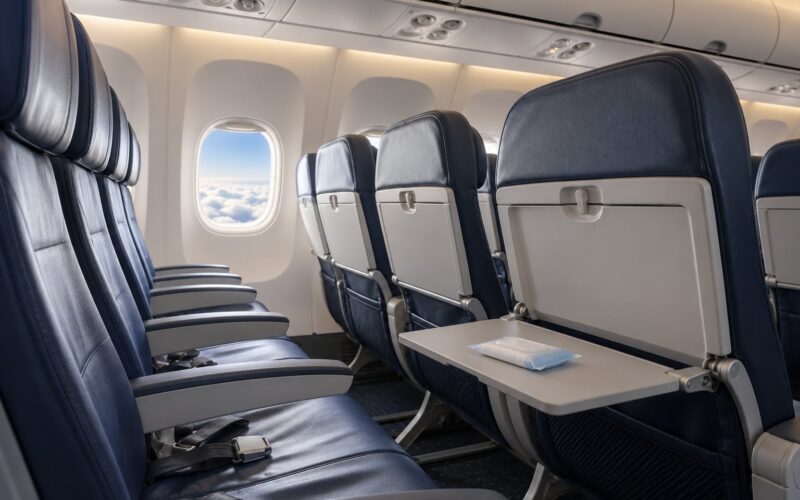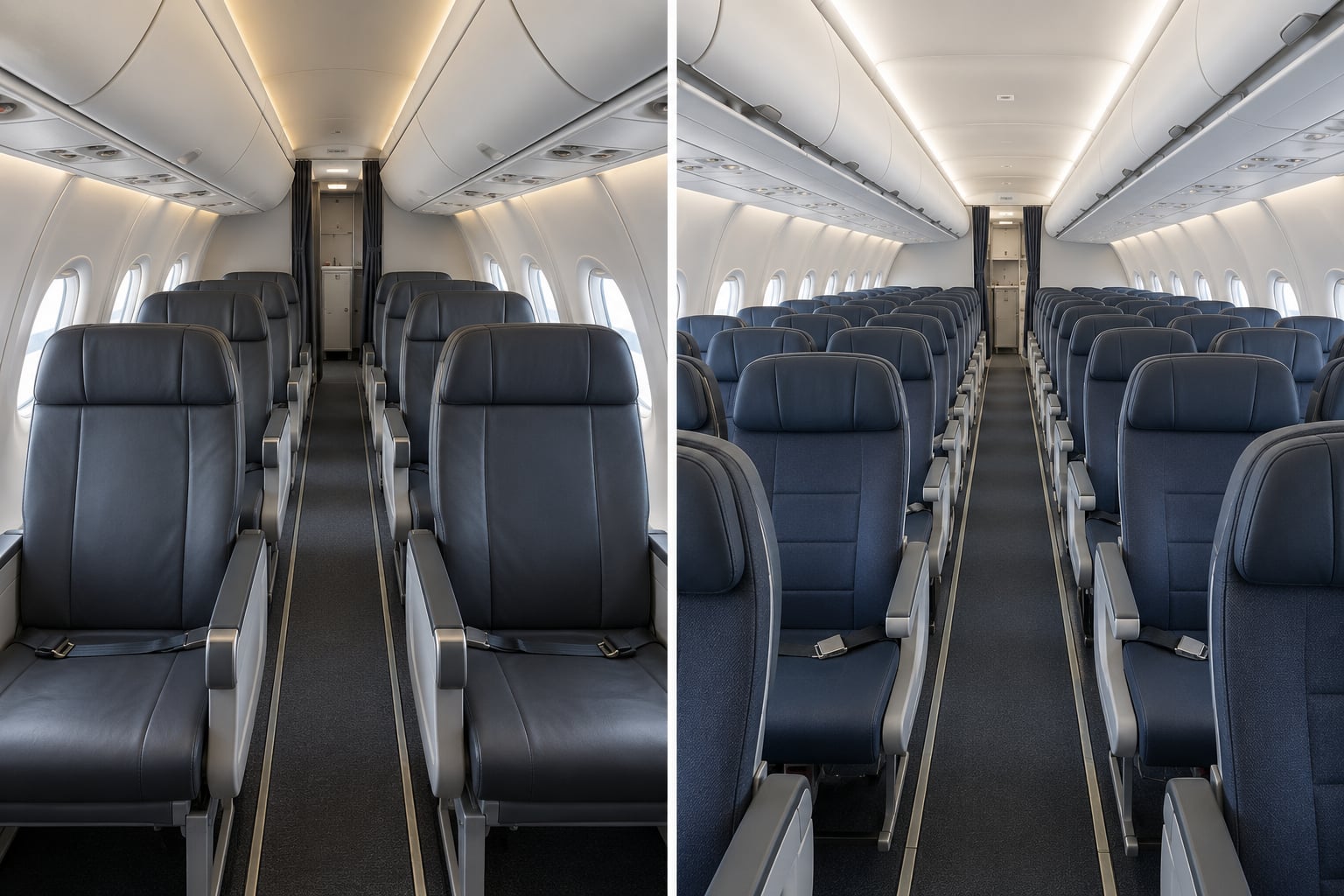
What regional jets feel like inside ranges from genuinely pleasant to genuinely tight, and the aircraft type matters more than the word “regional.” A CRJ-200 feels noticeably older and smaller than a mainline narrow-body. An Embraer E175 or E190 can feel close to a 737 for the first hour, with two seats on each side of the aisle and no middle seat to squeeze past.
The most useful thing a traveler can do is learn to read the specific aircraft and cabin before booking. That means checking seat width, pitch, bin space, whether there’s a first-class cabin, and where the engines sit relative to your seat. Below is a plain-language breakdown of how these cabins actually feel, aircraft by aircraft.
Table of Contents
- What Regional Jets Feel Like Inside at a Glance
- What Is a Regional Jet?
- How Cabin Size and Layout Shape the Experience
- What Regional Jets Feel Like Inside by Seat and Cabin Layout
- Are Regional Jets Noisy?
- How Do Regional Jet Seats and Legroom Compare?
- What Amenities Can You Expect?
- What Regional Jets Are Usually Best For?
- How to Check Comfort Before You Book
- Frequently Asked Questions
- Are regional jets less comfortable than larger planes?
- Are regional jets noisier than mainline aircraft?
- Do regional jets have the same amenities as larger planes?
- Can regional jets be used on long or international flights?
- Do regional jets have smaller windows and lower ceilings?
- Is it worth paying extra for a better regional-jet seat?
- Conclusion
What Regional Jets Feel Like Inside at a Glance
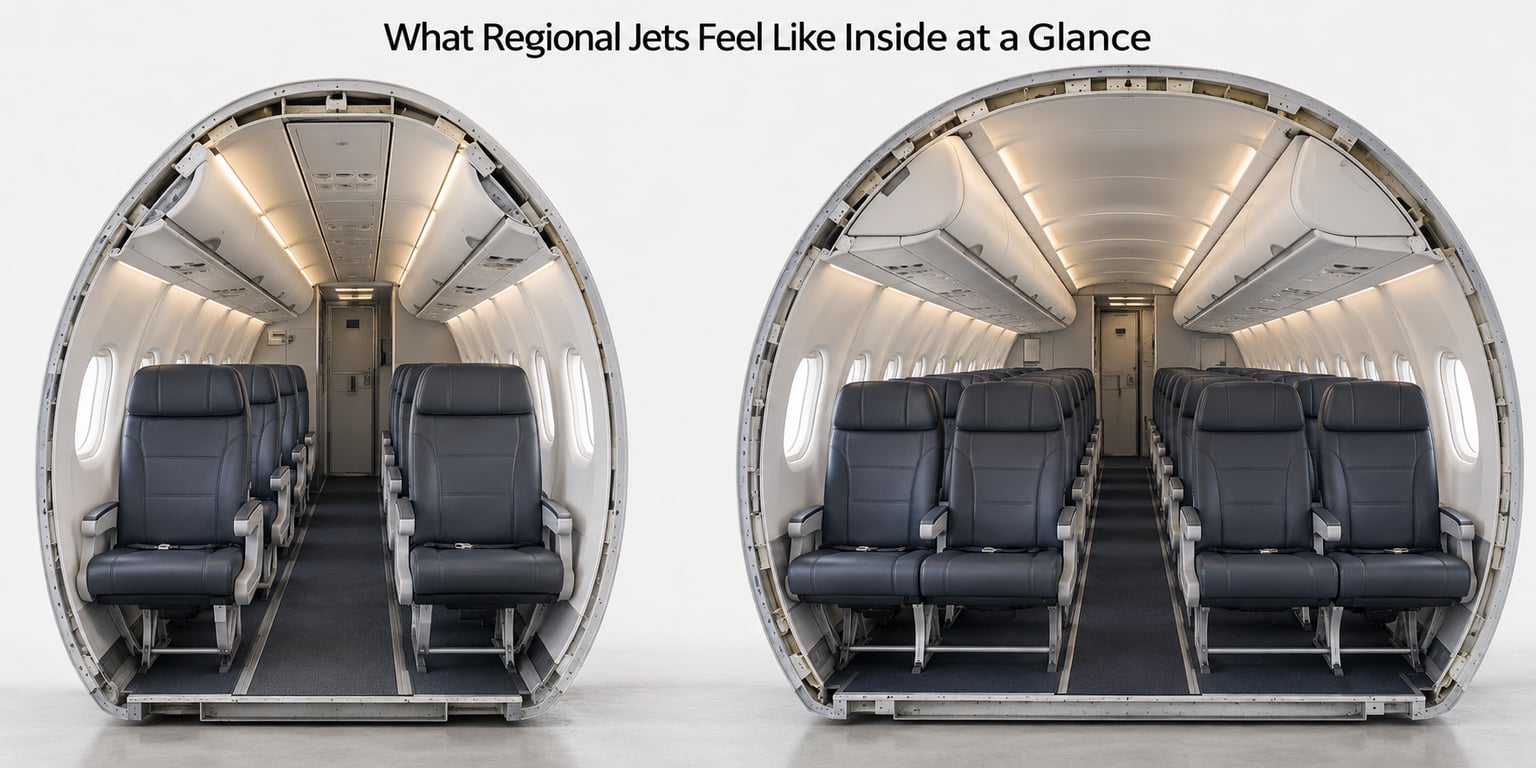
The table below is the honest summary. Ratings describe a typical flight on that aircraft in economy, on a daytime regional route.
| Aircraft | Typical economy seats | Layout | Seat width | Seat pitch | Cabin feel | Noise feel | Best for |
|---|---|---|---|---|---|---|---|
| CRJ-200 | 50 | 2-2 | about 16 in | about 24-28 in | Narrow, low windows, dated | Loud near the engines | Price-sensitive short hops |
| CRJ-700 | 66-78 | 2-2 | about 17-18 in | about 28-31 in | Tighter than a jet of similar row count | Loud near the engines | Short to mid-length routes |
| CRJ-900 | 76-90 | 2-2 | about 17-18 in | about 30-32 in | Long and narrow, few amenities | Loud near the engines | Quick regional hops, high-frequency flyers |
| ERJ-135 / 140 | 37-44 | 1-2 | about 17 in | about 25-27 in | Cramped in a different way: narrow cabin | Moderate, spread along the cabin | Very short routes, few seats needed |
| ERJ-145 | 50 | 1-2 | about 17 in | about 27-29 in | One third of the cabin has no window | Moderate | Smaller cities, thin demand |
| E170 | 66-80 | 2-2 | about 18-19 in | about 30-32 in | Wide-feeling for the class, low ceiling | Quieter, engines under the wings | Comfort-conscious flyers |
| E175 | 70-88 | 2-2 | about 18-19 in | about 30-32 in | The regional benchmark, no middle seat | Quieter than CRJ types | Nearly everyone, especially for 2-4 hours |
| E190 | 88-114 | 2-2 (or 3-3 on some) | about 18-19 in | about 30-33 in | Closest to a mainline narrow-body | Quiet | Longer regional sectors |
Seat width and pitch figures vary by operator and by how the airline sells the cabin, so treat them as ranges rather than promises. The layout column is the one that never lies.
What Is a Regional Jet?
A regional jet is a commercial jet sized for routes with too little demand to fill a mainline aircraft. Under the common US definition used for scope clauses, a regional jet carries roughly 76 or fewer seats, or a smaller payload on a larger frame. Most fall into two families: the Bombardier CRJ series (CRJ-200, CRJ-700, CRJ-900, and the stretched CRJ-1000) and the Embraer E-Jet line (E170, E175, E190, E195), plus the older ERJ-135, ERJ-140 and ERJ-145.
The label tells you very little about comfort on its own. Two regional jets with the same seat count can feel completely different, because one may be a 25-year-old CRJ-200 and the other a nearly new E175. Airline configuration is the second big variable: the same E175 operated by two partners of the same airline can have different pitch, different seat fabrics, and a different level of Wi-Fi.
Route length is the third. A regional jet on a 45-minute hop between hub spokes and the same aircraft on a three-hour sector are not the same experience, mainly because the plane is full on the first one and you have time to notice every gap on the second.
Most regional flying is done under contract by a regional carrier for a mainline brand: SkyWest, Envoy Air, PSA, Republic, Horizon and Mesa among them. You fly on United Express, Delta Connection or American Eagle and the metal may be operated by someone else entirely. That is why the flight number rarely tells you the cabin you’ll get.
How Cabin Size and Layout Shape the Experience
The reason a CRJ feels cramped is not just the seat count. It’s the fuselage. The cabin is a narrow tube, so seats sit closer together shoulder-to-shoulder across the aisle, and the ceiling is low enough that a tall passenger notices it before sitting down. The CRJ-200’s windows also sit low, which puts the view near your lap rather than at eye level and makes the cabin feel smaller than its numbers suggest.
Embraer E-Jets are noticeably wider inside than CRJ-200s, which is why an E175 with 76 seats frequently feels roomier than a CRJ-700 with 66. Both may be “regional,” and both may show similar pitch, but the shoulder room and headroom are not comparable.
Where the cabin furniture sits also changes the impression. Galleys and lavatories eat a surprising share of a small cabin, and a single lavatory at the back means a queue that forms during the one hour it matters most. Overhead exits, or the absence of them in an older CRJ-200, force doors and bins into places that lower usable space.
Pressurization matters too. Regional jets are smaller and often climb and cruise somewhat differently than mainline aircraft, and the cabin is quieter in the sense that you hear more of your own body and your neighbor. Turbulence also tends to be more noticeable on smaller aircraft, not because the ride is worse but because the airframe moves more.
What Regional Jets Feel Like Inside by Seat and Cabin Layout
The 1-2 seating on the ERJ-145 is the biggest structural difference most travelers encounter. One seat sits beside the window, two on the other side of the aisle, so about a third of the cabin has no window and nobody has three people to climb past. Riders on the solo side often say it feels private; riders who like to stretch out say the cabin is too narrow to make that comfortable.
Every other aircraft on the list uses 2-2, so the word “aisle” is misleading: every seat has window or aisle access, but the aisle is shared with a stranger for the whole flight. That trade is usually worth it on a two-hour hop and gets old on a four-hour one.
Within a cabin, seat choice changes more than passengers expect.
- Front cabin, behind the galley or near the lavatory: extra legroom is common here, but you trade quiet for foot traffic, galley noise and door swings.
- Exit rows: noticeably more knee room and no seat in front of you. On smaller aircraft the pitch gain is often modest, and the seat is narrower, and the armrest is fixed rather than movable.
- Window seats on a 2-2: you get a place for a cup and a bag, but on a curved fuselage you lean slightly into your seatmate to look out.
- Aisle seats on a 2-2: easiest to get out of, easiest to stretch one leg, and the only position where you can stand briefly without blocking anyone.
- Bulkhead row: space ahead of you, no tray table or armrest shared with the row in front. On some regional jets this is the best seat on the aircraft.
- Rear cabin, behind the wing or the engines: the noisiest rows on CRJ aircraft, and on some models the bins are shallowest there too.
Tall passengers get a specific set of complaints that show up repeatedly in traveler discussion: knees at the seat ahead on shorter pitch, no room to stand fully in the aisle, and a lavatory too small to use comfortably. If you are over six feet, the exit row or a bulkhead row is worth more to you than it is to an average-height passenger.
Are Regional Jets Noisy?
Regional jets are usually louder than mainline aircraft, and the reason is where the engines sit. On most CRJ-200, CRJ-700 and CRJ-900 models the engines are mounted at the rear of the fuselage, so the loudest rows are in the back and the cabin noise falls off toward the front. In the first few rows the engines are behind you and the flight is quietly fine. In the last few rows they are beside and slightly ahead of you, and takeoff and landing are loud and vibration-heavy.
Embraer E-Jets mount their engines under the wings, which spreads the sound differently. The cabin is generally quieter overall, though the wing rows sit closer to the airflow and pick up more rushing wind noise during climb and descent.
Noise also comes from inside the cabin. Announcements and call tones carry in small spaces, galley carts rolling down the aisle are hard to miss, and a single lavatory at the back creates a queue of people standing in the aisle for much of the flight. On a full flight, the sound of people shifting around and opening bags is part of the regional signature.
If noise bothers you, the front third of the cabin is the reliable choice on a CRJ. On an Embraer, pick an aisle seat away from the lavatory and the galley, and bring earplugs on anything longer than two hours.
How Do Regional Jet Seats and Legroom Compare?
Regional jet economy seats are commonly quoted at 17 to 19 inches wide and 30 to 32 inches of pitch, which sounds reasonable until you sit down. The measurements that matter for comfort are not the same ones on the spec sheet. Seat pitch measured from the back of one seat to the back of the next includes cushion compression and seat-back thickness, and a nominal 31 inches can feel like 28 after you settle.
Seat width has the same problem in reverse. A 16-inch CRJ-200 seat and a 19-inch E175 seat differ by three inches, which sounds minor but shows up as elbows meeting your neighbor’s armrests on both sides. Wider passengers, and anyone trying to work on a laptop, feel that difference far more than the number suggests. Frequent flyers tend to describe the E175 as unremarkable in a 737 and the CRJ-200 as punishing after an hour, and the difference comes down to width plus cabin height.
Recline matters more than people expect. Older regional jets have fixed, upright seats with minimal recline, and a short pitch plus a shallow recline means the seat ahead stays upright even when yours goes back. That is the single most common reason a regional jet feels worse than its pitch number suggests. If you are tall or you sleep on planes, check the recline style in the seat map before choosing.
There is a practical way to sanity-check any itinerary. Look up the aircraft type in the booking flow or on the airline’s fleet page, then check the seat map for a 1-2 or 2-2 layout, the pitch, and whether a first or premium cabin is offered. If two flights on the same route show different aircraft, that is a sign the schedule uses whatever is positioned that morning.
Seat selection technique works the same way here as anywhere else: pick by position, board early, and travel light.
What Amenities Can You Expect?
Amenities on regional jets are where the label costs you the most. The older the aircraft and the smaller the operator, the fewer extras there are, and the extras are the first things cut when an airline configs a small cabin.
| Amenity | Common regional condition | Exceptions worth checking |
|---|---|---|
| Overhead bins | Shallow, often smaller than a roller bag allows; gate checks common | Larger bins on E190 and newer CRJ-900/1000 |
| Seat-back entertainment | Rare | Still rare even on newer regional aircraft |
| In-flight Wi-Fi | Often none, or an optional paid service | Streaming-capable service on some partner-operated E175s |
| Power | Absent on many CRJ-200 and ERJ-145 | AC power at every seat on some E175 and E190 configs |
| Meals | Snack service or nothing on short sectors | Hot meal and full drink service on 3-plus hour flights |
| Drinks | Paid on board | Some carriers include beer or wine in premium cabins |
| First or premium cabin | Not offered on the smallest aircraft | 1-2 cabin with wider seats on most E175 and CRJ-900 conversions |
| Carry-on space | One roller bag plus a personal item is the usual assumption | Bins that take wheels-sideways bags reduce gate-check risk |
Overhead bin space deserves its own note. On several regional types, a standard roller bag has to go in wheels-first or on its side to close the bin, which is why gate agents start checking bags at the door on a full flight. If you want to avoid that, board early with a status, or pack a soft-sided bag that flexes. Some operators solve it differently: on Horizon’s Q400 flights, leaving your bag on the airline’s baggage cart at the jet bridge is a routine alternative to carrying it on.
Gate checks are the thing travelers dread most about these cabins, and the pain is mostly about uncertainty rather than the bag itself. Put your essentials in your personal item, and you are fine either way.
What Regional Jets Are Usually Best For?
A regional jet is a good deal when the alternative is not flying at all, or when it protects your connection. Most small cities have no mainline service, so the E175 or CRJ-900 at 8:00 am may be the only way to reach a hub in time for an onward flight. In that case the aircraft type is a detail you plan around rather than shop for.
They also suit short daytime sectors. On a 60 to 90 minute flight, you board, you take off, you land. Pitch barely matters, bins rarely fill, and a 2-2 layout with a window is a perfectly pleasant two hours of reading. The cabin weaknesses show up after roughly two and a half hours, which is why experienced travelers treat regional jets as a poor choice for long segments and a fine choice for short ones.
They work well for travelers who want the main-cabin experience on a smaller aircraft: no middle seat, mostly domestic or short-haul routes, low tolerance for long walks through a huge airport. Someone who wants a lounge, a meal, a screen or reliable power should check that first, because those are the amenities most likely to be missing.
They are a worse fit for very tall passengers on longer flights, for anyone who needs to work productively with a laptop open, and for passengers sensitive to turbulence. A smaller airframe moves more in rough air, and there is less distance from the nearest wing. None of that makes the flight unsafe. It does make it less comfortable than the same trip on a larger aircraft.
How to Check Comfort Before You Book
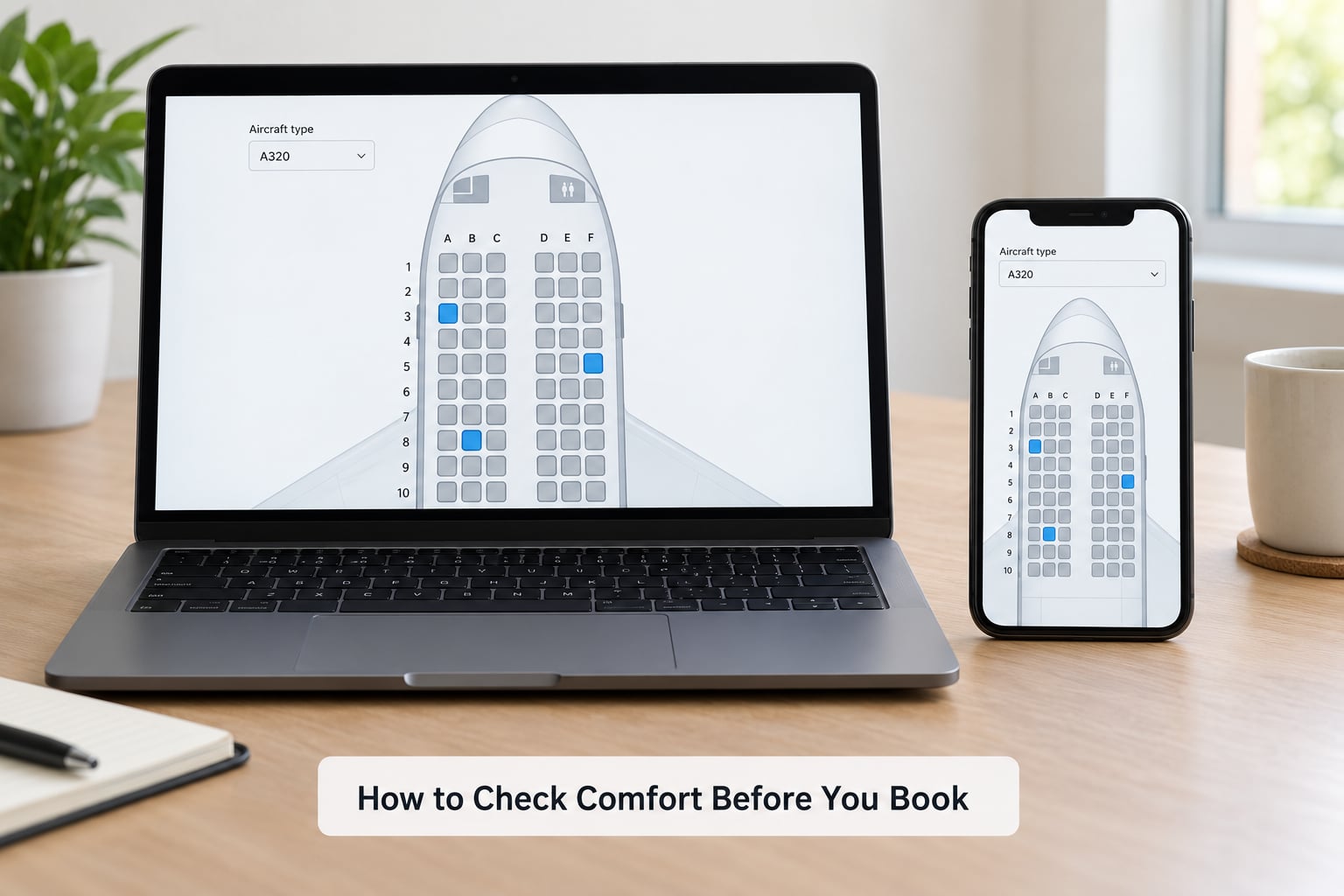
You cannot control what the airline flies tomorrow, but you can usually find out what they have scheduled, and in most cases you can choose a seat on purpose. Here is the order I work in.
- Find the aircraft type. Search the flight number plus the date and the aircraft model. If a flight number is codeshared, the answer will differ by which partner is operating that day, so check the operating carrier rather than the marketing brand.
- Read the seat map before paying. The map tells you the layout, whether it is 1-2 or 2-2, which rows are exit rows, and how many rows of premium cabin exist. It also shows which seats are taken, which is often a better guide to load than anything else.
- Pick a seat for the aircraft, not the route. On a CRJ, go forward. On an E175, the bulkhead or the second row behind the door is usually the best legroom in the cabin.
- Check the fare inclusions. Whether drinks, a snack, Wi-Fi or a carry-on without a fee are included varies by operator and by aircraft, and a fare that includes them on a mainline flight may not on the same itinerary flown by a partner.
- Confirm recline and power for long sectors. Seat-back screens and seat power are the two features most often missing on smaller aircraft, and both are worth checking when the flight runs three hours or more.
- Board early when you care about bins. On most regional aircraft the front of the cabin fills first and bins run out with the last third of the boarding groups.
None of this guarantees a particular seat or feature on the day you fly. Equipment swaps happen, and the aircraft type can change between the version you searched and the version that shows up at the gate. Treat the check as a strong expectation, not a promise.
Frequently Asked Questions
Are regional jets less comfortable than larger planes?
Usually a little, but the gap is far smaller on newer Embraer E-Jets than on older CRJ-200s and ERJ-145s. An E175 with 76 seats often feels close to a 737, while a CRJ-200 feels meaningfully tighter in width, headroom and recline. The layout matters most: 2-2 seating means no middle seat, which offsets some of the smaller cabin size.
Are regional jets noisier than mainline aircraft?
On older CRJ models, yes, especially in the rear rows where the tail-mounted engines sit. Noise falls off noticeably toward the front of those cabins. Embraer E-Jets, with engines under the wings, are generally quieter throughout. Cabin noise also rises with a full load, a busy galley and long waits for the single lavatory on small aircraft.
Do regional jets have the same amenities as larger planes?
No, and this is the biggest real difference. Seat-back screens are rare, Wi-Fi is often absent or paid, and power outlets are missing on many older models. Meals are usually a snack or nothing on short sectors, and drinks are frequently pay-per-use. Newer E175 and E190 configurations can match mainline expectations on power and sometimes on streaming Wi-Fi.
Can regional jets be used on long or international flights?
They can, though routes long enough for a widebody are rare for them. The regional fleet is built for sectors of up to roughly four hours, and the constraint comes from range and cabin capacity rather than a rule. Longer sectors exist in US markets, Europe, Latin America and parts of Asia. Expect thinner amenities than mainline on those flights, and check the seat pitch before booking.
Do regional jets have smaller windows and lower ceilings?
Both, and older models are the worst for it. CRJ-200 windows sit noticeably low, near lap height, which makes the cabin feel smaller and the view worse. Ceilings on CRJ-200s and ERJ-145s are low enough that tall passengers notice on the way in. E170 and E175 have higher ceilings and better-placed windows, so they feel more open at the same seat count.
Is it worth paying extra for a better regional-jet seat?
Often yes, especially a first-class cabin on an E175, where the 1-2 layout gives you a single wide seat with more pitch and no stranger alongside. For economy, bulkhead and exit rows usually deliver most of the benefit for much less. Bring a soft-sided bag, board early, and sit forward on a CRJ, which together solve most of the common complaints.
Conclusion
So: what regional jets feel like inside depends almost entirely on the aircraft, not the category. A CRJ-200 or ERJ-145 is tight, loud at the back, and short on amenities. An E175 or E190 is wide enough to feel like a mainline cabin with no middle seat, quieter, and close enough in comfort that most people stop thinking about the plane.
Check the aircraft type for your specific flight, read the seat map, and choose a seat on purpose: forward on a CRJ, bulkhead or second row on an Embraer. That single habit resolves most of the complaints people post about these cabins.