The fastest way to learn how to prop up a phone on a tray table is to fold a stiff piece of paper into a wedge, slide it between your phone and its case, then hook the loose end over the tray table latch so the screen stands up. It takes about thirty seconds, costs nothing, and needs no assembly. Here are five methods that work, ranked by how fast each one sets up and how well it survives turbulence.
For most of us this is not an accessory problem. It is a geometry problem. The tray table is too shallow for a phone to lean against the seat in front, and a phone lying flat means looking down at a steep angle for three hours. Getting the top of the screen near eye level is the whole trick.
Table of Contents
- What You Need
- Step-by-Step: Five Ways to Prop Up Your Phone
- Step 1: Fold a paper wedge and hook it on the tray latch
- Step 2: Use a case with a built-in kickstand
- Step 3: Use a rigid card or boarding pass as a back support
- Step 4: Use a soft pouch when the table has no latch
- Step 5: Build a stable base from stacked items
- Common Mistakes to Avoid
- Leaning the phone forward so it slides off the tray
- Leaving the tray latch or the screen in the way
- Building so close to the edge that a bump ends it
- Looking down at the screen for three hours
- Setting the phone down during service
- Forgetting to clear the prop before stowing
- Frequently Asked Questions
- What is the easiest way to prop up a phone on a tray table?
- Can I use my phone case to prop up my phone on a flight?
- Will a phone stand fit in the airplane seat pocket?
- How do I stop my phone from falling off the tray table?
- Is it allowed to watch videos during a flight?
- Can I use a tray table to work on my phone?
What You Need
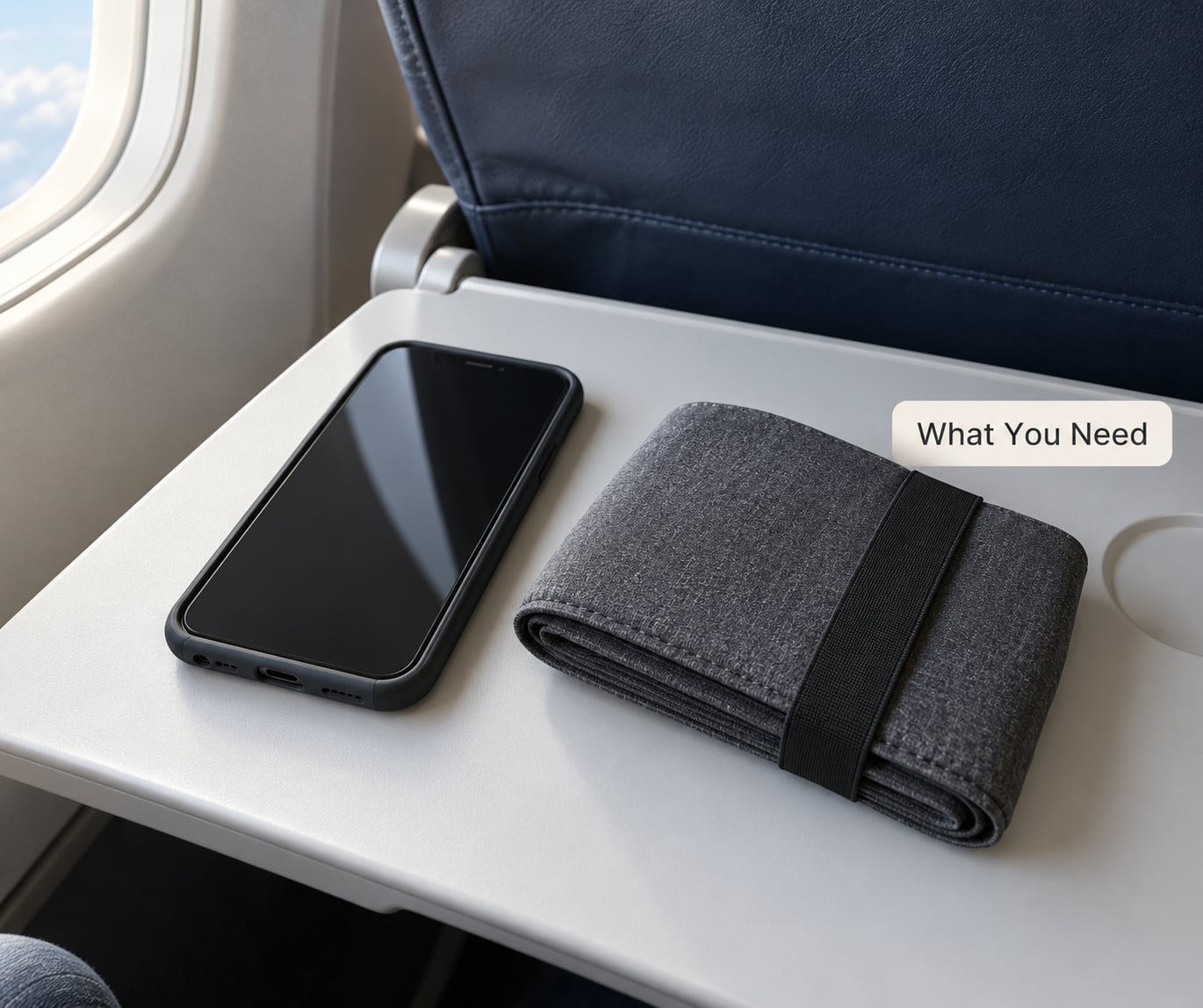
The good news is that most of these methods use things already in the seat pocket in front of you, so nothing goes in your bag and nothing gets lost in an overhead bin.
- Your phone — the thing being propped up, obviously.
- A protective case — four of the five methods below work best with one because the case gives the paper something to grip. A case with a built-in kickstand makes method two unnecessary.
- The tray table — down, flat, and locked before you start.
- The tray table latch — the small hook or thumb recess on the leading edge of the table. This is the anchor point for the paper method. Some newer aircraft have a flat edge with no latch, which changes things. Method four handles that case.
- Optional, all free on board: the safety card from the seat pocket, your boarding pass or any printed paper, a napkin, a barf bag, a small zip-lock bag, or a paper cup from the drink service.
- Optional, packable: a foldable travel stand that lives flat in a jacket pocket until you need it.
Step-by-Step: Five Ways to Prop Up Your Phone
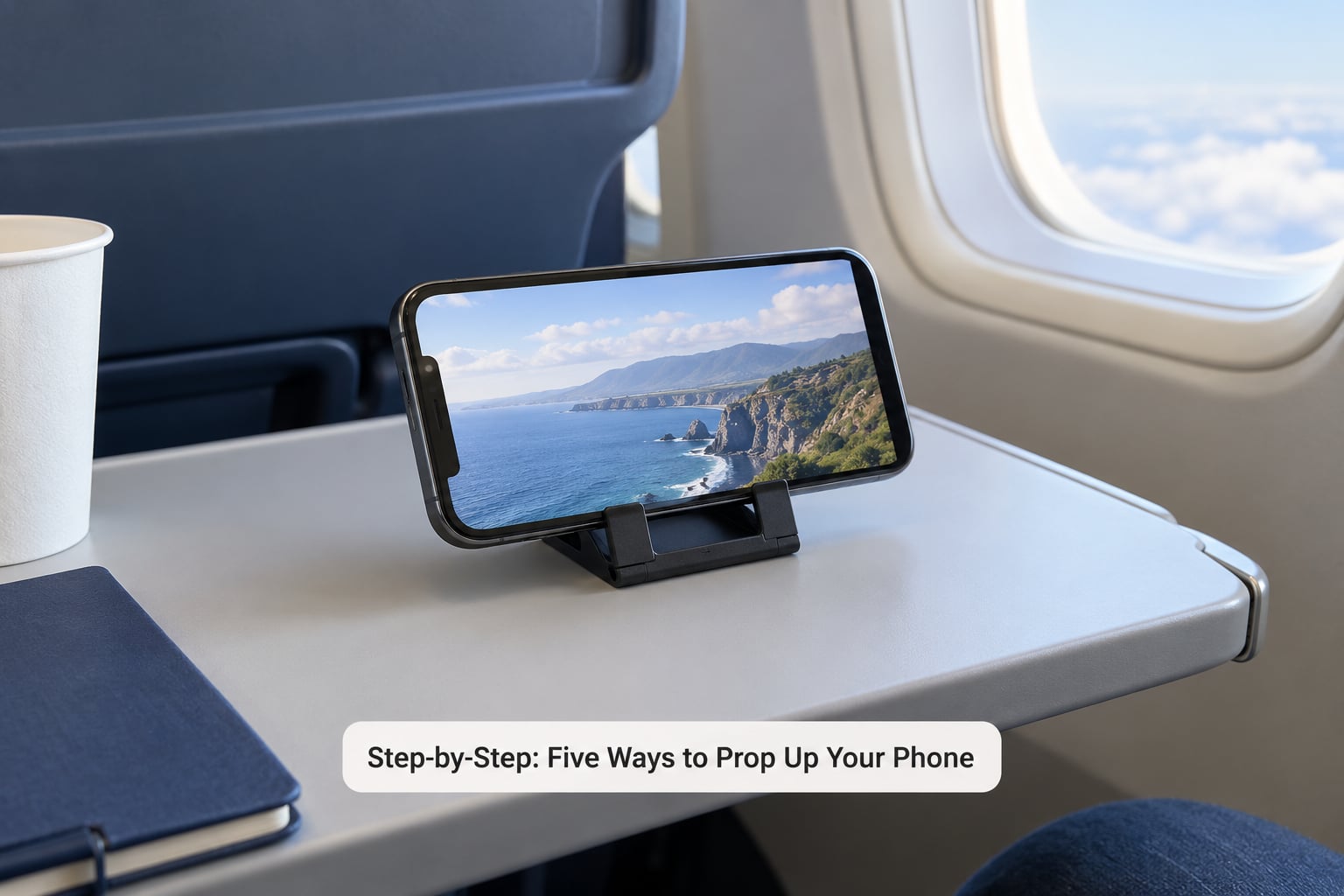
Step 1: Fold a paper wedge and hook it on the tray latch
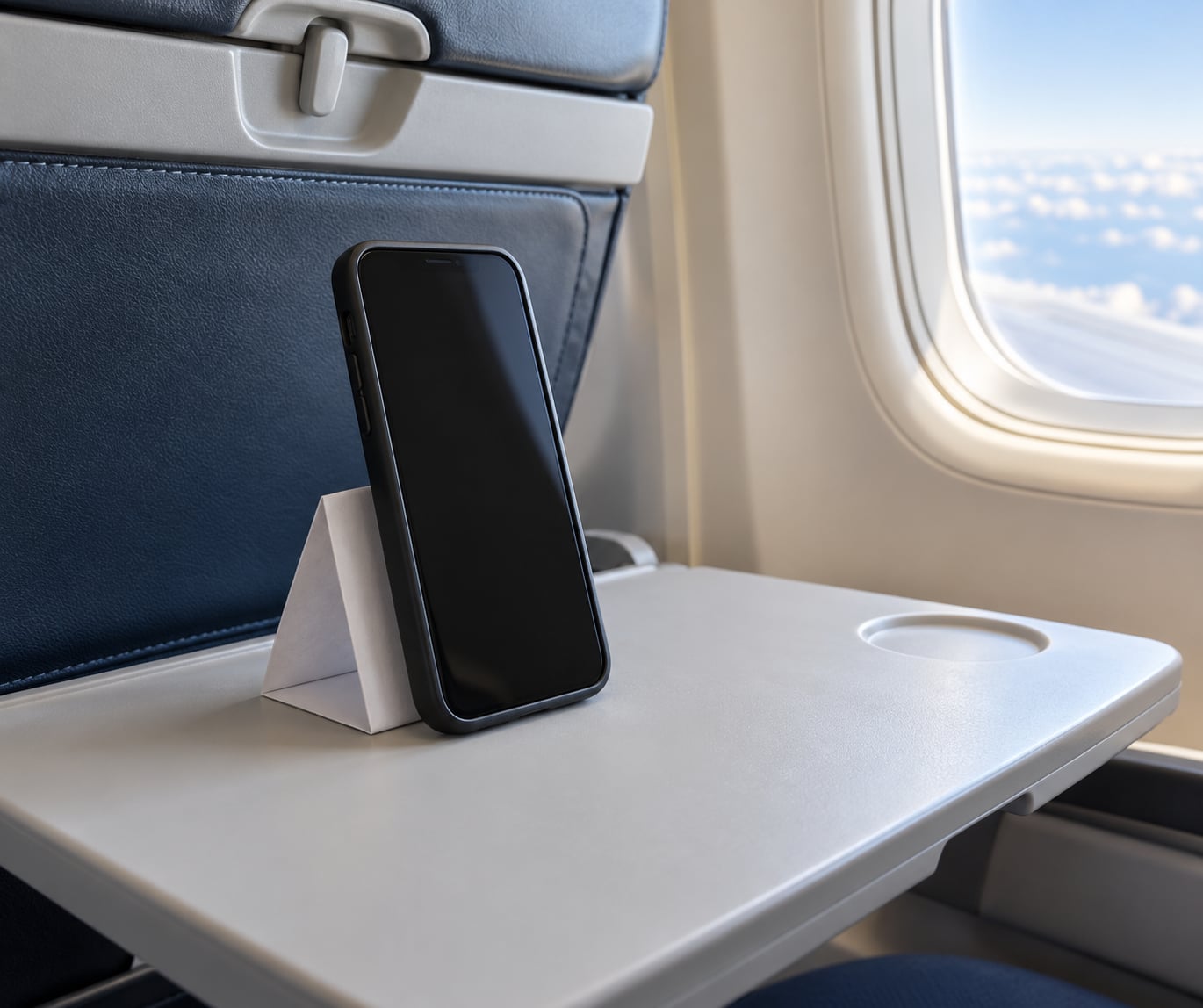
This is the classic airline hack, and it is how to prop up a phone on a tray table with nothing but a piece of paper and a case. A popular version circulating on r/lifehacks snaps a barf bag into the case and wraps the excess over the tray edge.
- Fold a sheet of paper into a narrow rectangle roughly the width of your phone, then fold it lengthwise once more so it holds its shape instead of flopping flat.
- Slide the folded paper behind the phone, between the screen side and the case, so the phone clamps it at roughly a 60-degree angle.
- Fold the top third of the paper down toward the phone so the loose end points outward and stays stiff.
- Pull the tray table latch or hook up and away from the table, catch the folded end of the paper over it, and let the latch press the paper back down. The paper is now tensioned in a triangle and cannot slide.
- Tilt the phone until the top of the screen sits near eye level. You want your chin roughly level with the top edge, not looking down at it.
If it worked, the phone stays put when you tap the screen and does not slide when you nudge the table. If the paper flops, you folded it the wrong way. Fold it again with the crease on the outside so the ridge faces the case.
Step 2: Use a case with a built-in kickstand
Many travel cases have a hinged flap on the back that folds flat against the phone. Stand the phone on the tray, flip the flap out to about 60 degrees, and it holds its own angle with no paper at all. A commenter on one of these discussions credited a kickstand case with making a 14-hour flight easier, which is about as strong an endorsement as you get.
The limitation is fixed angle. You get one viewing angle, usually steeper than ideal, and on a bumpy section the phone can rock because there is nothing behind it but air. Push the top of the phone toward the seat back and it usually settles.
Step 3: Use a rigid card or boarding pass as a back support
A boarding pass is stiffer and thicker than most paper, which makes it the best free prop on any plane. The r/LifeProTips version suggests folding a safety card and sticking it into the tray table or into the seat-back pocket above it.
- Fold the boarding pass or safety card twice, side to side then top to bottom, so it stands as a shallow tent on the tray.
- Lean the phone against the tent face with the card behind it and the bottom edge resting on the tray.
- Use the card’s thickness to set the angle. A single fold gives a shallow lean; a double fold holds the phone closer to upright and closer to eye level.
- If you want more height, tent the card against the seat-back pocket lip and rest the phone’s bottom edge on the tray in front of it.
Paper alone will not survive real turbulence. Card stock, a boarding pass, or a laminated safety card will. Paper towels from the lavatory are described by one travel creator as giving just the right amount of stiffness for the job.
Step 4: Use a soft pouch when the table has no latch
Newer aircraft often have thin or laptop-style tray tables with a smooth edge and no hook. Paper has nothing to latch onto. This is where a soft, slightly stiff item works instead: a barf bag, a napkin folded into a pad, a small zip-lock bag, or a soft phone pouch.
- Fold the item into a flat pad about the width of the phone and just thick enough to keep a shape.
- Place it behind the phone, pressing the pad against the case so the phone grips it.
- Bend the top of the pad forward so the phone leans back roughly 20 to 30 degrees, giving a triangular side profile.
- Press the bottom of the pad against the seat back below the tray line so the phone leans into the seat instead of away from it. Gravity and the seat do the anchoring.
A zip-lock bag with a folded safety card inside it works well here. The plastic stops the phone sliding sideways and keeps the card from folding flat.
Step 5: Build a stable base from stacked items
Sometimes the tray is too small or the seat gap is wrong for any of the above, and what you need is a taller base rather than a better angle. This is the method for working sessions rather than movies.
- Stack two or three magazines or safety cards flat on the tray to raise the base by a few centimetres.
- Lay your folded boarding pass or card tent on top of the stack so the phone’s screen clears the tray lip.
- For a taller build, cut or tear a paper cup down to a wedge and stand the phone in it, screen angled toward you, with the narrow end toward the seat back.
- Check stability by pressing the top of the phone with one finger. If it rocks, widen the base rather than adding height.
A clip-on or magnetic travel mount does the same job with less improvisation. A small foldable stand that opens flat and locks at a chosen angle is the version worth packing if you fly more than a couple of times a year.
Common Mistakes to Avoid
Learning how to prop up a phone on a tray table is easy. Learning why yours keeps sliding off takes most of the trial and error. These are the failures I see most often, with the fix for each.
Leaning the phone forward so it slides off the tray
The single most common mistake. A phone resting at an angle on the tray wants to travel, and it goes over the edge. The fix is to make the support push back instead: hook the paper on the latch, or press the top of the phone into the seat back so gravity works for you.
Leaving the tray latch or the screen in the way
A phone wedged into the latch can stop the table from folding up, and a tall setup can block the seat-back screen. Seat the table fully down and locked first, then build your prop. Keep the prop under the height of the seat-back screen, and take everything down before take-off and landing.
Building so close to the edge that a bump ends it
Turbulence is the real test. Set up so the phone leans into something solid, not into open air. A propped phone with a seat back behind it survives a bump; a balanced phone on the tray lip does not. Keep the base wider than it is tall.
Looking down at the screen for three hours
A prop at the wrong angle is no better than holding the phone. Aim for the top of the screen at eye level. If your eyes are looking down at the display, you are too low and should raise the base by a folded card or two.
Setting the phone down during service
A phone propped at eye level sits right where a drink gets set down. Stand the setup slightly off the tray centre and slightly back, out of the napkin-and-cup zone. Leave enough tray in front for a full meal.
Forgetting to clear the prop before stowing
A folded boarding pass hooked over the latch will rip or crease the latch when you snap the table up. Take the paper down first, then the table. It takes five seconds and saves a bent latch.
Frequently Asked Questions
What is the easiest way to prop up a phone on a tray table?
Fold a safety card or boarding pass into a narrow wedge, slide it between your phone and the case, then hook the folded end over the tray table latch. The latch tensions the paper into a triangle that holds the phone at a viewing angle you can adjust by rotating the phone in the case. The whole setup takes about thirty seconds and needs nothing bought or packed.
Can I use my phone case to prop up my phone on a flight?
Yes, and the case is what makes the free methods work. Most cases give the paper something to grip so the wedge holds its angle. Bulky cases are fine, sometimes better, because the paper grips a thicker edge. Cases with a built-in kickstand skip the paper step entirely, though they only offer one fixed angle and need the phone leaned against the seat back to stop it rocking in turbulence.
Will a phone stand fit in the airplane seat pocket?
The foldable stands made for travel are designed for exactly this. They open flat to the thickness of a couple of folded bank cards and slide into a seat pocket or a jacket pocket. The stiff clip-on mounts are bulkier and are better kept in your bag than the seat pocket. Nothing you need for the paper method fits anywhere, because it comes from the seat pocket in front of you.
How do I stop my phone from falling off the tray table?
Stop the prop from pushing the phone toward the tray edge. Hook the paper over the latch so tension pulls the phone inward, or press the top of the phone against the seat back so it leans away from the tray lip. Also move the whole setup back from the tray centre, keep the base wider than it is tall, and check it by pressing the top of the screen with one finger before you trust it.
Is it allowed to watch videos during a flight?
Usually yes, but not during take-off and landing. Most airlines require screens to be stowed or in low-power mode during those phases, and the crew will ask. Take your prop down and put the phone flat before the seat belt sign comes back on, then set it up again once the cabin is at cruising altitude. Download your content before boarding, since in-flight Wi-Fi is often too slow or blocked.
Can I use a tray table to work on my phone?
Yes, and this is where a taller base beats a better angle. For typing and email you want the screen higher and closer to vertical, which means stacking two or three magazines or folded cards as a base under a card tent. If you are also opening a laptop on the tray, check the space first: a full laptop tray leaves almost nowhere to prop a phone, so use the seat-back pocket instead.
Start with the safety card in the seat pocket in front of you. Fold it twice, slide it behind the phone, hook it over the tray latch, and tilt until the top of the screen is at eye level. That is how to prop up a phone on a tray table in under a minute, and it costs nothing.