An airplane seat is a certified piece of aircraft furniture, not a padded chair. A tubular aluminium or composite frame carries the load, cushion foams and covers are cut and sewn around it, screens and power are wired in, and the finished unit has to survive crash, fatigue and flammability testing before anyone sits in it. The build takes months, and the details are why seats differ so much between cabins.
Understanding how airplane seats are built explains a lot of what passengers notice in practice: why economy seats are narrow, why some barely recline, and why a tray table feels different in business class than it does at the back of the plane.
Table of Contents
- Airplane Seat Construction at a Glance
- What Are the Main Parts of an Airplane Seat?
- What Materials Are Used to Build Airplane Seats?
- How Airplane Seats Are Built Step by Step
- How Are Airplane Seats Attached to the Aircraft?
- How Do Airplane Seats Pass Safety Tests?
- Why Do Airplane Seats Differ Between Economy and Premium Cabins?
- Frequently Asked Questions
- Are airplane seats made of wood or metal?
- Why are economy airplane seats so narrow?
- Can an airplane seat be moved after installation?
- How thick are airplane seat cushions?
- Why do some airplane seats not recline?
- Are all airplane seats built and tested the same way?
- Conclusion
Airplane Seat Construction at a Glance
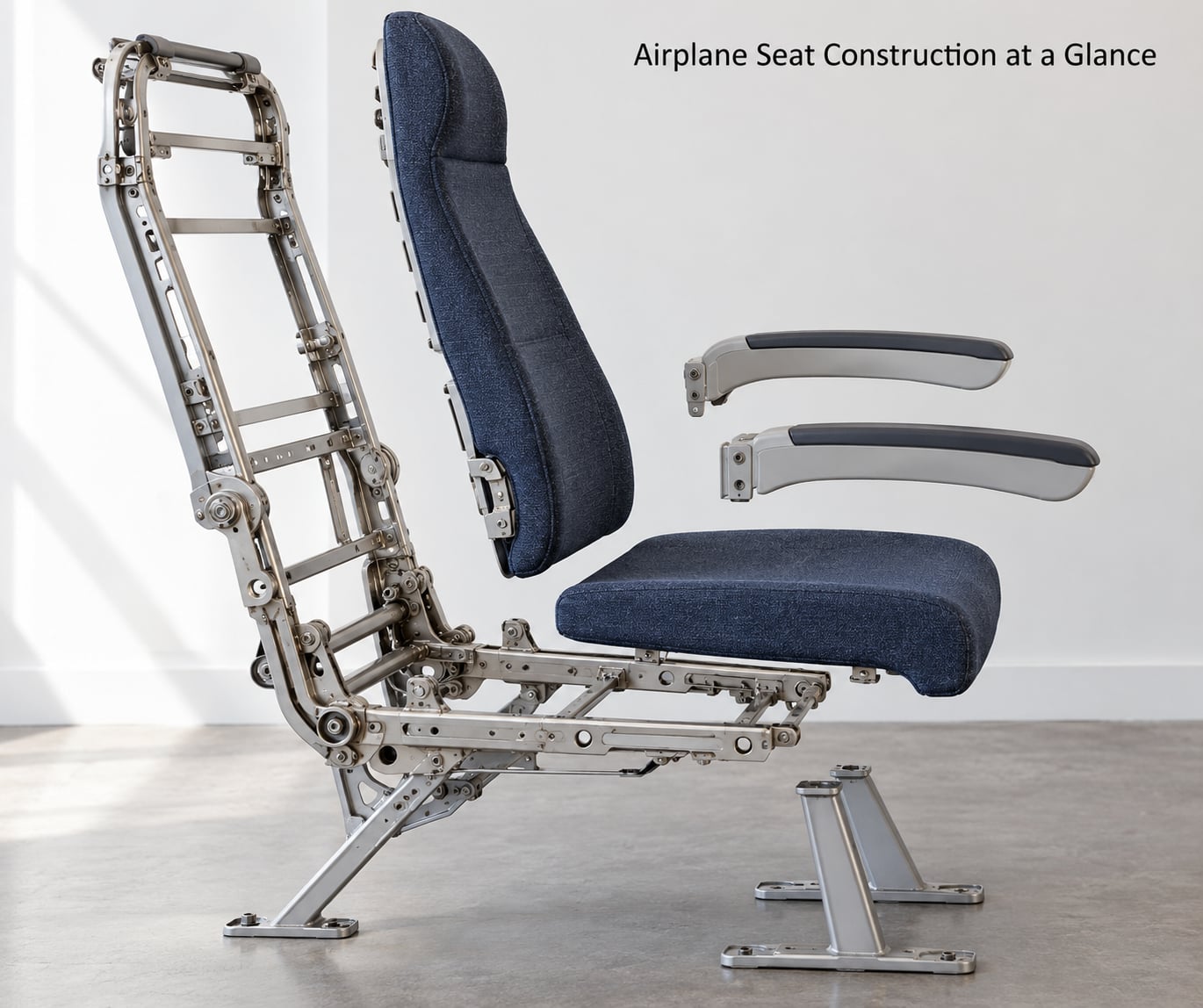
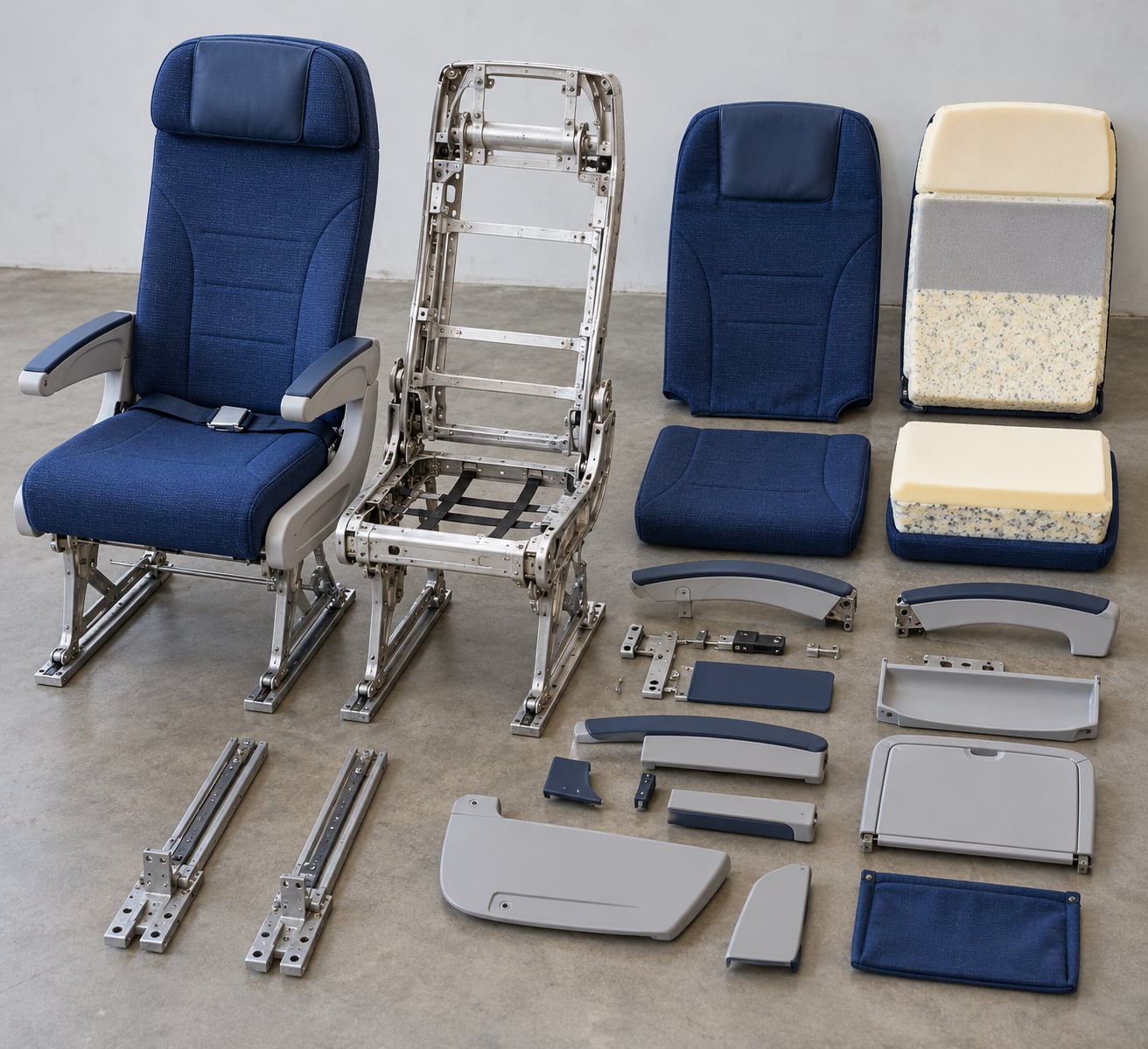
A standard forward-facing economy seat is a layered assembly. Reading it from the floor upward shows which parts have to survive a crash and which parts exist purely for comfort.
| Component | Job | Structural or comfort |
|---|---|---|
| Seat frame and legs | Carries occupant load into the floor track | Structural |
| Seat pan and backrest shells | Supports the cushions and defines the seat shape | Structural |
| Cushion foam and infill | Distributes body weight over long periods | Comfort |
| Cover (fabric, leather or synthetic) | Wear surface, hygiene barrier, flame-retardant layer | Comfort and safety |
| Headrest | Support for the head and neck | Comfort |
| Armrests | Support and shared boundary between seats | Comfort |
| Recline mechanism and locking pins | Moves the seat pan back and locks it upright | Structural and comfort |
| Seat belt, buckle and pretensioner fitting | Restrains the occupant in a crash | Structural and safety |
| Tray table and latch | Work surface and stowage, cycle-tested | Comfort |
| Screen, power outlet and wiring | Entertainment and charging on equipped seats | Comfort |
| Floor track fittings | Interface between seat legs and the aircraft floor | Structural |
Premium seats use the same categories of parts but add a privacy shell, thicker foam, electric recline motors, more wiring and larger screens. The frame underneath is still a load path into the floor.
What Are the Main Parts of an Airplane Seat?
The frame is the part everything else hangs off. It is usually welded from aluminium tube or machined and riveted, and it defines the seat pan angle, the backrest contour and the geometry of the leg supports. If the frame is wrong, no amount of foam makes the seat work.
The seat pan and backrest come next. On conventional seats these are moulded shells, often from a composite or a filled plastic, bonded or fastened to the frame. On some designs the pan is a sling of webbing tensioned across the frame; the end result feels different and wears differently.
Cushions sit on those shells as layers: a bottom foam base, an intermediate comfort layer and sometimes a spring or spacer element. Premium cabins add more thickness and more layers, which is where much of their extra weight goes.
Then come the fittings passengers actually touch. Armrests, the headrest, the tray table and its latch, the belt buckle and, on equipped aircraft, the screen and power module. These are interchangeable across a cabin layout, which is why an airline can swap a broken tray table without replacing the seat.
A useful way to sort all of it: parts that take load or restrain a body are structural and certified as part of the seat assembly, while covers, foam, armrest caps and screens are comfort and amenity items built to the same flammability rules but not to the same crash limits.
What Materials Are Used to Build Airplane Seats?
Weight is the constraint that shapes everything. A seat is a large object inside an aircraft that has to carry fuel, so manufacturers spend constantly shaving grams off parts that do not need to be heavier.
Frames are aluminium in most cabins because it is light, cheap to form and easy to join by welding or riveting. Steel appears where a fitting must resist wear or a locking mechanism must not slip, and composite shells use carbon fibre with a honeycomb or foam core for stiffness at low weight.
Cushions are flexible polyurethane foam, sometimes with a spring mat or spacer underneath on premium seats. Covers come in three families, and the choice is about weight, cleaning and how the seat ages.
| Cover material | Strengths | Tradeoffs |
|---|---|---|
| Woven fabric | Light, durable, hides everyday marks, easy to replace | Shows stains over time, needs careful cleaning |
| Leather or synthetic leather | Hardwearing, easy to wipe down, feels premium | Heavier than fabric, harder to repair, creases with age |
| Vinyl | Lowest maintenance, cheapest to replace | Can feel sticky and crack in dry cabins, not used everywhere |
Every cover material must be treated to slow burning, which adds a processing step. The seat-belt webbing is a separate high-strength textile, and the plastic fittings, latches and screen housings are chosen for flame behaviour as much as for strength.
How Airplane Seats Are Built Step by Step
How airplane seats are built in practice runs from an airline brief to a seat bolted into a cabin, and the order is fairly consistent across suppliers.
- Design brief and CAD. The airline specifies cabin layout, seat pitch, width, finish colours and features. Engineers model the seat in 3D and check it against the aircraft interior envelope, including where knees and heads of the row behind land when the seat reclines.
- Ergonomic mock-up. A non-flight model is built and reviewed by cabin crew and human-factors specialists, who sit in it, reach for the tray table, check sightlines and adjust the pan angle before tooling is cut.
- Frame forming and joining. Aluminium tube is cut, bent on a former, then welded or riveted into the leg and backrest structure. Fittings and the track adapters are machined and fitted.
- Shell and moulding. Seat pans, backrests and side supports are made by one of three routes: autoclave curing of pre-preg composite under vacuum and heat, compression moulding in matched tooling, or bladder moulding, where a flexible bag presses a pre-preg lay-up against a hard tool. Compression and bladder moulding allow complex shapes and shorter cycle times, which is why they are common on premium interiors.
- Cushion cutting and bonding. Foam is cut to shape, layered and bonded to the shells, with the lumbar and bolster infill placed by hand.
- Upholstery. Covers are cut from rolls or kits, sewn on panels and trim, then stretched and stapled or bonded over the foam. Premium seats add piping, quilting and stitched details that take far longer than a plain slip-on cover.
- Mechanisms, screens and wiring. Recline mechanisms, latches and armrests are fitted, then in-flight entertainment screens, power modules and reading lights are wired in and tested for current draw and connector security.
- Inspection and qualification. Every seat gets a functional check, and the design must clear structural, flammability and durability qualification before the airline type certificate is amended.
Large suppliers build thousands of these a year in dedicated plants. Names that come up constantly in the industry include Safran Seats, Collins Aerospace, Thompson Aero Seating, RECARO, Adient and Acro Aircraft Seating, and much of European and North American output comes from Northern Ireland, France and northern Spain. Delivery of a complete seat runs into months, which is why a shortage of seats can hold up an aircraft that is otherwise finished.
How Are Airplane Seats Attached to the Aircraft?
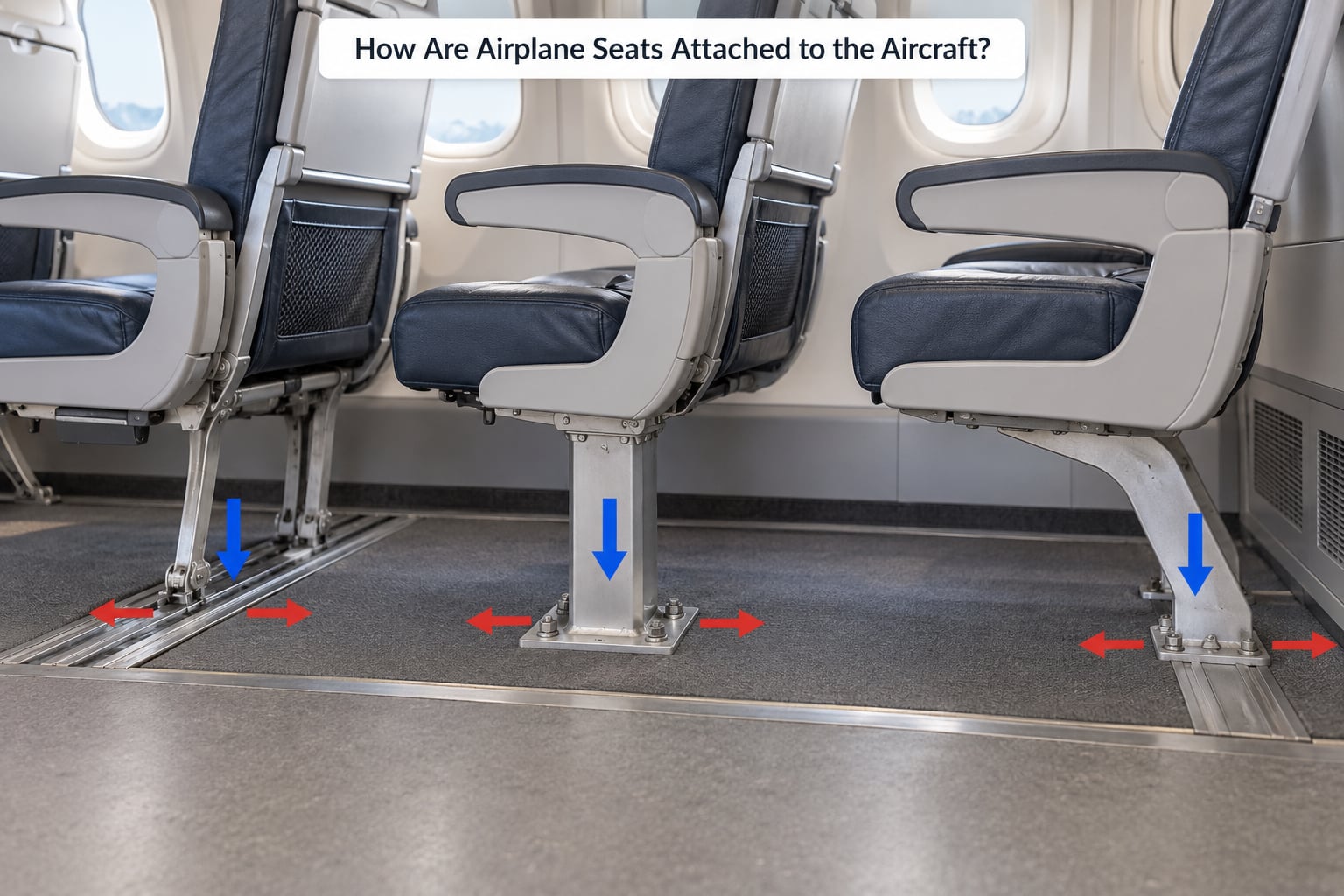
Every seat ends up bolted to something, and there are three main methods. The one you are sitting in depends on the aircraft type and the cabin layout, not on the airline’s preference.
| Method | How it works | Where you see it |
|---|---|---|
| Floor track | Seat legs slide into a rail running fore and aft and lock into discrete holes, so positions can be set during cabin outfitting | Most narrowbody and many widebody economy cabins |
| Fixed pedestal | The seat sits on a bolted base rather than sliding, giving a fixed pitch | Short-haul and commuter layouts with fixed spacing |
| Cantilever support | The seat hangs off side supports attached to the cabin wall or a beam, clearing the floor underneath | Business and first class on some widebodies |
In every case the legs act as compression columns and the back supports act in bending, and both loads pass into the airframe floor beams. That is why seat positions cannot simply be moved in service: the track holes are certified positions, and a change may exceed what the floor is approved to carry.
How Do Airplane Seats Pass Safety Tests?
A finished seat has to do well in a static test and in a sled test, and it has to survive years of daily abuse before either of those. The exact limits vary by aircraft type and certification basis, but the categories of test are consistent.
Structural testing covers loads applied through the seat track and the backrest, including cases where a leg fails and the load shifts to the structure around it. Dynamic testing puts the seat on a sled that accelerates along a rail, with instrumented dummies sitting in it at up to 16 G for a seat row position and lower levels for other positions. Good results are measured on head excursion, spine loading and pelvic motion, not simply on whether the seat stayed attached.
Restraint testing checks the belts, buckles and the way the cushion deforms, because a seat that absorbs the load but lets a passenger slide under the belt has not passed. Flammability testing follows regulations such as FAR 25.853 in the United States and the equivalent EASA rules, covering burn rate, heat release and smoke for covers, foam and tray tables.
Durability testing is the boring one that saves the airline money. Recline mechanisms, tray table latches and armrests go through repeated cycles, and seats are vibrated and loaded to simulate years of service. A tray table that fails a latch cycle test after a few thousand operations gets redesigned before certification.
After delivery, airline maintenance inspections check belts, tracks, latches and covers on a schedule, so an individual seat is inspected repeatedly during its life rather than certified once and forgotten.
Why Do Airplane Seats Differ Between Economy and Premium Cabins?
The cabin label mostly tells you how much weight and space the airline decided to spend on you. Seats get lighter and simpler as density rises, because on a full narrowbody every extra kilogram is fuel burned on every flight.
Economy seats are built for high density: narrow frames, thin foam, small or no screens, and a mechanism sized for light use. Width has crept down over the years, from roughly 18.5 inches in the early 2000s toward about 17 inches on many narrowbody layouts, while pitch varies by airline and by row position rather than by any cabin standard.
Premium economy adds a deeper pitch, thicker cushions, a footrest on some designs and larger screens, and it usually means a noticeably heavier seat. Widebody business class seats go further: shells with privacy, lie-flat beds built from several cushion sections, side consoles, larger power modules and touch controls, plus the wiring and structures to support them.
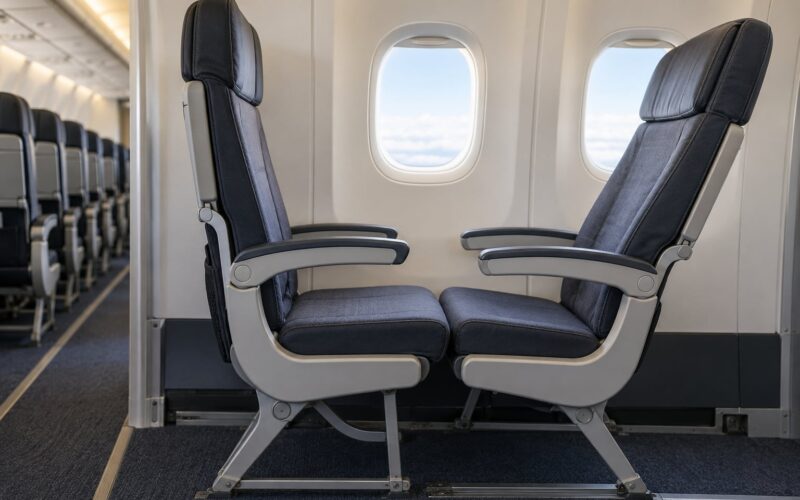
Recline is where the manufacturing limits show. A shallow recline keeps the seat in its crash envelope and stops a row behind from being hit by knees, so many economy mechanisms stop at a few degrees, while premium designs use more travel and more complex kinematics. That is also why the last row on a reclining cabin or a seat in front of a fixed bulkhead behaves differently, and why passengers keep asking whether a given seat number reclines at all.
Frequently Asked Questions
Are airplane seats made of wood or metal?
No wood is used in a certified seat. The load-bearing structure is aluminium tube, welded or riveted into a frame, with machined aluminium or steel fittings at the joints, track adapters and lock points. Backrests and side shells are usually moulded composite or filled plastic over a honeycomb or foam core. Wood and other interior decorative finishes exist elsewhere in the cabin, but never in the parts that carry occupant load.
Why are economy airplane seats so narrow?
Because the seat is competing with the aircraft for weight and rows. Each kilogram added to a cabin has to be carried on every flight, so high-density cabins get narrower frames and thinner cushions, and many narrowbody layouts now sit closer to 17 inches of width than the 18.5 inches common in the early 2000s. Airlines vary, so width is a per-airline fact rather than a universal standard.
Can an airplane seat be moved after installation?
Sometimes, but only to certified positions. Most seats slide into a floor track with discrete locking holes, and moving one changes the load distribution and the spacing to the row behind, so airlines reconfigure cabins during scheduled maintenance under an approved procedure. A casual swap during a turnaround is not allowed, because the track interface is part of the certified installation.
How thick are airplane seat cushions?
Economy seat cushions are usually only a few centimetres thick, typically a base foam layer with a thin comfort layer on top. Premium and lie-flat seats use noticeably deeper, multi-layer cushions that can be several times thicker, which is where a large share of their extra weight comes from. Exact figures vary by design, and the same seat can feel thinner after years of use as the foam compresses.
Why do some airplane seats not recline?
Several reasons. Budget carriers sometimes fit a fixed or pre-reclined mechanism, and seats in the last row or next to a bulkhead often have limited travel because a full recline would hit the wall. A seat may also be blocked by the leg rest of the row behind or by an occupied tray table. Manufacturers cap travel to keep every seat inside its certified crash envelope.
Are all airplane seats built and tested the same way?
The main stages are similar across suppliers, but materials, tooling and test severity vary with the aircraft type and the seat position. Certification requirements are set by the approving authority, FAA in the United States or EASA in Europe, and the numbers a seat must meet depend on its role in the cabin. A lie-flat business class seat is a completely different engineering problem from a short-haul economy seat.
Conclusion
Knowing how airplane seats are built explains most of what feels good or bad in a cabin. The seat is a certified structural assembly with soft goods layered on top of it, built to survive loads and fire far beyond anything a passenger will ever see, and every part is chosen against the same two pressures: crash survivability and cabin weight.
When you judge comfort before booking, check four things in this order: seat width, pitch, how far the seat actually reclines, and where it sits in the cabin. Everything else, from armrest feel and foam quality to the weight of the tray table, is secondary to those four.