A herringbone business class seat is a staggered, diagonal seat layout in which every seat in the cabin angles toward the window. Nobody has to climb over anyone else to reach the aisle, because every passenger gets direct aisle access. You gain privacy and easy movement, and you give up some seat width, foot space and window view.
You have almost certainly seen the word in a seat map or a trip report without knowing what it meant. Here is the plain version, then the details that actually matter when you pick a seat.
Table of Contents
- What Is a Herringbone Business Class Seat?
- Where you find a herringbone business class seat today
- Herringbone and reverse herringbone, in one line each
- How Does the Herringbone Layout Work?
- What Makes Herringbone Seats Different?
- Are Herringbone Seats More Comfortable?
- Who Benefits Most from a Herringbone Seat?
- How Do You Choose the Best Herringbone Business Class Seat?
- Confirm the aircraft, not just the airline
- Then choose window side or aisle side
- Two practical warnings
- One last check on the seat itself
- Frequently Asked Questions
- What is the difference between herringbone and reverse herringbone seating?
- Do herringbone business class seats lie flat?
- Which passengers do well in a herringbone seat?
- Should I choose a window or aisle seat in a herringbone cabin?
- Are herringbone seats good for couples and families?
- How do I find out which seat layout my flight has?
- Bottom Line
What Is a Herringbone Business Class Seat?
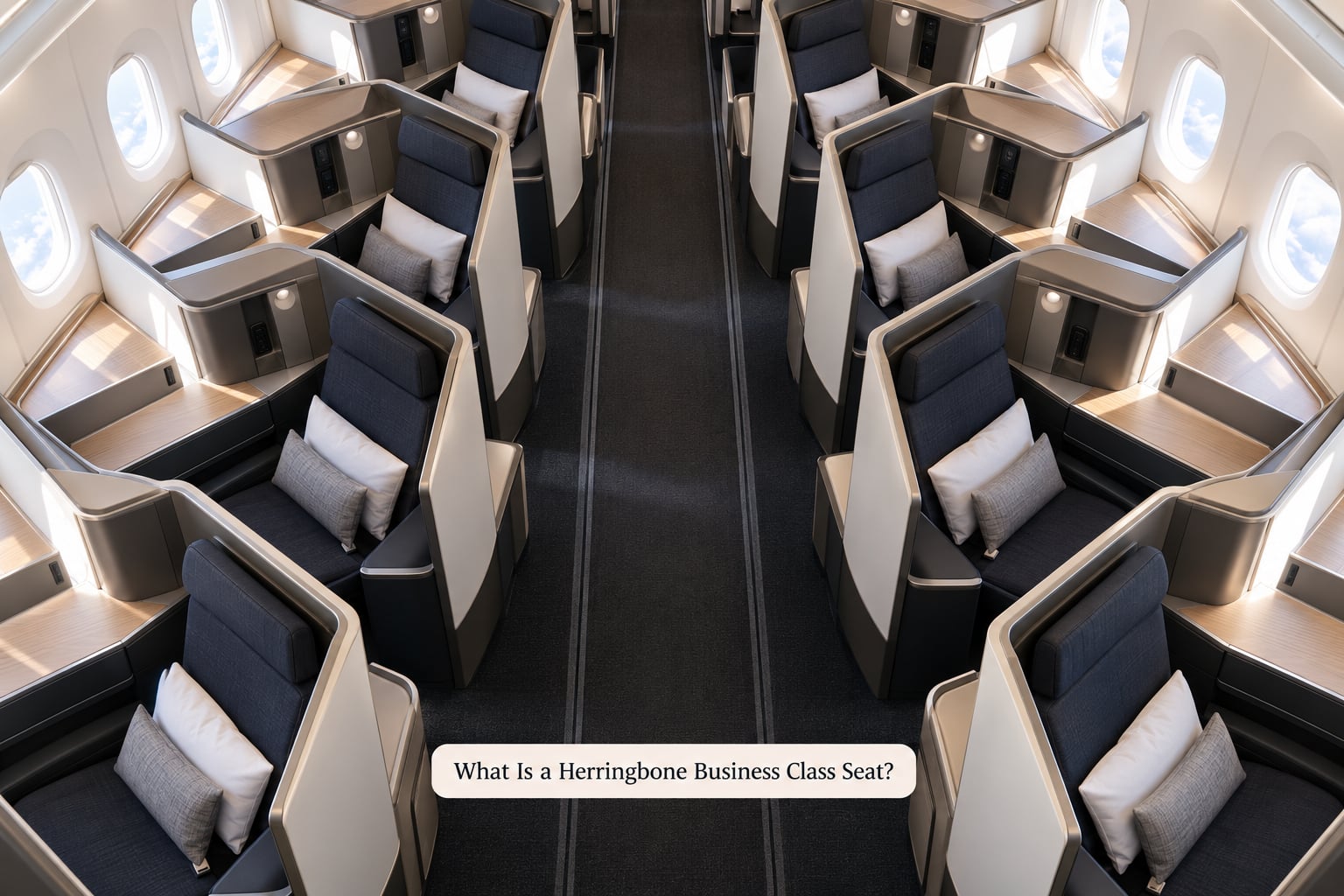
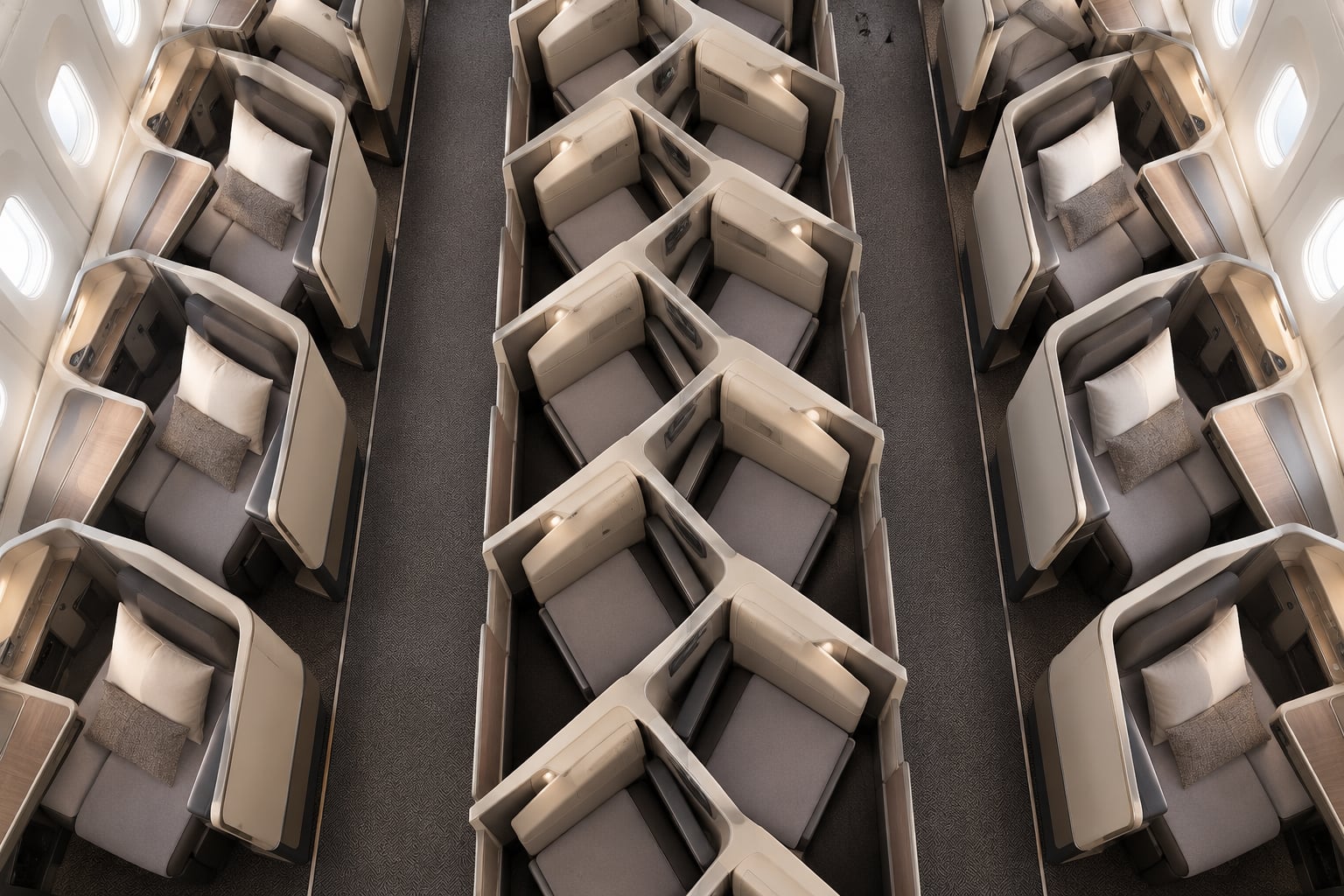
A herringbone business class seat is a seat positioned diagonally across the cabin rather than straight in line with the fuselage. The rows alternate direction, so the seat beside you faces the opposite way. That alternating pattern looks like the bones of a herring, which is where the name comes from.
Three characteristics define the layout:
- Angled. Each seat sits diagonally, roughly 45 degrees to the fuselage, rather than pointing straight ahead.
- Staggered. Because each seat is angled, rows do not line up neatly one behind the other. They overlap instead, which lets an airline fit a wide cabin with plenty of room around every seat.
- All aisle access. Every single seat has a walkway leading straight to an aisle. There is no middle seat you have to cross someone to reach.
That last point is the reason airlines adopted the layout in the first place. Before it, most business class cabins used a 1-2-1 arrangement with a forward-facing window seat, a forward-facing center seat, and a rear-facing aisle seat. In that 1-2-1 layout, only two of the three seats in a row have direct aisle access.
Angling the seats let the airline give all three positions a walkway, which solved a real problem for overnight passengers who did not want to crawl over a stranger in the dark to reach the lavatory.
Where you find a herringbone business class seat today
The layout is not new, and it is not spreading. Virgin Atlantic built a herringbone cabin into its 787-9, and Delta, American and Air France have all flown herringbone equipment on twin-aisle aircraft at various points. On several of those routes the airline has since moved newer aircraft to reverse herringbone or to staggered suites with doors.
That gap between what an airline has and what you actually get on your flight date is the single biggest source of confusion in this topic. Two people can book the same route, the same fare and the same seat number on different days and end up in completely different cabins.
Herringbone and reverse herringbone, in one line each
Herringbone means the seat angles toward the window and the passenger’s back faces the rear of the plane. Reverse herringbone flips that: the seat angles toward the aisle, the passenger faces forward and slightly inward, and the center seats point at each other across the cabin.
How Does the Herringbone Layout Work?
The mechanism is simple geometry. Take a forward-facing seat and rotate it about 45 degrees, so the seatback sits closer to the fuselage and the seat front sits closer to the aisle. Do that to every seat in the row, and then offset each row by half a seat so the angled shells do not collide.
That half-seat offset is the staggering. It is what creates the extra floor space between seats, and it is why a herringbone cabin feels more open than a straight 1-2-1 cabin with the same number of seats.
Because the angle alternates, the cabin reads visually as a series of chevrons or a zigzag running the length of the plane. Some people describe it as seats arranged like the bones of a fish. The same idea gets called herringbone, chevron and sometimes diagonal seating in different reviews, so a trip report using one of those words may be describing the seat you are reading about.
The alternative naming convention worth knowing is the reverse herringbone, where the angle points the other way and the passenger faces forward. Many of the products people confuse with plain herringbone are actually reverse herringbone, including the Safran VUE family and the Thompson Vantage range.
One more detail that trips people up: on some aircraft, the outboard columns can be configured as herringbone or reverse herringbone by the airline at installation, while the center pair stays the same. The herringbone choice is therefore partly a manufacturer option and partly an airline cabin-planning decision.
What Makes Herringbone Seats Different?
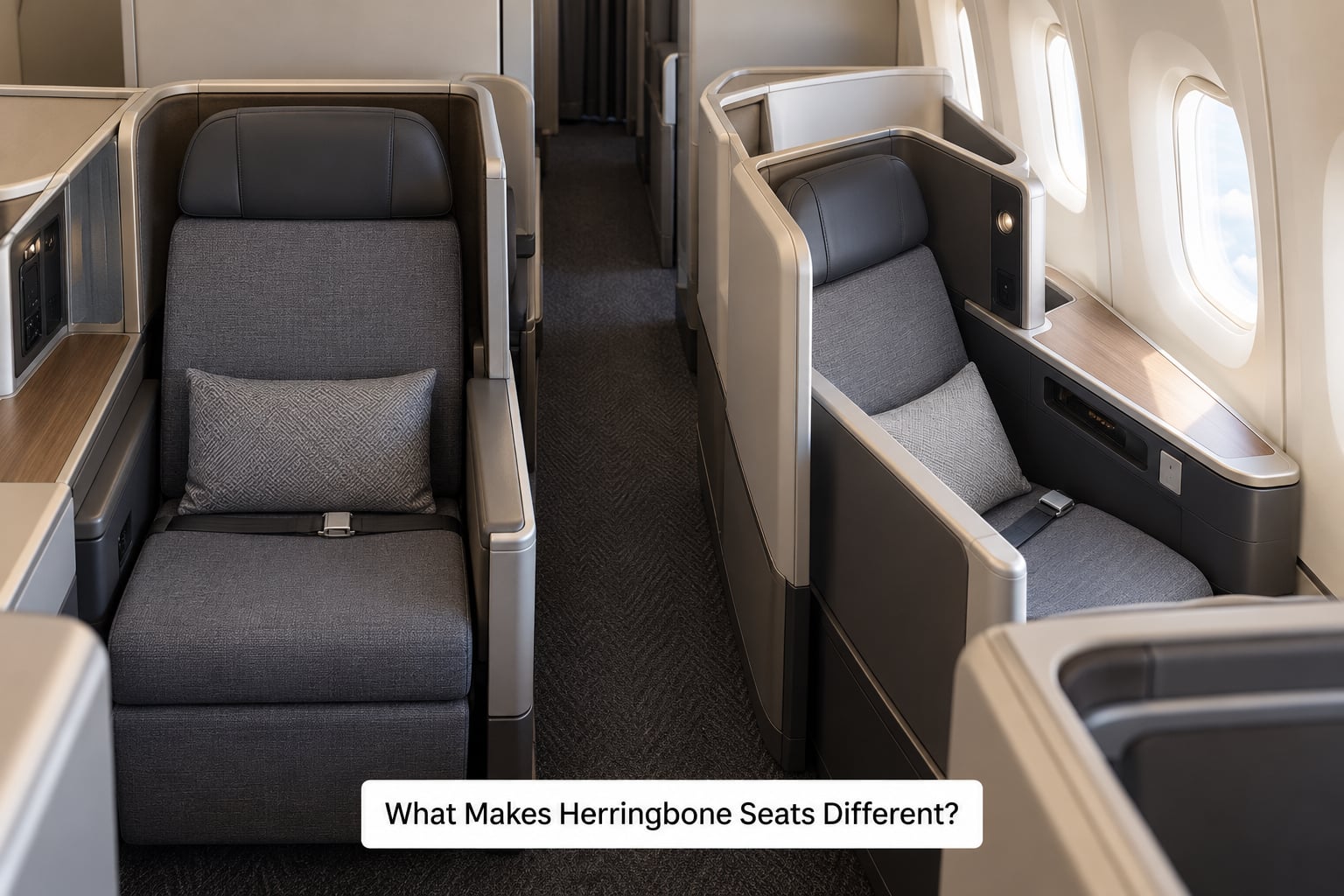
The defining difference is that a herringbone seat trades a normal forward view for privacy. Every passenger gets their own walkway and a seat shell that shields them from the cabin, and the price of that is a slightly oblique view out of the window and a narrower shell than a straight-facing seat of the same nominal width.
Here is how the four premium layouts that readers most often confuse with each other compare.
| Layout | Seat direction | Aisle access | Flat sleeping | Privacy |
|---|---|---|---|---|
| Herringbone | Angled toward the window, alternating by row | Every seat has direct access | Usually angled-flat, sometimes not fully flat | High, sides and screen shield the passenger |
| Reverse herringbone | Angled toward the aisle, passenger faces forward | Every seat has direct access | Most modern versions are fully flat | High, with a taller shell on many products |
| Staggered suite | Forward facing, rows offset | Every seat has direct access | Fully flat on most products | High, with partial or full doors on some |
| Suite with door | Forward facing | Every seat has direct access | Fully flat | Highest, the door closes |
Two distinctions in that table come up constantly. First, direct aisle access is not unique to herringbone any more. Reverse herringbone, staggered suites and door suites all give every passenger a walkway, which is why aisle access on its own no longer tells you much about a cabin.
Second, herringbone seats are often described as lie-flat when they are not. Older herringbone products stop short of horizontal, and even the newer angled-flat versions put your feet higher than your head. A seat that reclines to about 135 degrees feels nothing like a bed. If you want a genuinely flat bed, check the specific product rather than the layout name.
Storage and width follow the same pattern. A staggered angled seat usually gives you a side table or ledge within reach and a shell that keeps the aisle out of your personal space. A traditional forward-facing seat often gives you a wider, flatter side table and more shoulder room, but you may end up shoulder to shoulder with a stranger.
Are Herringbone Seats More Comfortable?
It depends entirely on what you value, and on which herringbone seat you end up in. The layout is a space-efficiency solution, not a quality tier. A well-built herringbone seat can be a superb way to sleep eight hours, and a cheap one can be a plywood bench with a cushion.
What most people rate highly:
- Privacy. The angled shell and the screen give you a genuine sense of being in your own space, even without a closing door. Frequent flyers consistently report that sleeping quality in a herringbone cabin beats a straight-facing seat with a stranger’s elbow two inches away.
- Movement. Getting up for the lavatory does not involve negotiating with strangers in the dark. On a red-eye flight, most people tell me this matters far more than they expected.
- Open cabin feel. The extra floor space between angled seats means fewer people feel crowded, and crew can move through the cabin without turning sideways.
What people rate badly, usually for good reasons:
- You lean sideways on takeoff. Because the seat is angled and the shell narrows toward the foot end, you are not simply pushed straight back into the headrest. You settle into the angle. For some passengers this feels odd, and it is one of the most commonly reported surprises with the layout.
- The shell narrows. Forum reviewers describe these seats as narrow, with a small box-like compartment at the foot end for your feet. If you are tall or broad across the shoulders, that narrowing is the deciding factor, not the privacy.
- The window view goes away when you are flat. Fully reclined and angled, you end up looking at the seatback in front of you or a patch of wall rather than out of the window.
- No room to talk. The angled layout deliberately separates passengers. If you are travelling with a partner and want to compare notes on the day, this is the wrong cabin.
- Side sleepers struggle. Lying at an angle is uncomfortable for a share of people. Back sleepers and many front sleepers do fine.
So the honest answer to “are they more comfortable” is: more private and easier to move around in, not softer or wider or better suited to every body. Reviews that only list the upsides are usually written by people who bought the ticket themselves.
Who Benefits Most from a Herringbone Seat?
Herringbone tends to suit solo travellers on overnight long-haul flights, especially if you value privacy over a straight-on view and you sleep well on your back. It also suits anyone who dreads climbing over strangers in a dark cabin, and travellers who want a lie-flat style sleep without paying for a suite with a door.
It suits some people more than others on the basis of body shape. Shorter passengers generally find the angled shell and footwell more manageable than taller passengers do. Side sleepers tend to do worse. Anyone over roughly six feet who has been burned by a shallow footwell before should look for a specific product with a documented bed length rather than trusting the layout name.
The layout works badly for couples and for families with children. There is no shared surface and no conversational angle, so two people in a herringbone cabin sit essentially back to back. A staggered forward-facing suite or a door suite is a much better fit if you want to sit together.
It also works badly for anyone who plans to work. The angled position and the shell limit a flat laptop setup, and although every seat has a table, the working posture is more cramped than in a straight-facing seat.
Everyone is different here, and plenty of people love the layout. Treat these as tendencies rather than rules, and read recent trip reports from passengers with a similar body type to yours.
How Do You Choose the Best Herringbone Business Class Seat?
Choosing well comes down to verification before you book, then one straightforward decision inside the cabin.
Confirm the aircraft, not just the airline
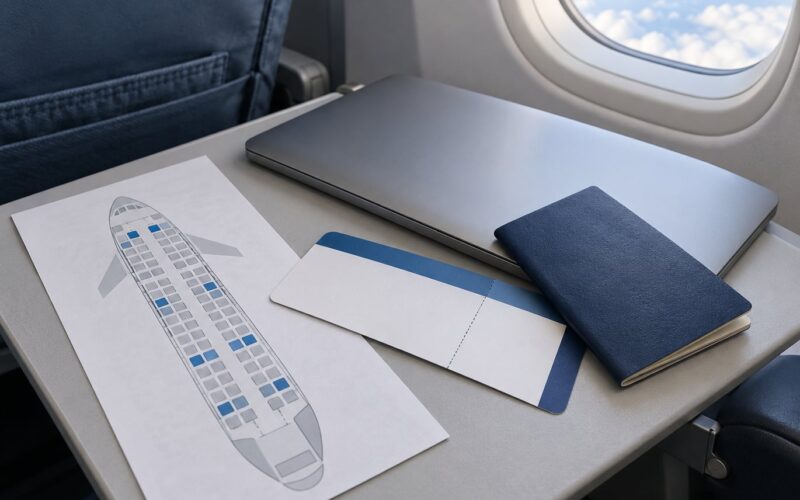
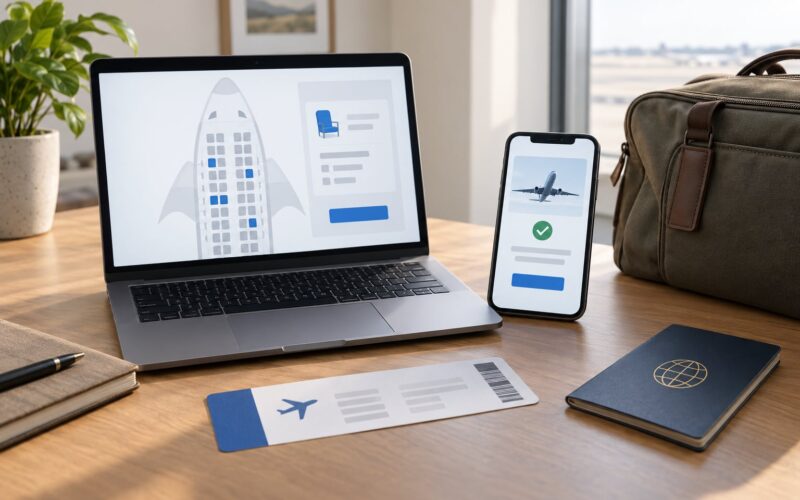
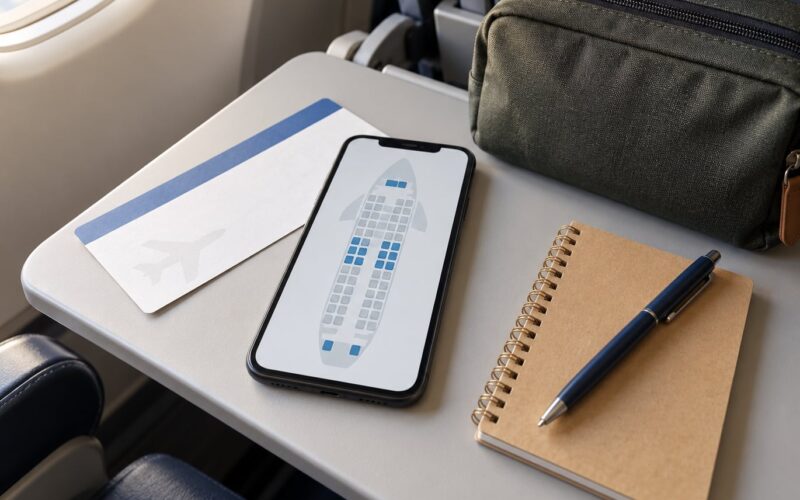
Seat maps on airline websites are labelled by equipment type, and the same airline may run two different business class cabins on the same route. Check the aircraft assigned to your specific flight number, then look up that aircraft type’s seat map. A map tool or a seat map site is the quickest way to see whether the cabin is herringbone, reverse herringbone or a staggered suite.
Do this before you pick seats, not after. If the cabin turns out not to be herringbone, your seat choice will probably change too.
Then choose window side or aisle side
With every seat offering aisle access, the choice narrows to what you want from the position.
- Window side for the wall beside you, the window view while upright, and a stronger sense of enclosure. This is the classic sleeper’s choice.
- Aisle side for the easiest walk to the lavatory and the cabin, a wider sense of space, and a position that can feel less boxed in. This suits nervous flyers and anyone who hates feeling shut in.
Center seats in a herringbone cabin are not the awkward middle position they are in a 1-2-1 row, because they are aisle-accessible. They are simply less scenic and slightly harder to reach, which is why most experienced travellers pick a window side or aisle side instead.
Two practical warnings
Equipment swaps are real. Schedules change, aircraft get reassigned, and a herringbone booking can turn into a different cabin on the day. Build in a little flexibility and check your reservation again a few days before departure.
Award seat availability is uneven. In premium cabins that use these seats, the best positions can be unavailable to redeye or elite travellers even when other seats in the same cabin are open. If a specific position matters to you, select it as early as your programme allows.
One last check on the seat itself
Look for the product name and read what recent passengers say about the footwell, the bed angle and the seat width. If you need a genuinely flat bed, that is the question to confirm, because the herringbone label covers products that recline fully flat and products that never do.
Frequently Asked Questions
What is the difference between herringbone and reverse herringbone seating?
Both are diagonal 1-2-1 layouts that give every passenger direct aisle access. In a herringbone seat, the seat angles toward the window and the passenger faces the rear of the aircraft. In a reverse herringbone seat, the seat angles toward the aisle and the passenger faces forward. Reverse herringbone is the modern iteration and most current products are fully flat.
Do herringbone business class seats lie flat?
It depends on the product. Older herringbone seats stop short of horizontal, and even newer angled-flat versions leave your feet higher than your head. Some current products do recline fully flat. Check the specific seat rather than the layout name, because the word herringbone covers both.
Which passengers do well in a herringbone seat?
Solo travellers on overnight flights, back sleepers, and anyone who values privacy and easy lavatory access over a straight-on window view. Tall passengers often find the shell narrows toward the foot end, and side sleepers can find the angled position uncomfortable. The layout is also a poor fit for couples or families who want to sit together.
Should I choose a window or aisle seat in a herringbone cabin?
Pick the window side for the window view while upright and a stronger sense of enclosure, which suits overnight sleepers. Pick the aisle side for the shortest walk to the lavatory and a less boxed-in feeling, which suits nervous flyers. Since every seat has direct aisle access, there is no crowding penalty on either side.
Are herringbone seats good for couples and families?
Generally no. The angled layout deliberately separates passengers, so there is no shared surface and no conversational angle. Two people sit essentially back to back. If you want to sit together, work side by side or keep a child in view, a staggered forward-facing suite or a suite with a door is a much better fit.
How do I find out which seat layout my flight has?
Check the aircraft type assigned to your specific flight number, then look up that aircraft type’s business class seat map before you select seats. Airlines often label seat maps by equipment, and the same route can be flown with two different cabins. Recheck before departure too, since aircraft swaps happen and can change your cabin entirely.
Bottom Line
A herringbone seat is a layout, not a quality rating. Choose it if you are flying solo overnight, you care most about privacy and being able to get up without climbing over anyone, and you are comfortable sleeping at an angle. Look elsewhere if you are tall, you are a side sleeper, you are travelling with a partner or child, or you want a flat bed and a normal window view.
Before you book, check the aircraft assigned to your flight and confirm the cabin on the seat map. That single step prevents most of the disappointments people report with this layout.