Flying makes you tired because several small stressors pile up on the same trip: the cabin is pressurised to roughly 6,000 to 8,000 feet so you breathe slightly thinner air, humidity often falls below 20 percent, you sit still for hours, sleep badly and land out of step with your normal eating and sleeping routine. No single cause does it. The load is cumulative.
Table of Contents
- What Makes Flying Feel So Tired?
- How Cabin Pressure and Low Oxygen Affect You
- Why Flying Makes You Tired During Long Flights
- Does Dry Air and Dehydration Cause Flight Fatigue?
- How Lack of Movement Contributes to Tiredness
- Why Jet Lag and Disrupted Sleep Make Flying Exhausting
- Short Flights vs Long-Haul Flights: Why the Tiredness Differs
- What Helps You Feel Less Tired During and After a Flight
- Before you fly
- On board
- In the first day after landing
- When Flight Tiredness May Need Medical Advice
- Frequently Asked Questions
- Is it normal to feel exhausted after flying?
- How much water should I drink on a long flight?
- Should I sleep during a short flight if I am thirsty?
- Why do my eyes and throat feel dry on a plane?
- How can I reduce jet lag after crossing time zones?
- What to Do First
What Makes Flying Feel So Tired?
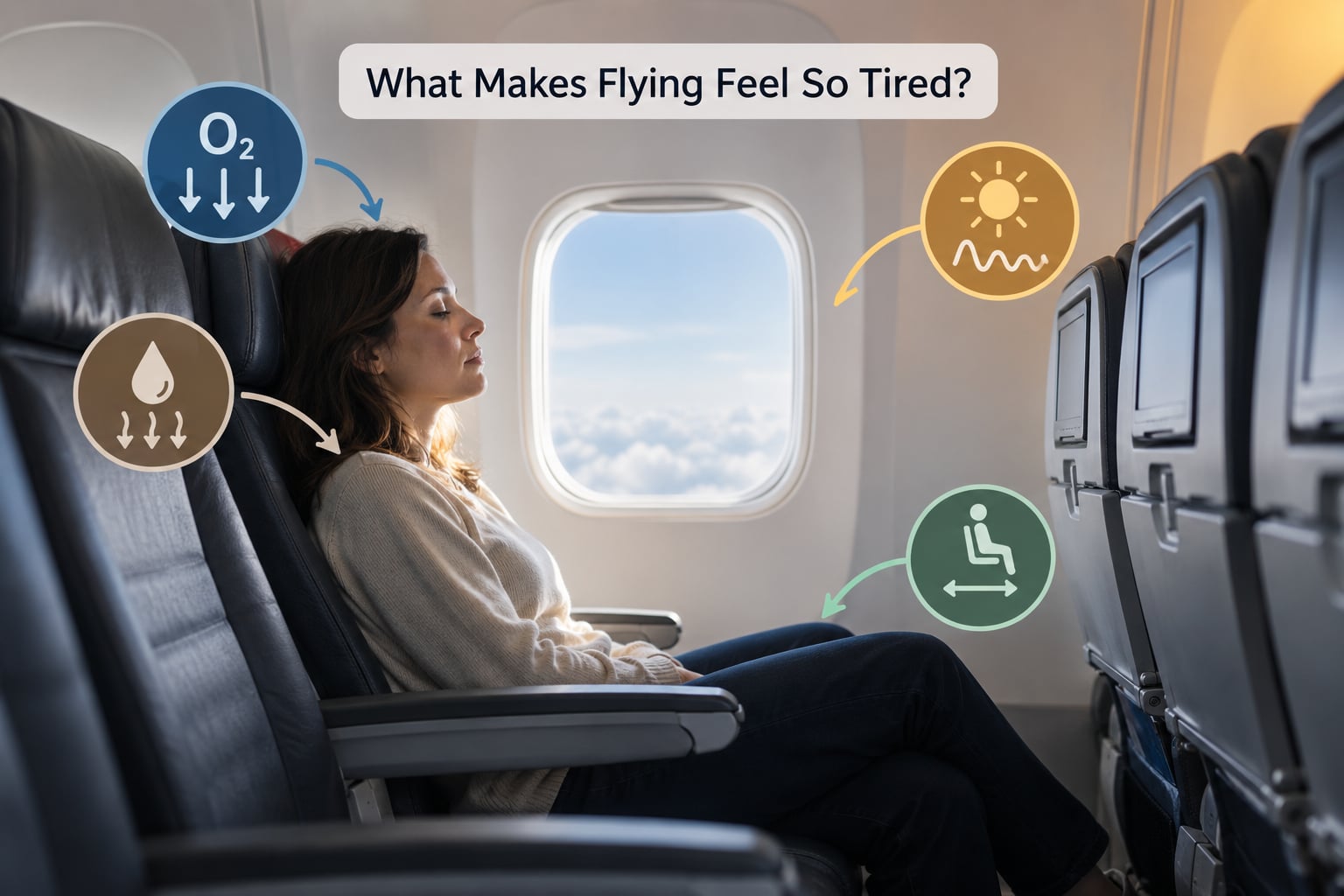
Short flights and long flights wear you out for completely different reasons, which is why the fix for one trip often fails on the other. A two-hour hop barely touches your sleep, but the security queue, the early start and the adrenaline afterward can leave you flat by the time you land. An eleven-hour flight does the opposite: you are stuck, upright and awake through the entire stretch your body would normally have spent asleep.
Long-haul flyers in travel forums tend to rank the causes in the same order, with dehydration first, broken sleep second, and the stress of everything around the flight third. The cabin noise and constant low vibration usually get mentioned too, and they are the cause most people never think to blame.
The honest summary is that the physical load and the mental load are both real. You cannot sit in a pressurised, vibrating, badly lit room for six hours without your body noticing, and you also cannot stay alert through all of it when there is nothing meaningful to do.
How Cabin Pressure and Low Oxygen Affect You
Aircraft cabins are not sealed at sea-level pressure. They are held at an equivalent altitude of about 6,000 to 8,000 feet, and roughly half the air in the cabin is drawn from outside, where it is thinner and drier. The practical effect is that the partial pressure of oxygen reaching your blood is a little lower than it would be at ground level.
For most healthy adults that drop is small enough that you would not notice it on its own. What makes it matter is everything stacked on top of it: poor sleep, a full stomach, alcohol, low fluid intake and several hours of immobility. Each one alone is trivial. Together they produce the heavy-eyed, can’t-concentrate feeling passengers describe.
Pressure changes during ascent and descent are more noticeable than the steady cruise pressure. On the way down, the pressure in your middle ear lags behind the cabin, and the eustachian tube has to open to let it equalise. Swallowing, chewing gum or yawning helps. If it does not, you get that dull ache across one side of your head that can hang around for hours after landing, and that ache on its own is tiring.
Some people feel this more than others. Congestion from a cold, a sinus problem or a long flight with poor air circulation all make equalisation harder. Anyone with a heart or lung condition should not self-assess whether a lower oxygen level is safe for them; that is a conversation with a doctor who knows their history.
Why Flying Makes You Tired During Long Flights
The tiredness on a long flight is accumulated, not instant. Over eight or ten hours the same small effects keep applying without a break, and by hour nine your reserves are simply spent.
Sitting still is the constant one. Bent at the hips, shoulders forward, head turned toward a tray table, the body holds an awkward posture for hours and the muscles start to ache in the lower back and the base of the skull. Add reduced movement in the legs and it gets harder to stay comfortable, which makes staying awake harder still.
Sleep on a plane rarely works the way sleep works at home. The cabin is lit, people talk, the seat does not lie flat and your neck is bent at an angle that your body was never designed to hold for hours. Many passengers get three or four broken hours and then describe it as eight. What they got was a nap with interruptions, and it leaves them groggy rather than rested.
Alcohol makes it worse in a specific way. A nightcap helps you drop off, but it suppresses REM sleep, so you get less of the deep, restorative part of a night and more of the shallow kind. You land feeling heavy rather than fresh.
Food matters too, particularly the airline version of it: salty, starchy, low on protein and generous with alcohol. Digesting that on a moving body uses energy, and the sugar spike from bread and dessert is usually followed by a dip right when the flight is boring and you need to be awake.
Does Dry Air and Dehydration Cause Flight Fatigue?
Dry cabin air is real and it is one of the more cited reasons people feel worn out after a trip. Aircraft cabins usually operate at 10 to 20 percent relative humidity. Hold your hand near a vent for a minute and you will feel the difference. Your eyes sting, your nose picks up, your throat gets dry and your skin tightens.
Here is the part most articles skip: ordinary flying does not automatically produce clinically significant dehydration. A few hours in a low-humidity cabin rarely takes a healthy adult past the point where hydration matters. It is uncomfortable, and it contributes to the tired feeling, but the deeper fatigue people report on arrival comes mostly from sleep and time-zone disruption, not from a fluid deficit.
Hydration is still worth doing, and the useful target is boring: drink steadily rather than in a rush, and avoid the mistake of drinking a large volume of water in the last hour before landing, because most people will need the toilet immediately on arrival.
Skincare-wise, a fragrance-free moisturiser on your face and hands before you board, and saline spray or a gel eye mask when your eyes start to sting, make the dry-cabin hours far more comfortable. Cheap measures, noticeable difference.
How Lack of Movement Contributes to Tiredness
Prolonged sitting slows the pump action in your lower legs. Blood pools, ankles swell, and the general sensation is heaviness and dullness through the legs, which your brain reports as tiredness even though nothing is actually depleted. Combine that with an awkward seat and you have a convincing explanation for the wiped-out feeling on a ten-hour leg.
The fix is unglamorous and effective. Get up and walk the aisle every hour or two on a long flight, and move at least every 30 to 60 minutes on a shorter one even if you cannot leave the seat. If you are stuck in a middle seat, seated calf raises, ankle circles and flexing your toes will keep blood moving.
Wear loose clothing. Tight denim, a belt pressing into the abdomen and anything cinching at the waist restrict circulation and add to the heavy, bloated feeling that passengers often complain about. If you are someone who flies frequently, travel socks are a reasonable low-risk option for long flights.
One caution: get up slowly after long stretches. Dizziness on standing is common after sitting for hours, and the aisle floor on a moving aircraft is not a forgiving place to land.
Why Jet Lag and Disrupted Sleep Make Flying Exhausting
Ordinary in-flight sleepiness and jet lag are different problems, and mixing them up leads to bad advice. Sleepiness is a wave of drowsiness you fight with caffeine, movement or a change of activity. Jet lag is your internal clock disagreeing with the local clock, and caffeine barely touches it.
Jet lag generally needs at least two time zones crossed. Its symptoms are distinctive: being exhausted right after landing and then wide awake at 2 a.m., trouble falling asleep in the evening, poor concentration, a foggy head and an appetite that is out of step with the local meal times. Travelling east is harder than travelling west, because you are asking your body to wind its clock back rather than hold it.
Light is the main lever you control, and it is the one people get wrong. Travelling west, seek light in the late afternoon and early evening and avoid bright light in the morning. Travelling east, get bright light early in your destination morning and keep the evening dim.
Coffee and meals should follow the destination schedule, not the one you left with. That means trying to sleep at your destination bedtime even if you are not tired yet, eating when locals eat, and being awake outdoors in the morning after an eastbound flight. A common mistake is napping for three hours on arrival, which guarantees a night of broken sleep.
Melatonin is the sleep aid most people ask about, and guidance from health authorities is to discuss any use with a doctor first. If a clinician agrees it suits you, published protocols use low doses, typically 2 to 5 mg, taken at your destination bedtime rather than at random on board. It works far better with the light timing above than on its own.
Short Flights vs Long-Haul Flights: Why the Tiredness Differs
The same journey can produce completely different fatigue depending on duration, and knowing which one you are dealing with tells you where to spend your effort.
| What changes | Short flight (1 to 3 hours) | Long-haul flight (8 to 12 hours) |
|---|---|---|
| Sleep disruption | Minimal; you rarely sleep but you rarely need to | Severe, with a nap that does not replace real sleep |
| Movement | Short enough that you can stretch before landing | Hours of sitting, stiff legs and swollen ankles |
| Dry air and hydration | Mild discomfort | Persistent dry eyes, throat and skin |
| Time-zone effect | Usually none, unless the trip crosses zones | Jet lag on arrival, worse heading east |
| Meal and alcohol effect | A quick snack rarely changes much | Heavy food plus alcohol, then a blood-sugar dip |
| What actually causes the tiredness | Airport logistics, early starts, adrenaline, disrupted sleep the night before | Accumulated immobility, poor sleep and clock misalignment |
| Typical on-arrival symptom | Feeling wired and slightly flattened | Deep fatigue, sometimes followed by an odd energy burst in the evening |
Multi-stop itineraries are worse than either. Every connection adds another early start, another security queue and another block of sitting, and the ground time between them usually eats the window you would have used to sleep.
What Helps You Feel Less Tired During and After a Flight
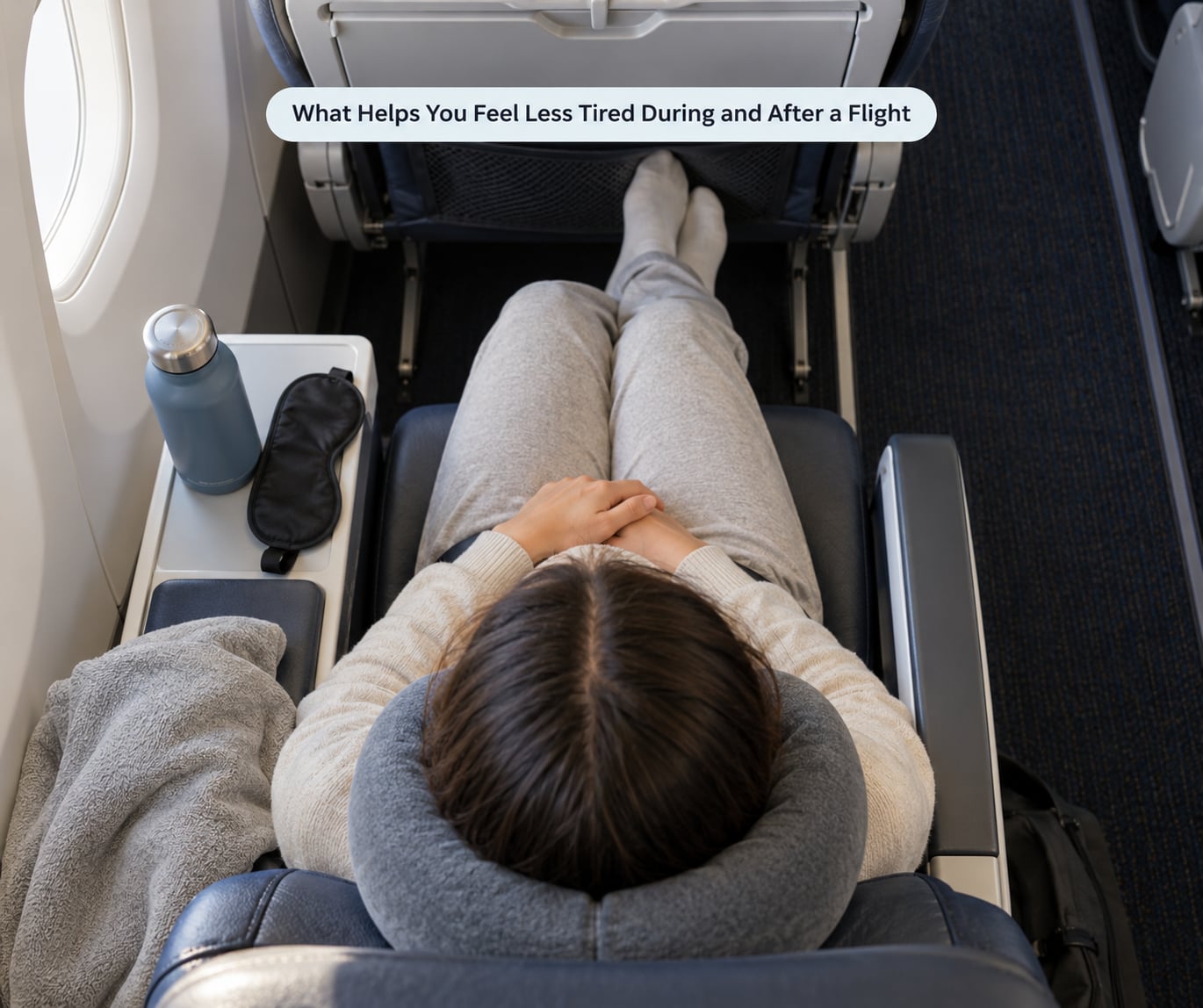
A useful plan splits into three parts: what you do the night before, what you do on board, and what you do in the first 24 hours after you land.
Before you fly
- Shift your sleep an hour earlier the night before if you can, rather than staying up and arriving already depleted.
- Eat normally. Boarding on a heavy dinner is a common cause of the unsettled, tired feeling in the first hour of the flight.
- Dress for six hours of sitting, not for the airport queue: loose layers, no tight waistband.
- Choose the seat that suits the trip. An aisle seat makes walking the cabin easy; a window seat over the wing is calmer in turbulence and blocks out light if you want to sleep.
On board
- Drink steadily through the flight rather than in one go.
- Set an alarm to move every hour or two, and use seated calf raises and ankle circles when you cannot leave the seat.
- Moisturise your face and hands after the doors close, and keep a gel eye mask or saline spray within reach.
- Use a foam earplug or noise-cancelling earplug if cabin noise is what keeps waking you. Low-frequency engine drone is harder to sleep through than most people expect.
- Take caffeine early in the flight, not in the last three hours.
- Skip the extra alcohol. It buys you sleep you will not get back.
In the first day after landing
- Get outside within an hour of arrival and let daylight set your clock. Ten minutes of bright light beats an hour indoors.
- Eat on the destination schedule, even if you are not hungry.
- Keep any nap to about 20 minutes, and never later than mid-afternoon.
- Move your body properly once you are through customs. A walk beats sitting in a hotel lobby with a headache.
- Aim to sleep at local bedtime the first night, even if that means an early night and a long wake-up.
When Flight Tiredness May Need Medical Advice
Ordinary travel tiredness is vague, general and improves within a day or two. What matters is when it stops looking ordinary. Do not automatically blame your flight for symptoms that are specific, severe or persistent.
Seek prompt medical care if you have significant breathing trouble, chest pain, fainting, confusion, a severe headache that does not settle, or one leg that becomes swollen, painful, red or warm. A clot can develop in the leg after a long flight, and the warning signs are not subtle enough to sit on. The risk is higher after long flights, prolonged immobility, recent surgery or injury, and for people with a personal or family history of clotting problems.
The same applies to exhaustion that lasts well past the trip. If you still feel flattened a week later, or if the tiredness comes with a fever, a persistent cough or a sore throat, that is worth checking. Post-flight tiredness is real, but it is not a diagnosis, and it should not be used to explain away symptoms that are getting worse.
If you have a condition that affects your breathing or circulation, talk to your doctor before flying rather than after. That conversation is far more useful than any article, including this one.
Frequently Asked Questions
Is it normal to feel exhausted after flying?
Yes. Most people feel tired after a flight, and the tiredness is a mix of thinner cabin air, dry air, hours of sitting, broken sleep and the stress of the whole airport-to-airport journey. A two-hour hop can leave you flat even though nothing physical happened, because the ground portion of the trip dominates. It is worth checking if the exhaustion lasts more than a few days or comes with other symptoms.
How much water should I drink on a long flight?
Around 250 ml an hour in the air is a widely used benchmark, which works out to roughly 1.5 to 2 litres over an eight-hour flight. Drink steadily rather than in one go, and spread it out so you are not rushing to the toilet right after landing. Ordinary flights rarely dehydrate a healthy adult to a clinical degree, so water is mainly about comfort, not emergency rehydration.
Should I sleep during a short flight if I am thirsty?
On a short flight, sleeping matters less than arriving with your body clock intact. Nap if you are genuinely drowsy, but keep it short, because a deep sleep on a two-hour hop can leave you groggy for the rest of the day. Have some water first, then sleep. You get far more out of a nap on a red-eye or an 11-hour leg than you do on a quick daytime hop.
Why do my eyes and throat feel dry on a plane?
Cabins usually run at 10 to 20 percent relative humidity, which is drier than almost any indoor room you spend time in on the ground. That is enough to pull moisture from your eyes, nose, throat and skin, which is why eyes sting and noses pick up on a flight. Saline spray, a gel eye mask and a fragrance-free moisturiser before boarding all make a real difference.
How can I reduce jet lag after crossing time zones?
Light does most of the work. Travelling east, get outside early in your destination morning and keep the evening dim; travelling west, seek light in the late afternoon and avoid it early. Then eat and sleep on the destination schedule, including the first night’s bedtime, and keep naps under 20 minutes. Recovery is often roughly one day per time zone crossed, and heading east is usually the slower direction.
What to Do First
If you only change one thing before your next trip, sort your sleep the night before. Everything else on this list adds a little; arriving already rested means the cabin air, the dry air and the sitting still have much less to work with.
On the day, drink steadily, move every hour or two, and put the alcohol away. In the first day after you land, get into daylight quickly, eat on local time and keep any nap short. That sequence handles most of what flying does to your energy, and it costs nothing.