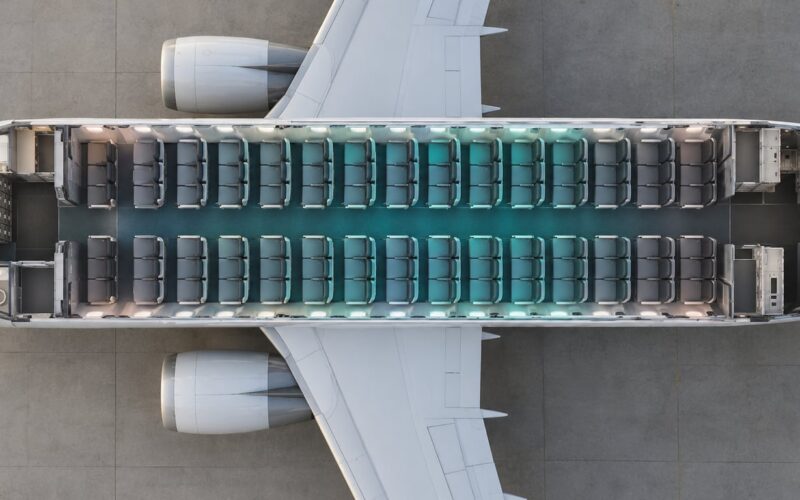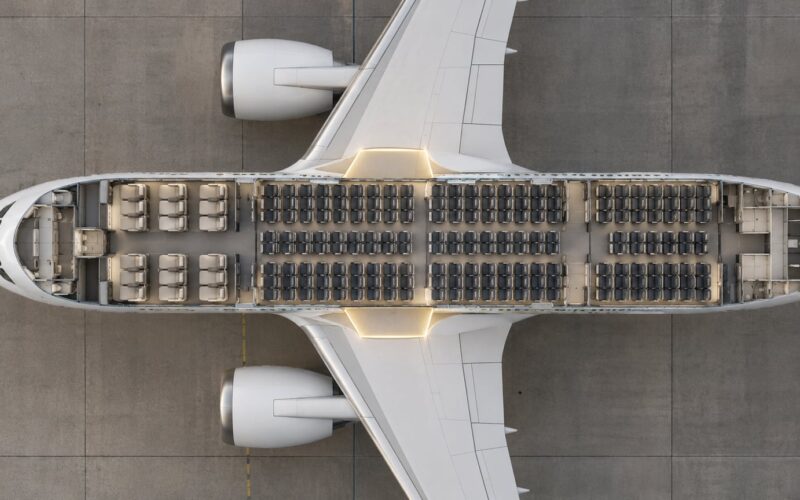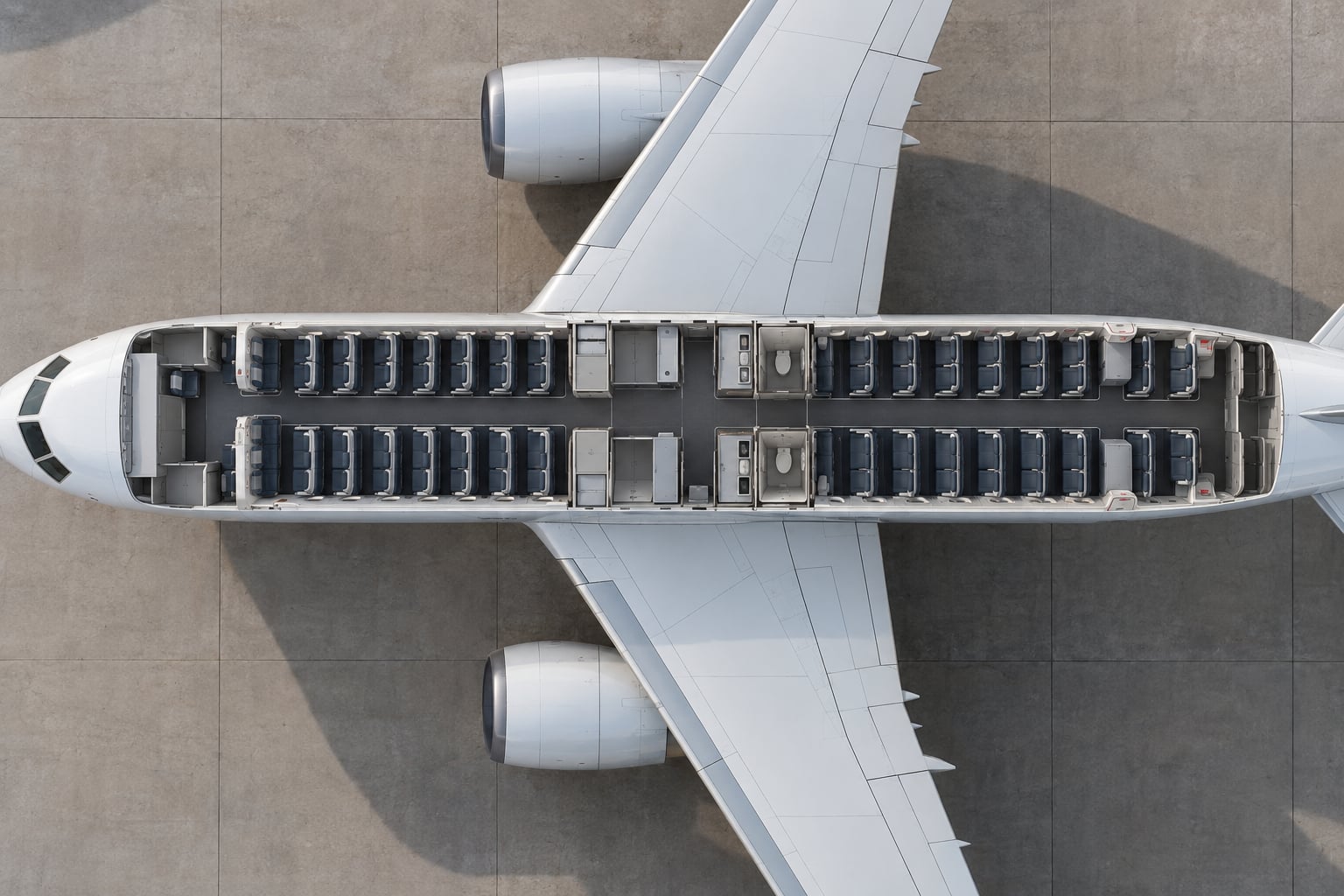
The quietest seats on any given airplane sit ahead of the wings, in the front third of the cabin. The loudest row is the one directly behind the wing, because that is where the underwing engines are closest to your head. Window versus aisle, and left versus right, change the noise far less than your position relative to that wing does.
That much is consistent across every aircraft type I have looked at. What changes is where exactly the wing starts, where the galleys and lavatories sit, and how far back the quiet front section runs. On a 33-row Boeing 737-800 with the wing ending around row 21, the usable quiet zone is roughly rows 5 through 15. Someone reading a generic guide will get that wrong on half the aircraft they fly.
I keep coming back to the same point when this question comes up: a seat map shows you geometry, not noise. Two seats can be the same distance from the wing and sound completely different because one is beside a galley door and the other is not. So treat the ranking below as a starting position, then check it against the aircraft you have actually been assigned.
Table of Contents
- Which Seats Are Quietest on an Airplane?
- What Makes Some Airplane Seats Noisy?
- Engine noise and airflow
- Galley, lavatory and passenger noise
- Window, Aisle, or Middle Seat: Which Is Quietest?
- Best Quiet-Seat Locations by Aircraft Type
- How to Find and Confirm a Quiet Seat Before Booking
- Quiet Seats in Economy, Premium Economy, and Business Class
- Your Quiet-Seat Checklist for the Next Flight
- Frequently Asked Questions
- Are the quietest airplane seats always near the front?
- Are seats behind the wings quieter than seats in front?
- Is a middle seat actually quieter than a window seat?
- Do bulkhead and emergency-exit rows have less airplane noise?
- Can I find out whether an airplane seat is quiet before booking?
- Do noise-cancelling headphones help with engine noise on a flight?
- Conclusion
Which Seats Are Quietest on an Airplane?
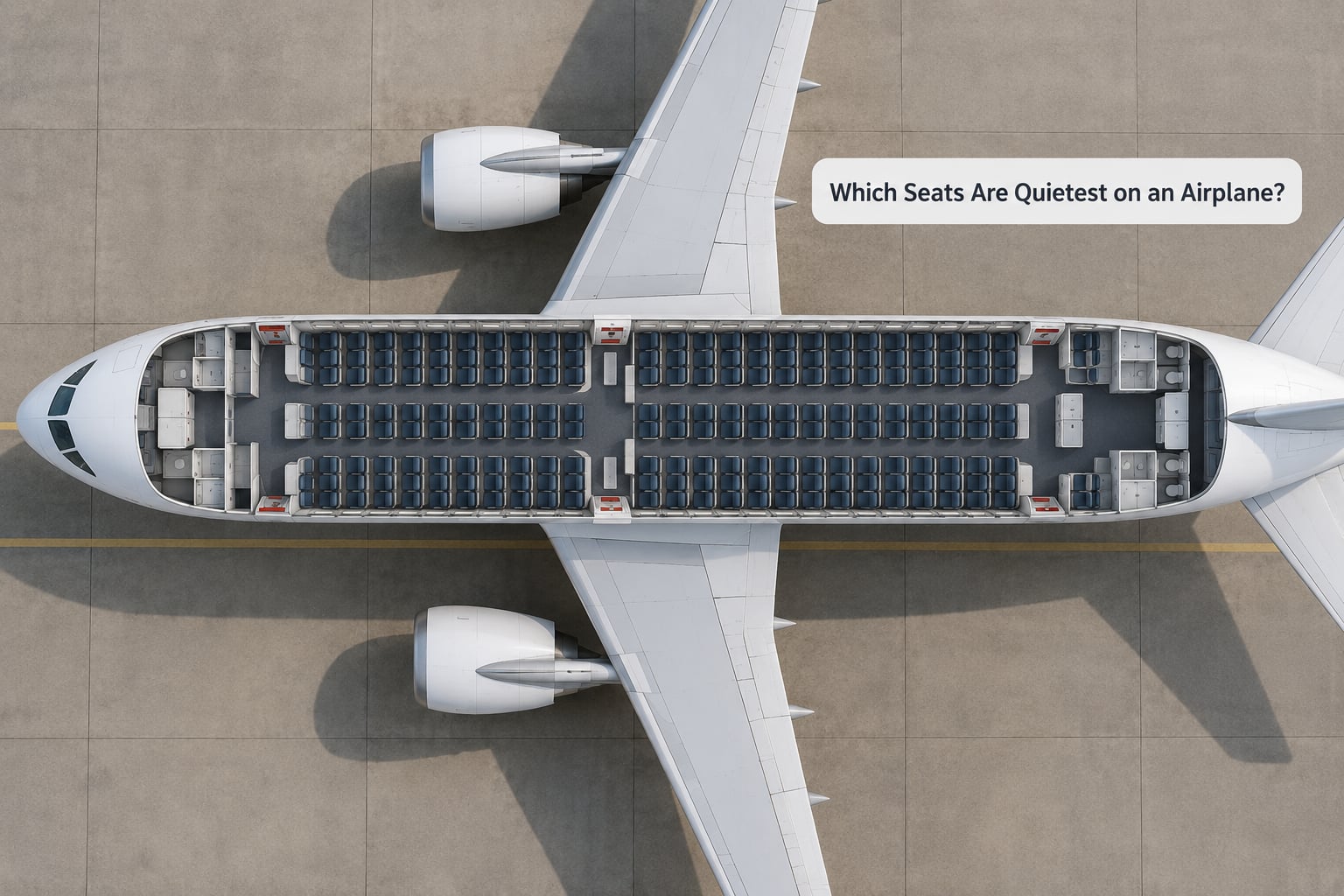
Here is the ranking, from quietest zone to loudest. Relative noise level is my own read of what changes cabin by cabin, not a measurement, so treat it as a comparison rather than a decibel figure.
| Cabin zone | Where it usually sits | Relative noise | Why | Best for |
|---|---|---|---|---|
| Front cabin, ahead of the wing | First third of the cabin, on most layouts rows 5 to 15 | Lowest | Engines are behind and below you, and the wing root and forward fuselage block much of the direct sound | Sleep, noise-sensitive flyers, working |
| Window seat near the wing leading edge | Just ahead of where the wing meets the fuselage | Low | Still shielded, and away from the aisle | Quiet sleepers who want the wall |
| Bulkhead row | Frontmost economy row, behind a partition | Low to moderate | Good on engine noise, but it becomes a congregation point for standing passengers and bassinet families | Short trips where nobody wants to crawl past |
| Over the wing | Usually two to four rows | Moderate, and the smoothest ride | Best ride quality in the cabin, but you sit directly above the engine and the wing | Turbulence-sensitive flyers, not noise-sensitive ones |
| Row behind the wing | One to three rows aft of the wing trailing edge | Highest engine noise | Directly downstream of the engines | Nobody, if noise is the priority |
| Lavatory and galley rows | Varies widely; often a pair mid-cabin and one aft | High and intermittent | Foot traffic, flushing, door movement, carts, announcements | Quick bathroom access if you need it |
| Last five to ten rows | Aft cabin, sometimes with an auxiliary power unit behind it | Moderate to high | Distance from the engines, added airframe flex, and often the aft galley and lavatories | Anyone wanting a quiet flight |
The single most useful rule of thumb is a row count: aim for at least five rows ahead of the wing’s leading edge, and eight or more if the flight is overnight and you plan to sleep. That rule survives equipment changes better than a specific seat number does.
What Makes Some Airplane Seats Noisy?
There are two kinds of cabin noise, and they behave differently. Continuous noise is the low engine hum and airflow you cannot switch off. Intermittent noise is the flush, the cart, the announcement and the neighbour’s phone call. Sleeping is mostly a fight against the second kind, which is why the front cabin wins even where engine noise levels are closer than most people expect.
Engine noise and airflow
Twin-engine airliners hang their engines beneath the wings, usually well ahead of and outboard from the wing root. Noise from those fans is thrown backwards and outwards along the airframe, which is why the nose section tends to be the acoustic refuge and the row behind the wing is not.
A second, quieter source is airflow over the fuselage. It rises with speed, so the same seat gets noticeably louder during climb and descent than in cruise. The rear cabin also picks up more airframe flex as the airframe works, and rear sections on some aircraft sit close to the auxiliary power unit that runs on the ground.
Galley, lavatory and passenger noise
The galley is a small kitchen with a kettle, a coffee machine and service carts. It runs through most of the flight, and a seat beside it hears a pot of water, a cart wheel and a cabin crew conversation in a small metal box. This is the noise that most often ruins an otherwise good seat.
Lavatories add their own layer: a queue in the aisle, a door that slides, a flush that is louder than it has any right to be, and running water. Two seats flank a lavatory door and hear all of it.
Then there is the cabin itself. Conversation carries surprisingly well, small children do not stop because of proximity to the wing, and overhead bin closing is a percussive sound that resets sleep. Window seats are insulated from most of that by two seatmates and a wall. That is the quiet advantage nobody frames correctly, because it is not about decibels at all.
Window, Aisle, or Middle Seat: Which Is Quietest?
Honestly, it depends on what noise you are defending against. If it is engine hum and airflow, all three positions in the same row are almost identical, because the source is outboard and below. If it is interruption, the ranking changes completely.
| Seat position | Engine and airflow noise | Foot traffic | Interruptions from seatmates | Sleep suitability |
|---|---|---|---|---|
| Window | Low, with the fuselage wall between you and the engine | None | Lowest; nobody needs to pass | Best, if you can get settled without waking your neighbours |
| Middle | Low | None | Two neighbours; either can lean or shift | Reasonable, but a wider surface to wake both of |
| Aisle | Comparable; some airflow at the door | Highest | Highest; shoulder taps and every lavatory trip | Worst for light sleepers, best for stretching and quick exits |
The middle seat is the sleeper’s compromise. Nobody walks past it, you get a wall on one side, and you only have one person to negotiate with instead of two. On a narrow-body 3-3 layout the middle is a genuinely good answer to this question, and it is the one most guides skip.
If noise sensitivity is the main reason you are asking, add a second layer. Over-ear noise-cancelling headphones handle the low engine hum well, but they do nothing about a cart or an announcement, which is what usually wakes people. Silicone or foam plugs under them cover the rest. If you have hyperacusis or are recovering from a hearing injury, test both combinations at low volume on a short flight before you rely on them for an overnight.
Best Quiet-Seat Locations by Aircraft Type
Layouts differ enough that the zone boundaries move, but the direction of the answer does not. On a standard narrow-body in 3-3, the engines sit under the wing in the middle third of the cabin. The quiet zone is rows 5 to 15, the row behind the wing is rough, and the last five rows often contain an aft galley and a lavatory pair.
Wide-bodies in 2-4-2 give you more choice, because the outer two seats are wall seats and the middle block is wide enough that a middle seat is genuinely comfortable. Aft lavatories on a wide-body are frequently more than one pair, so the last ten rows deserve real suspicion. People on Airliners.net’s forum threads comparing cabin noise tend to praise the Boeing 787 and the DC-9 for exactly this reason: newer acoustic linings, and in the DC-9’s case an engine that sits far aft and high on the tail.
Regional jets and turboprops are a different problem, and no ranking carried over from a mainline jet will help. A turboprop puts a propeller a few feet from your head, and the noise is broadband, rhythmic and loud in a way jet noise is not. Propeller blades pass closest to the cabin near the wing, so the front rows and the rear rows are both more tolerable than the seats over the wing. Regional jets are cramped, which concentrates every sound source into a shorter distance. If noise is the deciding factor on those routes, change aircraft rather than change seats.
Wide-body row numbering also restarts in places. Business or premium economy cabins occupy their own block, then economy resumes at a lower number, and some airlines skip row 13 entirely. That is why a seat number alone tells you almost nothing about noise.
How to Find and Confirm a Quiet Seat Before Booking
Confirming a quiet seat takes about five minutes if you approach it in the right order. Most people do it backwards, staring at seat letters and guessing.
First, confirm the aircraft type in the booking, not the marketing name of the fare. The same airline flies a 737, an A320 and a wide-body on the same domestic trunk, and the quiet zone sits in a completely different place on each.
Second, open the seat map and find the wing. On most airline maps the wing icon or a darker block shows the wing position. Count five rows forward from the leading edge of that icon. Anything in that band is a defensible pick.
Third, identify the lavatories and galleys. Seat maps usually show a gap or a symbol where they are, and a floor plan on the airline’s site or in its app often helps. Any seat sharing a gap with a lavatory or galley comes off your list.
Fourth, decide window or aisle based on your threat model. Noise-sensitive and light-sleeping passengers take the window; anyone who needs to move, or who travels with a child who might, takes the aisle and accepts the traffic.
Finally, go back at check-in. Online check-in opens 24 hours before departure, and that is the first moment unclaimed seats release. Frequent flyers on r/Flights point out the other half of this: check-in is also when an assigned seat can be taken away from you, so if you paid for the seat or fought for it, verify it in the app and again at the gate. Aircraft swaps happen, and a Boeing 737 announced the night before can turn a clever row 12 into a punishing one.
Quiet Seats in Economy, Premium Economy, and Business Class
The same location logic applies in every cabin, because the engines and the galley do not move. What changes is how much the cabin walls help you. Premium economy and business class sit in enclosed structures with thicker sidewalls, better acoustic lining, more seat pitch and fewer passengers per row, so a business class seat behind the wing is often quieter than an economy seat ahead of it.
That is worth saying plainly, because it corrects a common assumption. Business class is not automatically quieter. In a 1-2-1 layout the cabin is quieter in relative terms because the middle seat is empty of strangers and curtains separate the zones, not because the noise source moved. A premium cabin positioned behind the wing still has engines overhead.
Premium economy cabins sometimes sit forward of the wing on wide-bodies, which makes them the best quiet-per-dollar position on that aircraft when they are available. Check rather than assume, because airlines place them wherever the structure allows.
Your Quiet-Seat Checklist for the Next Flight
Run through this before you pay for anything.
- Confirm the aircraft type in the booking.
- Find the wing on the seat map and count five rows forward of its leading edge.
- Cross out every seat adjacent to a lavatory or galley gap.
- Drop the row directly behind the wing and the last five rows unless you need a short walk to a lavatory.
- Take a window seat for sleep, an aisle seat if you need to move, a middle seat if you are stuck in 3-3 and want a middle ground.
- Re-check at check-in and at the gate for equipment changes.
- Bring a second layer: noise-cancelling headphones over earplugs, or earplugs alone if over-ear cups press too hard on your ears.
One last trade-off worth naming. The smoothest ride on the aircraft is over the wing, and it is also one of the louder places to sit. If you are anxious about turbulence, prioritise the ride. If you are trying to sleep, take the noise. Those are two different questions and the answer should not be the same seat.
Frequently Asked Questions
Are the quietest airplane seats always near the front?
Usually, yes, but the useful version of the rule is a row count rather than a cabin section. Seats at least five rows ahead of the wing’s leading edge are consistently the quietest, because the engines sit behind and below you. The exact rows shift with the aircraft, and a wide-body premium cabin forward of the wing can beat a front economy row outright.
Are seats behind the wings quieter than seats in front?
No, the opposite. The engines hang under the wings on twin-engine airliners and throw noise backwards along the airframe, so seats ahead of the wing sit behind the acoustic shield and seats behind it sit in the engine’s direct wake. The row immediately aft of the wing is usually the loudest place in economy. Turboprops are the exception, where the rear can be calmer.
Is a middle seat actually quieter than a window seat?
For engine noise, barely; both sit inboard of the same sound source. For interruptions, yes, clearly. No passenger walks past a middle seat, nobody needs you to stand, and you have a seatback on one side. On a 3-3 narrow-body it is a solid sleeper’s compromise. The window seat wins only when two neighbours leaning and shifting wakes you up.
Do bulkhead and emergency-exit rows have less airplane noise?
They carry less engine noise, because both zones usually sit forward or well clear of the wing. The catch is congregation: exit rows draw standing passengers on landing, and bulkhead rows attract bassinet families, who then have whole rows moving around them. A forward bulkhead window seat can be excellent on a daytime hop and tiring on a red-eye.
Can I find out whether an airplane seat is quiet before booking?
Not precisely, but you can narrow it a lot. Check the aircraft type in the booking, find the wing on the seat map, and stay five to eight rows ahead of it. Then rule out seats beside any lavatory or galley symbol. No airline publishes verified quiet-seat data, so treat reviews as colour rather than evidence and expect the map to change if the aircraft is swapped.
Do noise-cancelling headphones help with engine noise on a flight?
They help a lot with the low, steady part. Active noise cancelling works best on low-frequency sound, which is exactly what a jet engine produces, so most of the constant hum disappears. They do almost nothing about the interruptions that actually wake people, so add foam or silicone earplugs underneath if a cart or an announcement is your problem.
Conclusion
Check the aircraft and the seat map before anything else, then pick a row at least five seats ahead of the wing’s leading edge with no lavatory or galley beside it. Take the window if you plan to sleep. Add earplugs under your headphones, because a seat position solves engine noise and nothing else.