You cannot sit in an exit row with a child because airlines treat exit-row seating as a safety role, not a comfort perk. Two separate rules apply: the child must meet the airline’s minimum age for that seat, and the accompanying adult is excluded when they are responsible for an infant or small child. In an evacuation the person in that row works the door first, and they cannot do that with a toddler on their lap.
As of 2026, there is no universal number. Published carrier pages range from a minimum age of 12 up to 16, and several airlines go further by blocking the whole travelling party. That is why a parent can book an exit row online and then get moved at the gate.
Below is what the individual airline rules actually say, which seats in an exit row are restricted, and what to do if you find out too late.
Table of Contents
- What Counts as an Exit-Row Seat?
- Why You Cannot Sit in an Exit Row With a Child
- The child’s own age minimum
- The accompanying adult’s caregiving duty
- The lap infant ban
- Airline Exit-Row Age and Ability Rules
- Beyond age: the other three tests
- Can a Child Sit Next to an Eligible Adult in an Exit Row?
- What Duties May an Exit-Row Passenger Need to Perform?
- Why the Rules Differ by Airline and Aircraft
- How to Check and Change Your Seats Before the Flight
- Frequently Asked Questions
- At what age can a child sit in an airplane exit row?
- Can a parent sit in an exit row while their child sits in the aisle seat beside them?
- Does an airline have to move a family out of an exit row at the gate?
- Can a child with a disability sit in an exit row?
- What if I did not notice the exit-row restriction when booking?
- Can an infant or lap child be accommodated in an exit row?
- What to Do First
What Counts as an Exit-Row Seat?
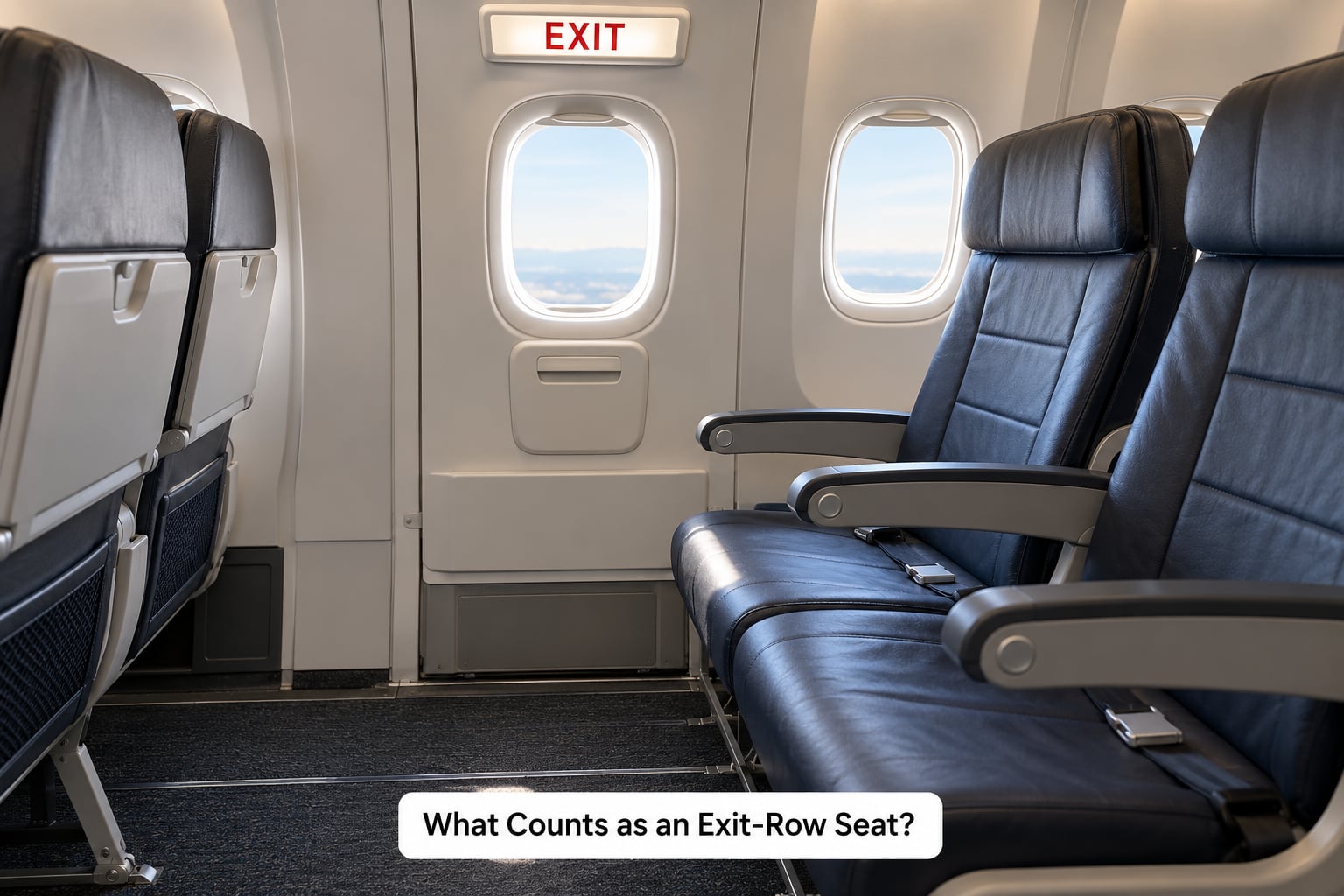
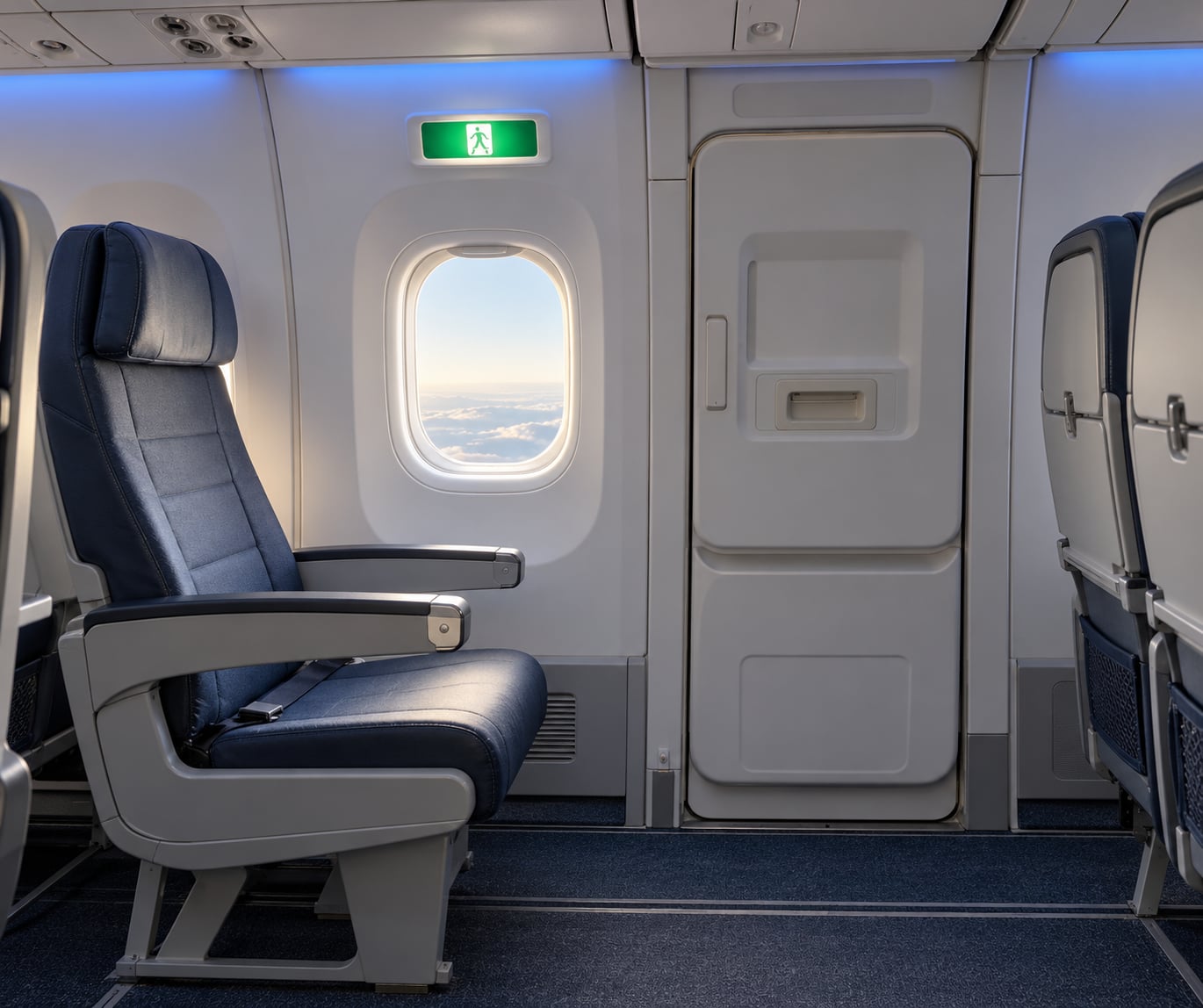
An exit-row seat is any seat in the row that sits directly beside a Type III emergency exit, which on most aircraft means the overwing pair of rows marked by the floor-level lighting and the exit sign above the window seat. It is not the same thing as the row behind the exit, and it is not the same as a bulkhead row.
Three different things get confused here. The exit row itself has more legroom and a door or hatch right beside it. The row in front of it usually has a standard seat pitch and no exit, so nothing about it requires special eligibility. A bulkhead row has extra space and no seatback in front, but no exit either, so it carries no exit-row restriction at all.
What makes the exit row different is the expectation attached to it. The occupant may be asked to open the door, hold the slide, or direct other passengers, so airlines screen who sits there before boarding.
Why You Cannot Sit in an Exit Row With a Child
Because exit-row passengers are screened for one thing above all else: whether they can do the job unaided, on their own, quickly. Airlines apply that screen to the whole party, and a child changes the answer in three separate ways.
The child’s own age minimum
Most carriers set a floor age for anyone in the exit row, independent of who they are sitting with. Ethiopian Airlines bars children under 15 from exit rows outright. A child who meets that number is still not automatically allowed, because the next two tests apply.
The accompanying adult’s caregiving duty
This is the rule that catches people out, and it is the one that answers the literal question. Ethiopian’s published criteria list having no caregiving responsibilities for small children among the exit-row conditions. Ryanair phrases it more bluntly: you may only sit in an emergency exit seat if you are 16 or older and travelling without an infant. So even a fully eligible adult gets moved when the reason they would slow down in an evacuation is a child they are looking after.
Parents on airline forums describe the practical version of this. One carrier’s policy as recounted on r/delta treats an itinerary with under-16s on it as disqualifying for the exit row across the booking, which is why some families report splitting reservations. That behaviour is reported anecdotally rather than published, so check the airline’s own page rather than trusting a forum thread.
The lap infant ban
An infant on the lap is a third, separate bar. The adult’s hands are occupied for the entire flight, which is exactly what the exit row assumes will not be the case. Travelling without an infant is listed as a condition in Ryanair’s help centre, and passengers with infants are named in Ethiopian’s list of prohibited categories.
Airline Exit-Row Age and Ability Rules
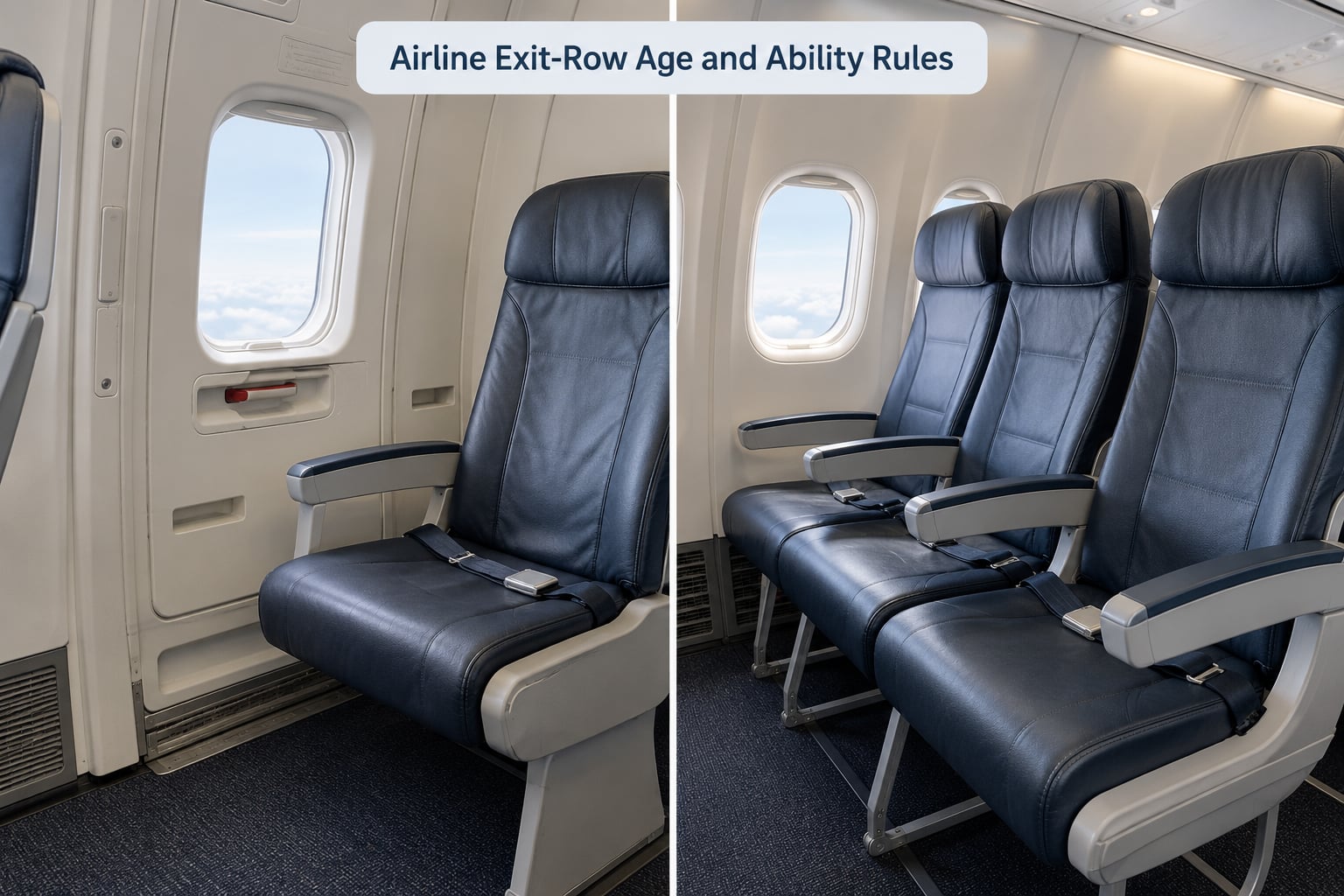
Minimum ages fall roughly between 12 and 16 depending on the carrier, and there is no threshold that works everywhere. Read the table below as a starting point, then confirm with the operating airline before you book.
| Airline | Published minimum age | Note on accompanying children |
|---|---|---|
| Ryanair | 16 or older | Must also be travelling without an infant |
| Finnair | 12 or older | Must speak and understand English or Finnish |
| Ethiopian Airlines | 15 or older | Children under 15 barred; no caregiving responsibility for small children |
| British Airways | Over 12 | Policy wording is “older than 12”, which matters on the exact day |
| easyJet | Check published policy | No fixed figure captured for this article |
| US carriers (Delta, United, American) | Generally 15 or older | Frequently extend the bar across the whole reservation |
| Southwest | Reported as more permissive | Families report being seated together in the exit row |
Three details catch families out in that table. British Airways is quoted as “older than 12”, and a HeadforPoints thread documents a parent whose child was 12 years and 359 days old being caught by the wording. Some US carriers block every passenger on a booking that includes a minor, so a 17-year-old can be moved because a 10-year-old is on the same reservation. Southwest is the outlier repeatedly reported as seating parents and children together in the exit row, which is worth knowing about before you rely on it for a specific aircraft.
Beyond age: the other three tests
Age is only the first filter. Ethiopian’s published exit-row criteria also bar passengers with reduced mobility and passengers with blindness, on the grounds that the physical and comprehension demands are not compatible with the role. A language test sits alongside the age test at some carriers: Finnair requires the passenger to speak and understand English or Finnish. That requirement follows the operating language of the aircraft, so a route flown by a different crew or a different aircraft can apply a different test to the same seat.
Can a Child Sit Next to an Eligible Adult in an Exit Row?
Usually no. A child under the airline’s minimum age is barred from every seat in the exit row, not just the window seat beside the door. A TripAdvisor Air Travel Forum post states the rule this way: no children in the exit row at all, and not only the window position.
The practical answer is that moving the adult out of the row does not rescue the child’s seat, because the restriction attaches to the seat, not to the pairing. If a child cannot occupy an exit-row seat, that seat is closed to the child whether the adult beside them is eligible, ineligible, or on a separate reservation.
Where it gets fuzzy is the crew’s discretion at the door. Some passengers report being left in place, others report being moved in front of the cabin with no explanation. That inconsistency is not permission, it is variation between gate agents and crew.
What Duties May an Exit-Row Passenger Need to Perform?
An exit-row passenger may be asked to handle the exit unaided, and a carrier can require them to confirm they are willing and able to do it. Ethiopian Airlines publishes the clearest version of that list, and it is the useful yardstick for judging whether you or your child qualifies.
- Understand the safety briefing and instructions given in the operating language
- Locate the exit release mechanism and the arming levers
- Open or close the door or overwing hatch
- Hold the hatch in position, which on some aircraft weighs up to 35 kg, or 77 lbs
- Deploy and stabilise the escape slide before anyone uses it
- Direct and assist other passengers in moving away from the aircraft
- Follow crew instructions quickly and without argument
Not every aircraft and not every carrier demands all seven. The point is that each task assumes two hands, full attention and no one to look after. That is the assumption a toddler breaks.
There is a real trade-off here, and experienced fliers make it deliberately. You get noticeably more legroom, sometimes priority boarding, and a fast route out. You give up a reclining seatback, you lose under-seat storage that you need to clear for takeoff and landing, and you take on a responsibility you did not ask for. Plenty of experienced travellers avoid the row for that reason alone.
Why the Rules Differ by Airline and Aircraft
Because the rule is written by the operator of the aircraft, not by a single regulator. An airline sets its own minimum age, its own language requirement and its own crew verification procedure inside the boundaries of the aviation regulations that apply to it. A US domestic operation, a UK operation and an operation between EU states each operate under their own regulatory frame, so the wording and the number differ.
Aircraft type matters too. The exit position, the hatch weight, the number of rows that count as an exit row, and whether an additional seat is blocked for crew movement all vary by type within the same airline’s fleet. A seat map from a third-party site is a starting point for browsing, not a guarantee of what crew will allow at the door.
How to Check and Change Your Seats Before the Flight
The cheapest fix is to settle the seat question before you pay for anything, because the awkward conversations all happen at the gate. Here is the order that tends to work.
- Open the operating airline’s own exit-row policy page and read the eligibility list. This is the only source anyone treats as authoritative.
- Confirm who is operating the flight. A codeshare can put you on a different carrier’s aircraft under a different policy.
- Book your party into seats together in a row that is not an exit row, rather than booking exit seats and hoping. Check every seat number on the confirmation.
- If you want extra legroom, look one row forward of the exit row instead. You keep most of the pitch without carrying the responsibility.
- If you have a child who is close to the minimum age, measure in days rather than years, because some policies say “older than” rather than “or older”.
- Check in early and confirm the seat assignment with the agent before the boarding queue forms.
- At the gate, if you are moved, ask which seat you are in and whether the seat selection fee is returned. Airlines are inconsistent on that refund, so ask rather than assume.
If the child needs a car seat or child restraint, that also rules out an exit row seat in most cabins, since there is nowhere to install one. An unaccompanied minor service usually requires a standard seat as well, and the minimum age for travelling alone is a separate set of rules per airline.
Frequently Asked Questions
At what age can a child sit in an airplane exit row?
There is no single answer. Published minimums range from 12 at Finnair to 16 at Ryanair, with Ethiopian Airlines at 15 and most US carriers at 15 or older. British Airways is worded as older than 12, so age in days can matter. Age is only the first test: language, physical ability and caregiving duties apply too.
Can a parent sit in an exit row while their child sits in the aisle seat beside them?
Rarely. A child under the airline’s minimum age is barred from every seat in the exit row, not just the window seat beside the exit. The restriction attaches to the seat rather than the pairing, so moving the adult out does not free the child’s seat. Some carriers extend the bar to the whole reservation if any minor is booked on it.
Does an airline have to move a family out of an exit row at the gate?
Yes, in practice. Gate agents and cabin crew verify eligibility at boarding, and if a child is too young or the adult has an infant or caregiving duty, the family is moved to another seat. How and how loudly that happens varies widely, which is why sorting the seat out online is much easier than sorting it out at the gate.
Can a child with a disability sit in an exit row?
It depends on the specific condition, and the airline makes the call rather than the passenger. Ethiopian Airlines, for example, lists passengers with reduced mobility and passengers with blindness among those not permitted in exit rows. If a child has a disability or assistance needs, contact the airline’s accessibility team before booking and ask about the seat directly.
What if I did not notice the exit-row restriction when booking?
Expect to be moved at check-in or at the gate, because the seat map lets families select exit rows it will not honour. Ask whether your seat selection fee is returned when you are reassigned; the answer varies by airline and is worth requesting on the spot. Seat one row forward of the exit row instead if legroom is what you were after.
Can an infant or lap child be accommodated in an exit row?
No. Travelling without an infant is a listed condition for exit-row seating at carriers such as Ryanair, and passengers with infants are named among prohibited categories at others. A lap infant occupies both of the adult’s hands for the whole flight, which is the one thing an exit-row passenger cannot be. A car seat also rules the seat out in most cabins.
What to Do First
Open the operating airline’s exit-row policy page and read the eligibility list for your specific flight. If your child may be under the minimum age, or you are travelling with an infant, select a standard row together now rather than at the gate. One row forward of the exit row gives you most of the extra legroom without the responsibility attached.