Some rows have misaligned windows because the aircraft manufacturer cuts the fuselage windows at a fixed structural pitch, while the airline mounts seat rows on floor tracks at a pitch of its own choosing. Two grids set independently by two different companies drift apart as you move down the cabin, and exits, doors, galleys and lavatories reset the drift again. Updated for October 2026.
That is the whole mechanism, and it explains why one row looks perfect and the row three seats behind it does not. A misaligned window seat is not a defect, a maintenance failure or a sign of a cheap aircraft. It is the arithmetic of a pressurised tube with fixed holes in it and a floor with rails that accept whatever spacing the airline is paying for.
What follows is the version of the answer flyers actually want: what misaligned means in practice, which rows drift and why, how to check a specific row before you commit to it, and what to do if you have already booked the awkward one.
Table of Contents
- What Does a Misaligned Window Mean?
- The three versions of a misaligned window
- Why Some Rows Have Misaligned Windows
- Why the drift is uneven from row to row
- How Airplane Windows and Seat Rows Are Positioned
- Which Aircraft Features Create the Offset?
- 1. Overwing emergency exit rows
- 2. Exit door rows and door plug rows
- 3. Galley and lavatory modules
- 4. First and last rows
- 5. Retrofit and densification programmes
- 6. Regional jets
- Why Do Some Seats Line Up Better Than Others?
- How to Check Window Alignment Before Booking
- 1. Identify the aircraft, not just the route
- 2. Find the specific registration when you can
- 3. Read passenger photos for that frame
- 4. Use the airline’s own seat map as a clue, not a verdict
- 5. Ask at check-in or at the gate
- Can You Fix or Avoid a Misaligned Window?
- Before you book
- When you are already sitting in the bad row
- Frequently Asked Questions
- Are misaligned airplane windows a sign of poor maintenance?
- Why are airplane windows not aligned with seats?
- Why is the window beside my seat slightly forward or backward?
- Does every passenger in the same row have the same window alignment?
- How can I tell whether a seat has a well-aligned window before booking?
- Can an airline change the position of a window for one passenger?
- Conclusion
What Does a Misaligned Window Mean?
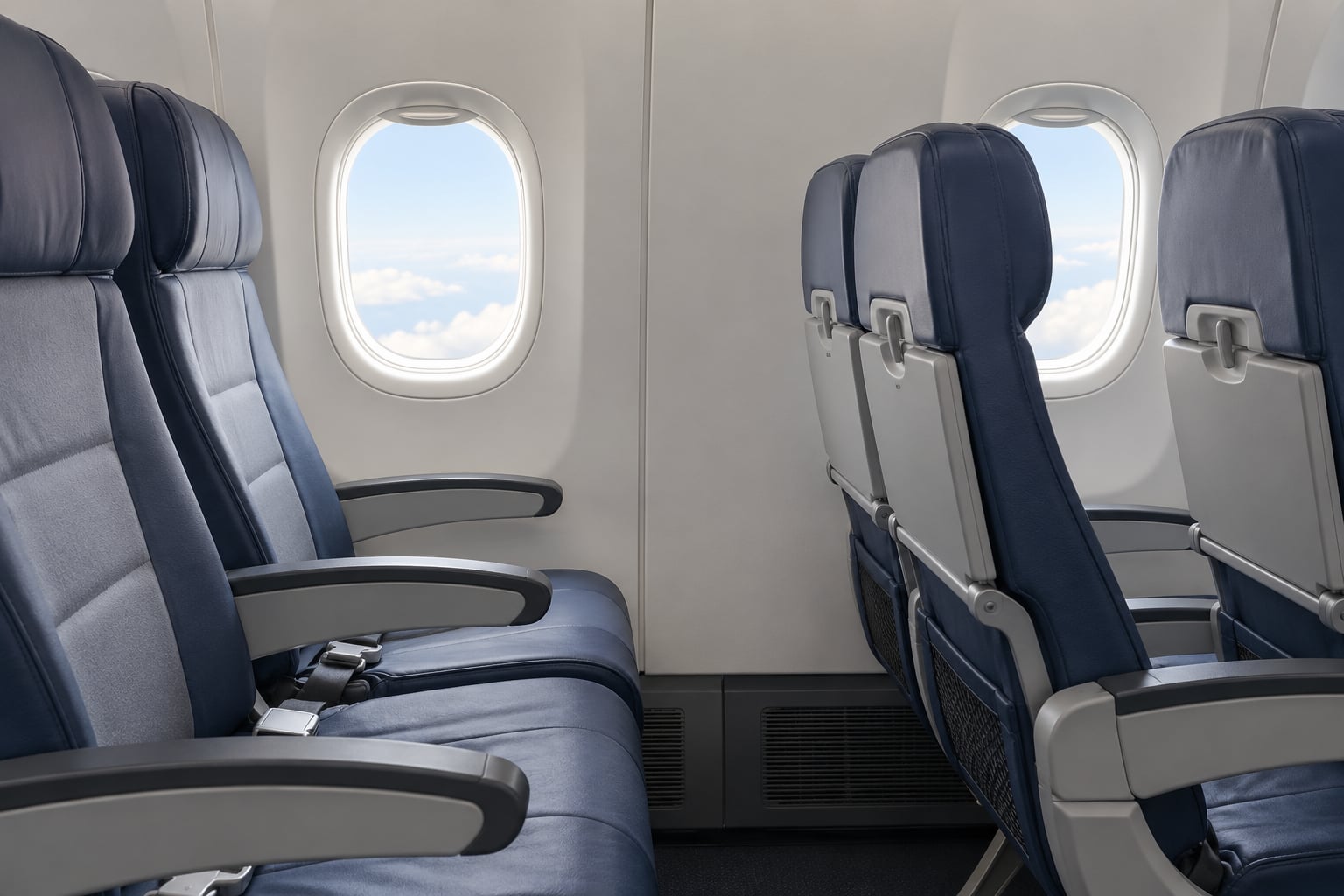
A misaligned window is a window that does not sit beside your shoulder. Usually it falls between two rows, so half of it is behind your seatback and half is behind your neighbour’s, and you end up leaning sideways to catch it.
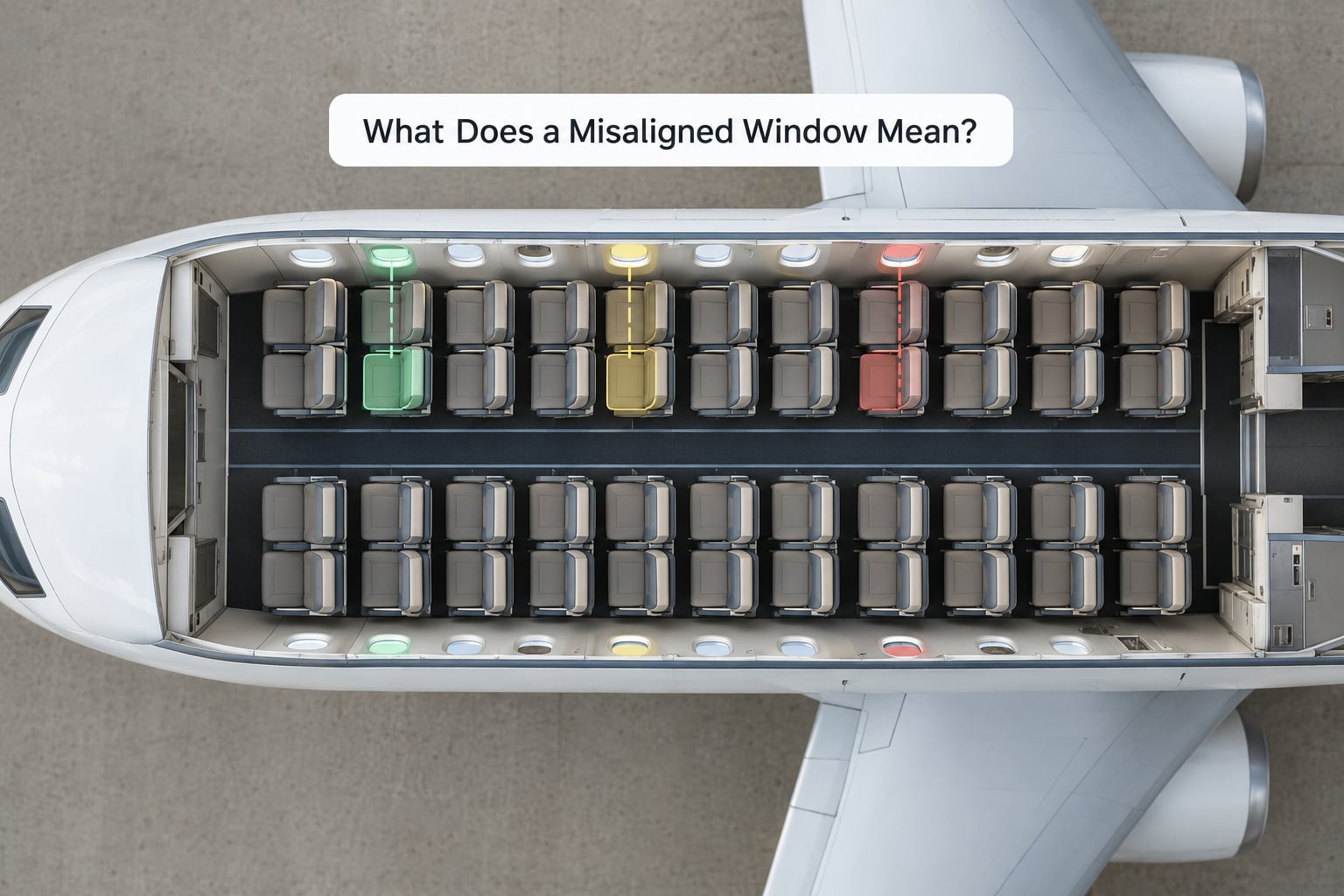
Passengers describe three distinct versions of the problem, and they are worth telling apart because the fixes differ.
The three versions of a misaligned window
- The split window. The window centre lands on the gap between two rows. You can still see out, but only by craning, and the seatback clips the view whenever you recline.
- The pushed-back window. The window sits noticeably behind your shoulder line, which is the common complaint in premium 1-2-1 layouts where the seat is wide and your torso sits further forward of the wall.
- The half window. A row has two windows but the seat map lists it as one, or the window you paid for is the smaller aft pane rather than the main one.
None of those is a broken window shade or a dirty pane. A defective shade stays put when you move your head and simply does not slide; a dirty pane still has the same relationship to your seat. Misalignment is about position, and it will not change during the flight.
Why Some Rows Have Misaligned Windows
Windows are set by the people who build the aircraft. Seats are set by the airline that buys it. The two decisions sit in different companies, different design offices and different decades of commercial pressure, and nobody reconciles them row by row because nobody has to.
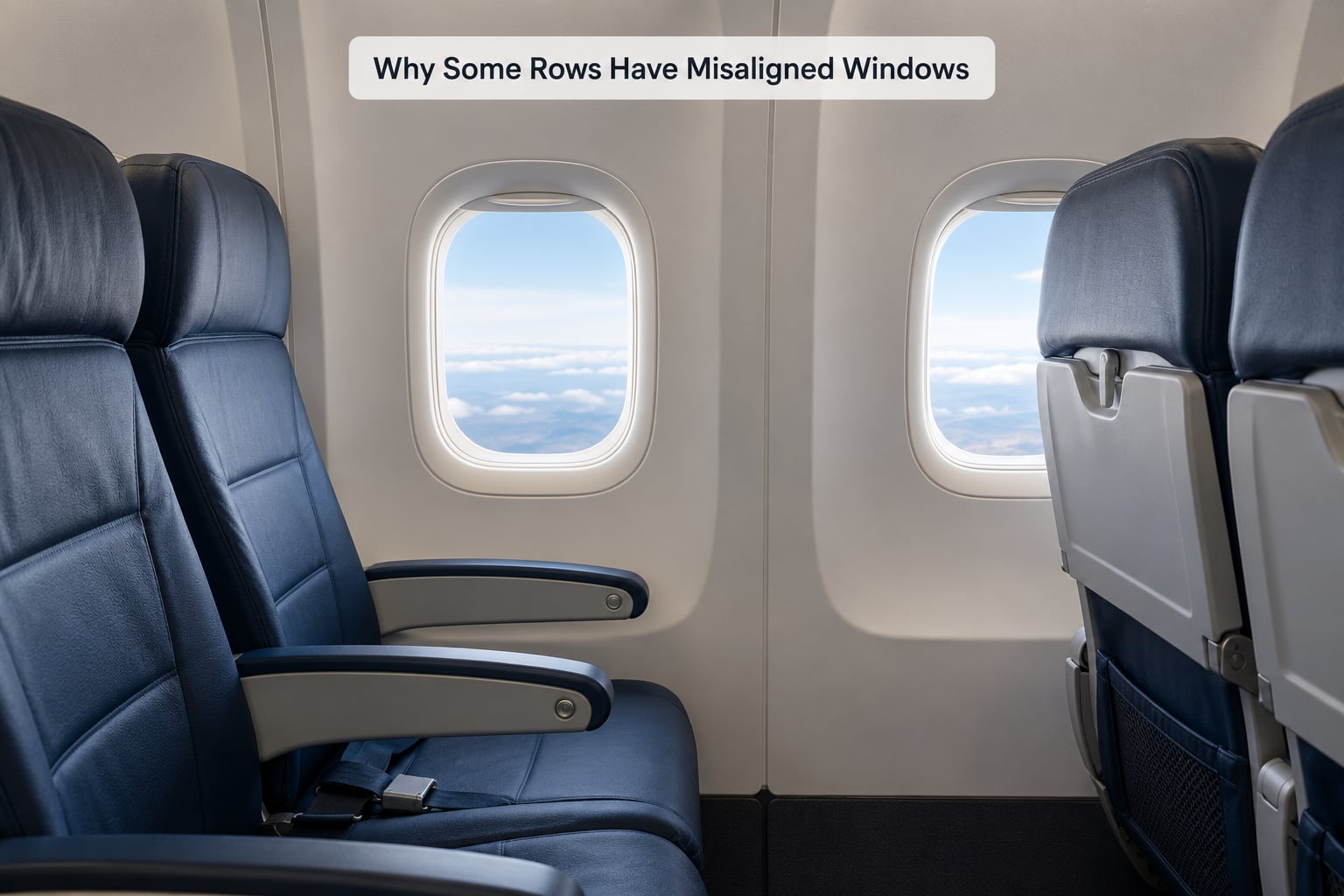
The manufacturer’s constraint is hard. Fuselage windows are cut into a pressure vessel that is already certified, so their positions follow the frame stations rather than the seating plan. Change one and you are re-running structural analysis, re-testing the window cutout and paying to re-certify the joint.
The airline’s constraint is soft. Seat rows bolt into seat tracks on the cabin floor, and the airline picks the spacing based on how many rows it can sell. Tighten the pitch from 32 inches to 30 inches and the same cabin gains rows, and those rows land wherever the arithmetic puts them relative to the fixed holes in the side of the plane.
So misalignment is not random and it is not uniform. It is a phase drift between two repeating patterns, which means it accumulates slowly through a cabin that keeps one pitch and then jumps suddenly wherever the layout has to stop, start or step aside.
Why the drift is uneven from row to row
A row of seats at a perfectly repeating pitch compared with windows at a slightly different repeating pitch produces a mismatch that repeats with a long cycle. Seat rows are not laid down in an unbroken line from nose to tail. They break for a galley, they break for a lavatory module, they break at an overwing exit where the row count drops from three seats to two, and they break at a door plug. Every break is a reset point, and the pattern of resets is different on every aircraft in the fleet.
How Airplane Windows and Seat Rows Are Positioned
Window pitch is the centre-to-centre distance between fuselage windows, fixed during manufacture. Seat pitch is the distance between seat rows, chosen by the airline and set by where each seat’s legs land on the floor tracks.
On a typical narrowbody the windows sit roughly 20 inches apart. Economy seat pitch on the same aircraft commonly runs between 30 and 32 inches. Those two numbers rarely share a common multiple, so each row drifts a little further out of phase than the one in front of it, and a handful of rows come out close enough to aligned to look deliberate.
| Measurement | Who sets it | Typical range | Can it change |
|---|---|---|---|
| Window pitch, narrowbody | Airframe manufacturer | About 20 inches centre to centre | No, structural |
| Window pitch, some widebodies | Airframe manufacturer | Varies by type, generally wider | No, structural |
| Seat pitch, economy | Airline | Roughly 30 to 32 inches | Yes, with a refit |
| Seat width, economy | Airline | About 17 to 19 inches | Yes, with a refit |
| Premium layout pitch | Airline | Wider than economy, wider drift | Yes, with a refit |
That table is the whole story in numbers. One of those rows cannot be edited after delivery without gutting the aircraft, and the other one is a commercial decision the airline can revisit at every interior refresh.
Historically the two grids did roughly agree. Early jet cabins were spacious, and windows were spaced with the expectation that a passenger in a standard two-by-two or three-by-two layout would get one window to themselves. As seating tightened row after row to add capacity, the seat grid moved while the window grid stood still.
Which Aircraft Features Create the Offset?
Six features account for most of the rows flyers complain about, and each one has a structural reason rather than an accident.
1. Overwing emergency exit rows
The wing exit forces the cabin to lose seats at that station, usually from three abreast down to two. The seat row pattern changes there and resumes in phase with itself afterwards, not with the window grid. This is the most reliably awkward stretch of any narrowbody, and it is also where the walls curve in most, which shrinks the usable window area.
2. Exit door rows and door plug rows
Wherever a full-size exit door interrupts a row, or where a door plug forces a seat out, the pattern breaks and restarts. Posters on the Emirates forum specifically avoided a Boeing 777-300 seat 7A after learning that window was misaligned, which tells you this is a named and known seat on that particular aircraft rather than a general rumour.
3. Galley and lavatory modules
Cabin service modules are fixed blocks that occupy fuselage length without containing seats. The rows either side of a galley or a lavatory stack have no relationship to each other, so the phase at row 24 can bear no resemblance to the phase at row 26.
4. First and last rows
The nose and tail areas are compressed by the flight deck, the galley and the tapering tail cone. Seat pitch there is often tighter than the standard cabin pitch, so drift starts immediately and accumulates faster than in the middle of the plane.
5. Retrofit and densification programmes
An aircraft delivered with a roomy cabin and later reconfigured with thinner seats has its entire seat grid re-laid. Rows that were once aligned stop being aligned, and rows that were once awkward can become acceptable. Advice about a specific row on a ten-year-old frame may describe a cabin that no longer exists on that registration.
6. Regional jets
Flyers report regional jets as the worst case. In the aviation forum, one poster’s summary of the Embraer 175 was that almost every operator runs a two-class layout and the windows are spaced further apart relative to the cabin width, so the alignment comes apart even more. The same post extends the point to the CRJ. Narrow cabin, wide windows, fewer rows, less room for a gradual correction.
| Row type | Why the alignment drifts | How noticeable |
|---|---|---|
| Overwing exit rows | Seat count drops and the pitch pattern restarts | Very |
| Exit door and door plug rows | Seats removed or shifted around the door | Very |
| Galley and lavatory rows | Non-seat modules break the row sequence | Moderate to very |
| First and last rows | Compressed pitch at the nose and tail | Moderate |
| Premium 1-2-1 window seats | Wide seats move the sitter’s torso forward of the wall | Moderate |
| Refitted aircraft rows | New seat pitch laid over an unchanged window grid | Unpredictable |
One row of folklore deserves a mention so you can discount it. The advice to never book an odd-numbered window seat circulates widely on Reddit, including a Delta thread telling readers in capitals to avoid them. It has no source and it does not survive contact with a real seat map, because nothing in the mechanism produces a rule based on the parity of a row number. Treat it as folklore.
Why Do Some Seats Line Up Better Than Others?
Two passengers in the same row can disagree completely about whether the window is aligned, and neither is imagining it. Alignment is measured against a body, not against the seat frame.
Your head sits above the middle of the seat cushion, not at the seat’s centreline on the wall. A window seat occupant naturally leans inward and forward to see out, which moves their head toward the cabin aisle and slightly forward, away from the window. If the window centre already sat slightly aft, the lean is what turns a mild offset into a badly offset one.
Seat width changes the geometry too. A 19-inch economy seat puts your torso closer to the wall than a 17-inch seat in the same row on the same aircraft, so a wide-cabin economy layout can look better aligned than a narrow one even when the window position is identical. That effect is why premium 1-2-1 layouts draw their own complaints: British Airways flyers on the A350 note that window seats across the aisle sit far apart and slightly off, because the seat is wide and centred further from the wall than the economy product.
Recline makes it worse for one person and better for another. Leaning back drops your head aft relative to the window; sitting upright and twisting forward brings it level. The same row can feel perfectly aligned to someone sleeping against the wall and completely wrong to someone trying to take a photograph.
How to Check Window Alignment Before Booking
No public tool reliably marks every misaligned window on every aircraft, because alignment is a property of an individual airframe and its current interior, not of the type. That is why FlyerTalk users maintain handwritten seat maps for specific registrations, and why the United forum’s 767-300 chart lists 7A and 17A as misaligned, 11A as having only one window, and 15A as having no forward window. Somebody sat in all of those seats and wrote it down.
Here is the order that actually works.
1. Identify the aircraft, not just the route
Check the aircraft type assigned to your booking. Airline fleet swaps happen, particularly on international routes, and a 737 outbound can be an A320 or a 737 MAX on the return.
2. Find the specific registration when you can
Fleet trackers and flight-tracking sites show the tail number assigned to a flight once the aircraft is planned. Search that registration alongside seat alignment terms and you will usually find a forum post, a photo review or a passenger trip report covering the exact cabin you are about to sit in.
3. Read passenger photos for that frame
Photos taken from the seat tell you more than any seat map. Look for shots taken straight ahead rather than straight out, because a photo taken forward from a window seat shows exactly how far the window is from your shoulder.
4. Use the airline’s own seat map as a clue, not a verdict
Many airline seat maps mark restricted view or limited recline. They rarely mark window misalignment, but they do flag the rows most likely to have it: exit rows, galley and lavatory rows, and bulkhead rows.
5. Ask at check-in or at the gate
Cabin crew fly the cabin. A polite question at the gate about which window seats line up well on that aircraft is a normal request and usually gets a straight answer, because they have boarded thousands of times and know where the good rows are.
Keep the operator in mind. Flyers repeatedly note that advice copied between threads is often wrong, because the same type in two different liveries can have two different seat configurations.
Can You Fix or Avoid a Misaligned Window?
You cannot move a window. A window aperture is cut into a pressurised fuselage and bonded into a certified surround; relocating one is a structural job measured in months, not a maintenance tweak. That is why no airline has ever re-phased its cabin to match the seats.
What you can do is choose, or cope.
Before you book
- Avoid overwing exit rows if the view is your priority, and note that these rows also have the tightest wall curve, so the usable window opening is smaller.
- Skip the first and last cabin rows unless you have a specific reason for wanting them.
- On a retrofit aircraft, search for recent seat map or trip report evidence rather than old advice.
- On regional jets, assume misalignment is the normal case and pick your seat on the strength of the specific frame.
When you are already sitting in the bad row
- Shift your seat position forward or back within the seat’s travel. Modern seats usually have several centimetres of fore and aft play, which is often enough to bring the window to your shoulder line.
- Sit upright and turn your head rather than leaning against the wall. It feels worse for ten seconds and then reads correctly through the whole flight.
- Ask a flight attendant whether the adjacent seat is empty before you settle. If it is, and the crew allows it, moving one seat across can put the window where you want it.
- Lower the shade to your elbow line rather than fully up or fully down, so the window sits inside your natural sightline.
It is worth saying plainly that this is a comfort issue, not a safety one. A window that sits between two rows changes what you see and how you lean. It does not affect the aircraft, the pressurisation or anyone else’s flight.
Frequently Asked Questions
Are misaligned airplane windows a sign of poor maintenance?
No. A window that sits between two rows is a layout outcome, not a defect. The aperture is exactly where the manufacturer cut it and it is certified in that position. Maintenance problems look different: a pane that flexes, a seal that lets cabin noise through, or a shade that will not travel.
Why are airplane windows not aligned with seats?
Because the aircraft manufacturer cuts windows at a fixed structural pitch while the airline mounts seat rows on floor tracks at a pitch it chooses for capacity. The two repeating grids drift out of phase along the cabin, and exits, doors, galleys and lavatories reset the drift at intervals. So why some rows have misaligned windows comes down to two companies setting spacing independently.
Why is the window beside my seat slightly forward or backward?
Small phase drift between the window grid and the seat grid. A typical narrowbody has windows about 20 inches apart and economy rows around 30 to 32 inches apart, so the relationship between the two repeats slowly and never settles. Where a galley or exit interrupts the seat sequence, the offset changes abruptly instead of creeping.
Does every passenger in the same row have the same window alignment?
No. Alignment is measured against where your head sits, and that depends on your torso position, seat width and how you lean. In a wide premium 1-2-1 seat your body sits further from the wall than in a narrow economy seat, so the same window can read as aligned to one passenger and badly offset to the one beside them.
How can I tell whether a seat has a well-aligned window before booking?
Work from the specific aircraft rather than the route. Check the assigned type, look up the tail number through a flight tracker, then search that registration for a trip report or photo review. Airline seat maps flag exit and galley rows, which are the weakest bets. At the gate, ask the crew, who know the good rows on that airframe.
Can an airline change the position of a window for one passenger?
No. A window is cut into the fuselage and bonded into a certified surround, so moving one means structural rework and re-certification. The seats are the adjustable half of the arrangement, which is why an airline can change pitch at a refit but the window grid stays exactly where it was delivered.
Conclusion
Some rows have misaligned windows because window spacing is fixed by the airframe and seat spacing is chosen by the airline, and the two rhythms slowly fall out of step until a galley, an exit or a door plug resets them. The window itself will never be moved, so your only lever is the row you pick.
Start with the seat map for the exact aircraft, then look for recent evidence about that tail number before you commit. If the row looks risky, avoid the overwing exit block and the rows beside the galleys, and treat any advice about odd-numbered window seats as folklore rather than fact.