Economy Plus is a paid extra-legroom seat product that lives inside the main economy cabin, usually a block of rows near the front with a little more space than the seats behind them. What you actually get depends on the airline, the aircraft, your fare and the route, and it can be as thin as extra pitch or as thick as extra pitch plus priority boarding, extra bags and lounge access.
I have flown enough long-haul economy legs to know that “extra legroom” is doing a lot of heavy lifting in that sentence. Some Economy Plus rows add real, noticeable inches. Others are a nicer spot to sit with the same space everyone else has. The trick is knowing which one you bought before you pay for it.
This guide covers what the label means, where airlines disagree, which benefits are common and which are marketing, and the practical checks that tell you whether the upgrade is worth your money.
Table of Contents
- What Is Economy Plus and What Do You Get?
- How Does Economy Plus Differ From Economy?
- Is Economy Plus the Same on Every Airline?
- Which Benefits Are Common in Economy Plus?
- More space and comfort
- Improved service and food
- Priority boarding and baggage
- Enhanced entertainment
- What Are the Downsides of Economy Plus?
- How Much Does Economy Plus Cost?
- How Can You Tell What You Get Before Booking?
- Frequently Asked Questions
- Is Economy Plus always a separate cabin?
- Does Economy Plus include checked baggage?
- Is Economy Plus guaranteed to have extra legroom?
- Can I select an Economy Plus seat for free with a fare?
- Is Economy Plus always available on every flight?
- Can I upgrade to Economy Plus at the airport?
- What to Check First Before Choosing Economy Plus
What Is Economy Plus and What Do You Get?
Economy Plus is an airline’s paid extra-legroom seat product inside the main economy cabin: a block of rows near the front with a little more space than standard economy. What you get depends on the airline, the aircraft, your fare and your route.
Four variables decide the rest, and they are worth separating before you go any further.
The airline sets the product. United sells Economy Plus as both a per-flight seat upgrade and an annual subscription. Plenty of other carriers sell a separate premium economy cabin instead and leave the main cabin alone, so the same search term can land you in two very different products.
The aircraft sets the space. A narrow-body like a 757 or an A321 has far less room to give away than a wide-body 777, and on some narrow-bodies the front economy rows are the only place the extra pitch exists at all.
Your fare brand sets the rules. Seat selection, changes and refunds are tied to the fare, not to the seat, and a cheap basic fare can change what you are allowed to do once you have paid for an upgrade.
The route sets the value. Ten hours over the Atlantic is a completely different proposition from a 90-minute hop, and international itineraries often have a different main-cabin product entirely.
The core promise never changes, though. You are buying space and position, and everything else rides along with it.
How Does Economy Plus Differ From Economy?
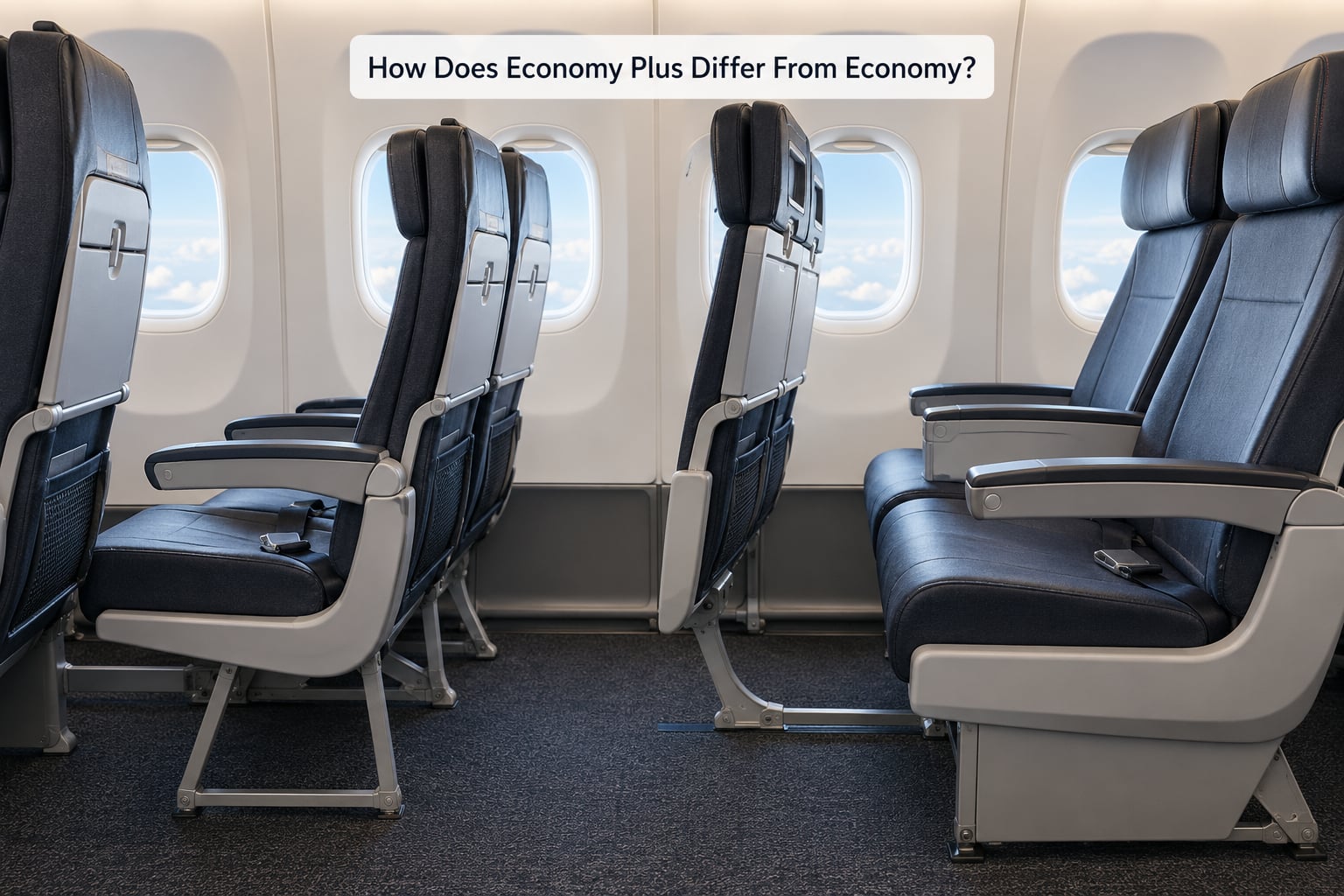
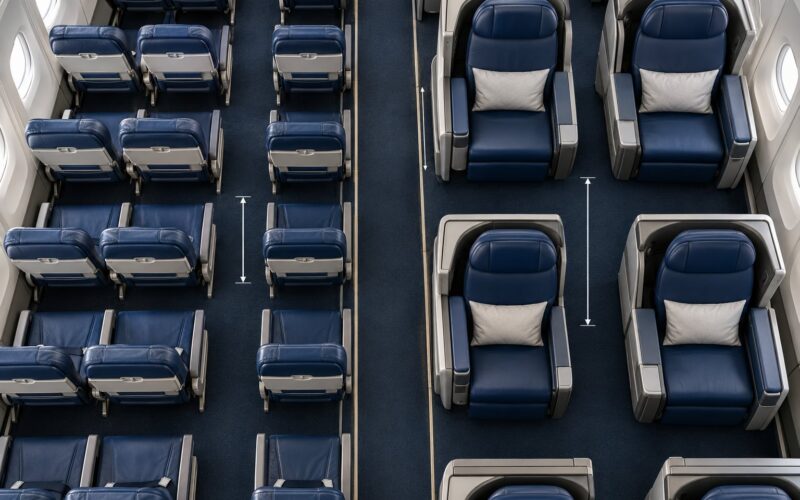
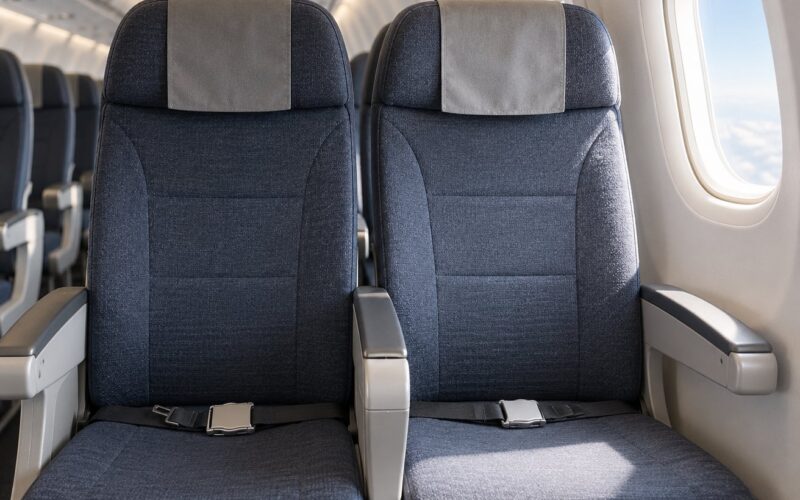
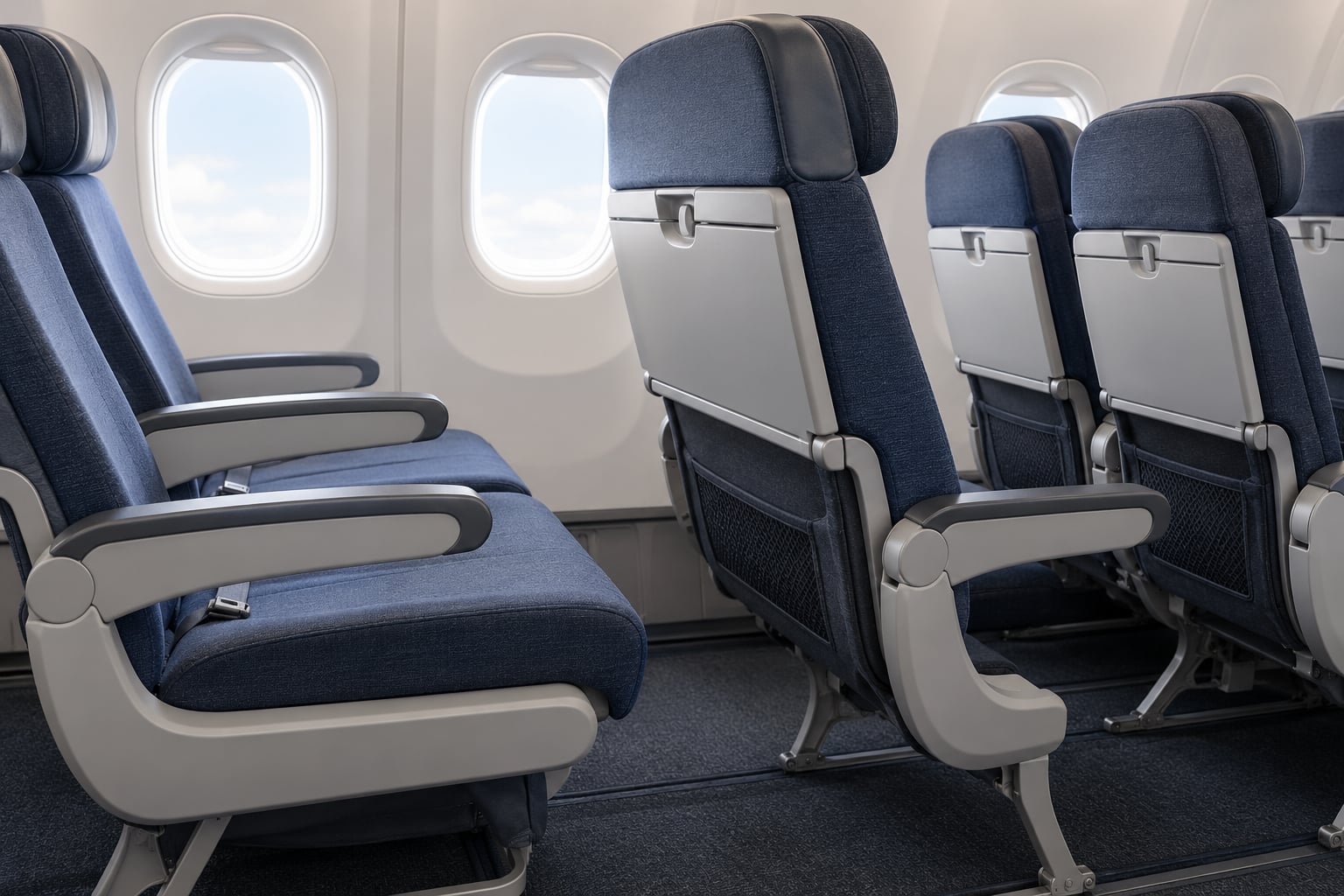
Standard Economy is a fixed product: one seat width, one pitch, one recline angle, whatever the cabin configuration allows. Economy Plus is not a different seat model. It is the same seat in a row that has been built out with extra pitch, and sometimes fitted with a wider cushion, a bigger tray table or a footrest-style leg rest.
That distinction matters more than it sounds. It is why an Economy Plus row on a small aircraft can be only marginally better than the row behind it, while the same product on a wide-body is a genuine upgrade.
| What changes | Standard Economy | Economy Plus | Premium Economy |
|---|---|---|---|
| Seat space | Baseline pitch and width for the cabin | Baseline plus a few inches of pitch, width varies by aircraft | Noticeably wider seat, deeper legroom, often a footrest or leg rest |
| Seat location | Behind the premium cabin, often at the back | Front of the main cabin, sometimes extending to the exit row | Own separate cabin with its own cabin crew |
| Recline and privacy | Standard upright-to-reclined range, upright in service | Usually the same recline as the cabin behind it | Wider seat, deeper recline, often a shell or divider for partial privacy |
| Storage | Under-seat bin, shared overhead space | Same, occasionally a larger footwell or shelf | Larger footwell, side console or tablet holder on many layouts |
| Food and drink | Buy-on-board on most domestic flights, included meal on many international | Same as economy on domestic; sometimes a free drink service on long international | Included meal, more snack options, non-alcoholic drinks often included |
| Boarding and bags | Depends on the fare brand | Priority boarding or an extra bag when bundled with a subscription or package | Priority boarding is normal; bag allowance follows the fare |
| Entertainment | Seat-back screen on most modern aircraft | Usually the same screen and content as the rest of economy | Screen, content and sometimes power or Wi-Fi included |
| Lounge access | Only with qualifying status or a purchased pass | Only with a qualifying subscription tier or bundle | Rarely included; usually still tied to status or a pass |
Treat that table as a pattern, not a promise. Seat pitch and width are configuration decisions that change with the aircraft and sometimes with the operator flying it, so the only reliable numbers are the ones on your own booking page.
Is Economy Plus the Same on Every Airline?
No. There is no industry definition of Economy Plus, and the label itself is mostly one airline’s trademark. Two carriers can use similar words for products that differ by eight inches of pitch and a completely different set of perks.
United is the clearest example because it sells two different things under two different names in the same aircraft. Economy Plus is extra legroom inside the main cabin. Premium Plus, called Super Economy on international routes, is a separate cabin with a wider seat, a deeper recline and, on many aircraft, a leg rest. Regulars on r/unitedairlines describe it plainly: Economy Plus is a regular economy seat with more legroom, while Premium Plus is closer to a domestic first-class recliner with a leg rest.
Other airlines take a different route entirely. Carriers such as Delta and American market a separate premium economy cabin rather than a mid-cabin extra-legroom block, so a search for Economy Plus on those airlines tends to land on a premium economy ticket rather than a seat upgrade. A few airlines use the term preferred seating for front-of-cabin seats, which is broader and can cover rows with no extra legroom at all.
Route type matters just as much. On many international itineraries the whole main cabin is configured with more space than the same aircraft flies domestically, so a seat that would be premium at home is ordinary abroad. The 2026 fare restructuring at United, which added new base and premium tiers and tightened how seats and bundles are sold, made this blurrier still: the fare you hold now often decides as much as the seat you sit in.
Worth remembering when you read a comparison written by someone else: check which airline, which aircraft and which route it describes.
Which Benefits Are Common in Economy Plus?
A few benefits show up almost every time. A longer list of extras shows up in airline marketing copy, and those change far more often than the core product does.
More space and comfort
This is the actual product. A few extra inches of pitch, a slightly deeper footwell, sometimes a wider cushion. On a narrow-body, that is the whole story. On a wide-body you may also get a footrest, a larger tray table and a small shelf or tablet holder.
Improved service and food
Not a given. On domestic flights, an Economy Plus passenger usually eats and drinks exactly what the row behind them eats and drinks, because there is no separate galley and no separate cabin crew. The exceptions are long international sectors, where some airlines serve a free drink in the front section of the main cabin and some premium-economy-adjacent packages include a drink credit.
Regulars on r/unitedairlines are blunt about this: if you are comfortable in a regular plane seat, save your money, because the upgrade is mostly about where you sit, not what you eat.
Priority boarding and baggage
These come from the fare or the bundle rather than from the seat itself. United’s Economy Plus subscription and its package options have historically bundled things like an extra standard checked bag, priority boarding through a subscription-linked status tier, a United Club trip pass and additional award miles, with the exact contents changing over time. The two package names that have circulated are an Essentials tier with the seat plus a bag, and an Enhanced tier that adds boarding perks, a lounge trip pass and mileage.
Two practical warnings on packages. They have not always been available on partner-coded itineraries, premium-cabin bookings or certain international routes. And their contents and refund rules get revised, so read the terms on the day you book rather than trusting a blog post from two years ago.
Enhanced entertainment
Rarely a real difference. The screen, the content and the power situation in Economy Plus are normally identical to the rest of the main cabin, and connectivity is usually a separate paid product. If a screen matters to you, check the aircraft rather than the cabin label.
What Are the Downsides of Economy Plus?
This is where most descriptions of the product get vague, so here is the honest version.
It costs real money for a real seat. You are buying inches of pitch, not a different trip. On a short flight the maths stops working quickly, and the cheapest possible Economy Plus fare can exceed the standard economy fare on the same flight by an amount that feels disproportionate for a two-hour hop.
Availability is never guaranteed. As the flight date approaches, the block of Economy Plus rows shrinks, and travellers who paid for a seat assignment can still find themselves reassigned when the cabin reseats. Families report being separated after paying. That is a real failure mode, not an edge case.
Recline is often the same as the cabin behind you. Plenty of Economy Plus rows use the same seat and the same recline as standard economy, and the person in front of you may still recline the same amount.
Privacy is unchanged. The seat next to you is still a stranger’s seat, the armrest is still shared, and the seat-back in front is still a seat-back in front.
Seat selection rules follow the fare, not the seat. A basic economy fare typically does not allow paid seat selection at all, which can mean an Economy Plus assignment behaves differently from the same assignment on a standard fare.
Overhead bins still fill up. Being in the front of the main cabin helps a little on a full flight, but it does not make bins larger.
Subscriptions have eligibility rules. The annual product generally covers eligible United-operated flights, and travellers report that it does not apply to partner-coded award bookings such as Aeroplan redemptions. If most of your trips are booked on partner metal or on awards, the subscription may be paying for flights you never use it on.
There is one more oddity worth knowing. United has publicly tested an Economy Plus layout that removes the middle seat and replaces it with open space and a shared table. It is an experiment rather than a product, but it shows where the idea is heading: more space and fewer strangers, in the row you already bought.
How Much Does Economy Plus Cost?
There is no single answer, and any page that gives you one is either stale or simplifying. The cost of an Economy Plus seat moves with route length, aircraft, how full the flight is, how far out you are booking, how many airlines are flying the city pair, and where in the cabin you sit.
The mechanics are more useful than a number, because they are what you can actually control.
A per-flight seat upgrade is priced by segment and generally scales with flight length and seat position, so the same seat costs different amounts on different legs of the same trip. Paying at booking is usually cheaper than paying later, because the front rows are the first thing to go.
An annual subscription is a flat fee that works across eligible flights rather than per segment, with separate tiers for a single traveller, for a companion travelling on the same itinerary, and for international coverage. The break-even point is the easiest calculation to run yourself: divide the annual fee by the per-flight upgrade cost and you get the number of flights per year at which the subscription pays for itself. If you are not taking several qualifying flights, buying the seat per flight is the better deal.
Bundles package the seat with extras, usually at a small discount to buying the parts separately. They make sense when you were going to buy the bag or the boarding perk anyway, and they are poor value if you were only after legroom.
An Economy Plus fare rather than a seat is a different purchase. Buying a ticket whose fare class already includes the front rows can cost more than a standard economy fare plus a paid seat on the same flight, so always price both versions of the same itinerary before you commit.
One more variable: equipment can change. Airlines swap aircraft on the same route, and a fare you priced on a wide-body may fly on a narrow-body.
How Can You Tell What You Get Before Booking?
Ten minutes on the booking page answers almost every question people ask about this product.
Read the cabin name, not the fare name. An itinerary can say economy in one place and premium economy in another, and the fare family tells you about flexibility and bags rather than about your seat.
Check the aircraft. Look up the flight number and find what equipment is scheduled. Seat maps, seat-back screens and tray tables all depend on the airframe, and a premium product on a small aircraft can feel like standard economy with a nicer view.
Open the seat map before you pay. It shows which rows are the extra-legroom rows, which are exit rows, and whether the block you want is still open. On a wide-body the front rows are a different product from the middle rows, and the map is the only honest way to see the difference.
Read the fare rules for seat selection, changes and refunds. These attach to the fare, and a basic fare can behave very differently from a standard or fully refundable one once an upgrade is involved.
Count the baggage allowance. If your trip includes a checked bag, the comparison changes, and a package that includes a bag may beat buying the seat on its own.
Confirm how you would get the seat. Subscription holders select an Economy Plus seat at no charge when one is available, and everyone else buys it either during booking or later. Both routes can run out.
Then check the airline’s own terms on the day you book. Bundles, subscription tiers and fare brands get revised regularly, and the 2026 fare changes at United are a good example of why a guide written earlier in the year can be quietly wrong now.
Frequently Asked Questions
Is Economy Plus always a separate cabin?
No. On United it is a block of extra-legroom rows inside the main economy cabin, not a separate cabin with its own crew. United’s separate product is Premium Plus, called Super Economy on international routes, which has a wider seat, a deeper recline and often a leg rest. Other airlines sell only the separate premium economy cabin and no mid-cabin extra-legroom product, so check what the label means on the airline you are actually flying.
Does Economy Plus include checked baggage?
Usually not on its own. The seat itself is what you bought, and the bag allowance follows your fare brand and your status level. Where a checked bag does come along, it is because you bought a package or a subscription tier that includes one, such as the Essentials tier. If bags are part of your trip, price the seat and the bag together rather than assuming the seat covers it.
Is Economy Plus guaranteed to have extra legroom?
It is meant to, but the amount varies by aircraft and sometimes by cabin configuration, so there is no single figure that applies to every flight. On a small narrow-body the extra rows may be only a modest improvement over the rows behind them, while a wide-body version can be a substantial change. Check the seat map and the aircraft type for your specific flight, and manage expectations on short hops.
Can I select an Economy Plus seat for free with a fare?
Sometimes. A subscription holder can select an Economy Plus seat at no extra charge on eligible United-operated flights whenever one is available, and some fare brands and packages include the seat as part of what you bought. That is not the same as a guarantee, because the block sells out and the assignment can still be changed when the cabin reseats. Non-subscribers generally buy the seat, either at booking or later.
Is Economy Plus always available on every flight?
No. It is sold on some aircraft, some routes and some cabins rather than on every flight in the network, and narrow-body and regional operations are the most likely to leave it out. Even where it is sold, the block shrinks as the flight fills and can be closed to further selection before departure. Check the seat map for your actual flight before assuming you can add it later.
Can I upgrade to Economy Plus at the airport?
Sometimes, and it is the most expensive way to do it. Upgrade inventory is usually still available within a few hours of departure, but by then the front rows are largely taken, the remaining seats are the less convenient ones and any online discount has expired. The same applies to subscriptions: a subscriber who waits until check-in to select a seat often finds the block closed. Book early if you want a specific row.
What to Check First Before Choosing Economy Plus
Before you pay, open the booking page and confirm four things: the exact cabin name, the aircraft flying that flight, the fare rules attached to what you are buying, and whether an Economy Plus seat is still open on the map. Then price the seat per flight against the annual subscription for your own travel pattern.
If you can do that in five minutes, you will already know more than most people do before they board.