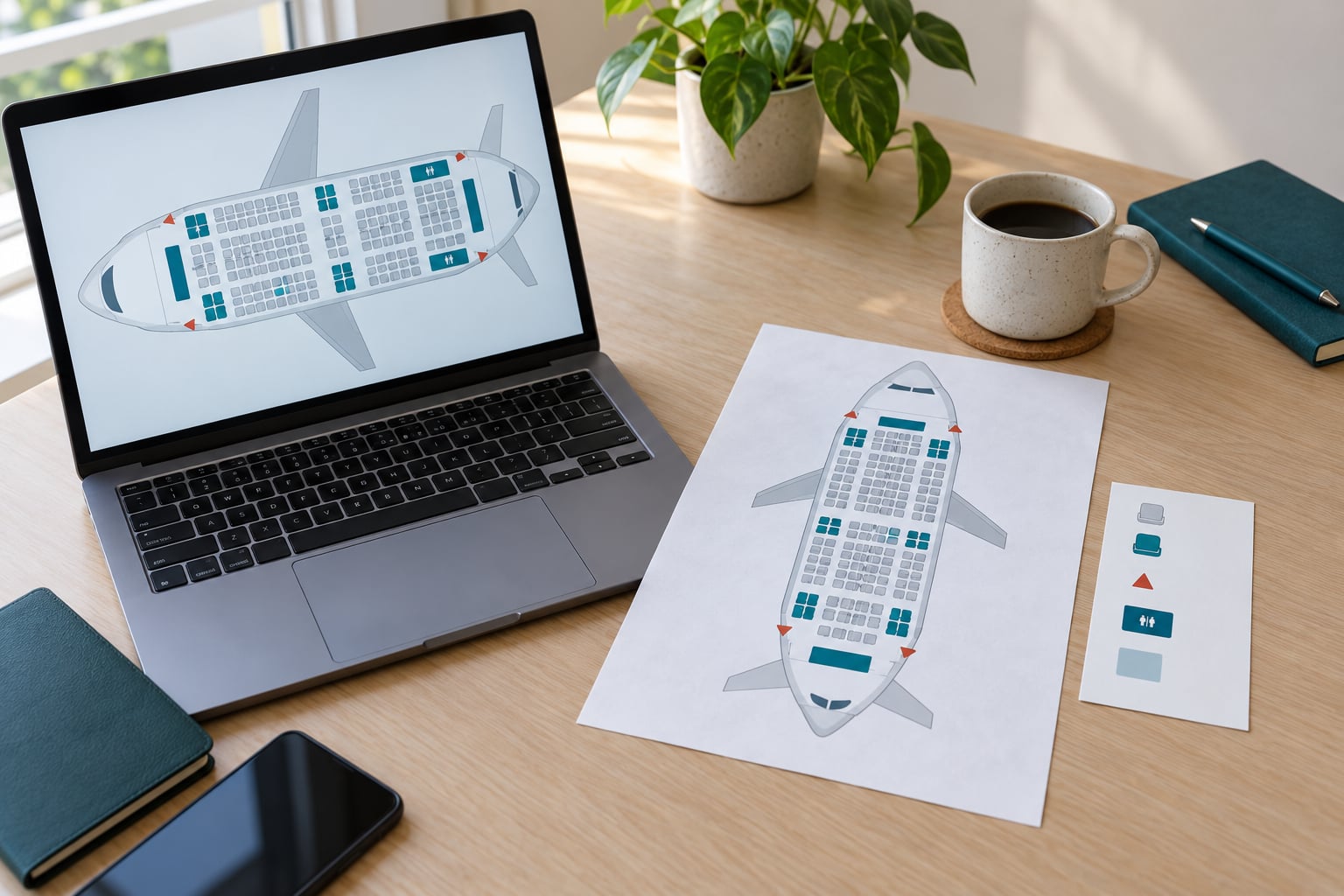
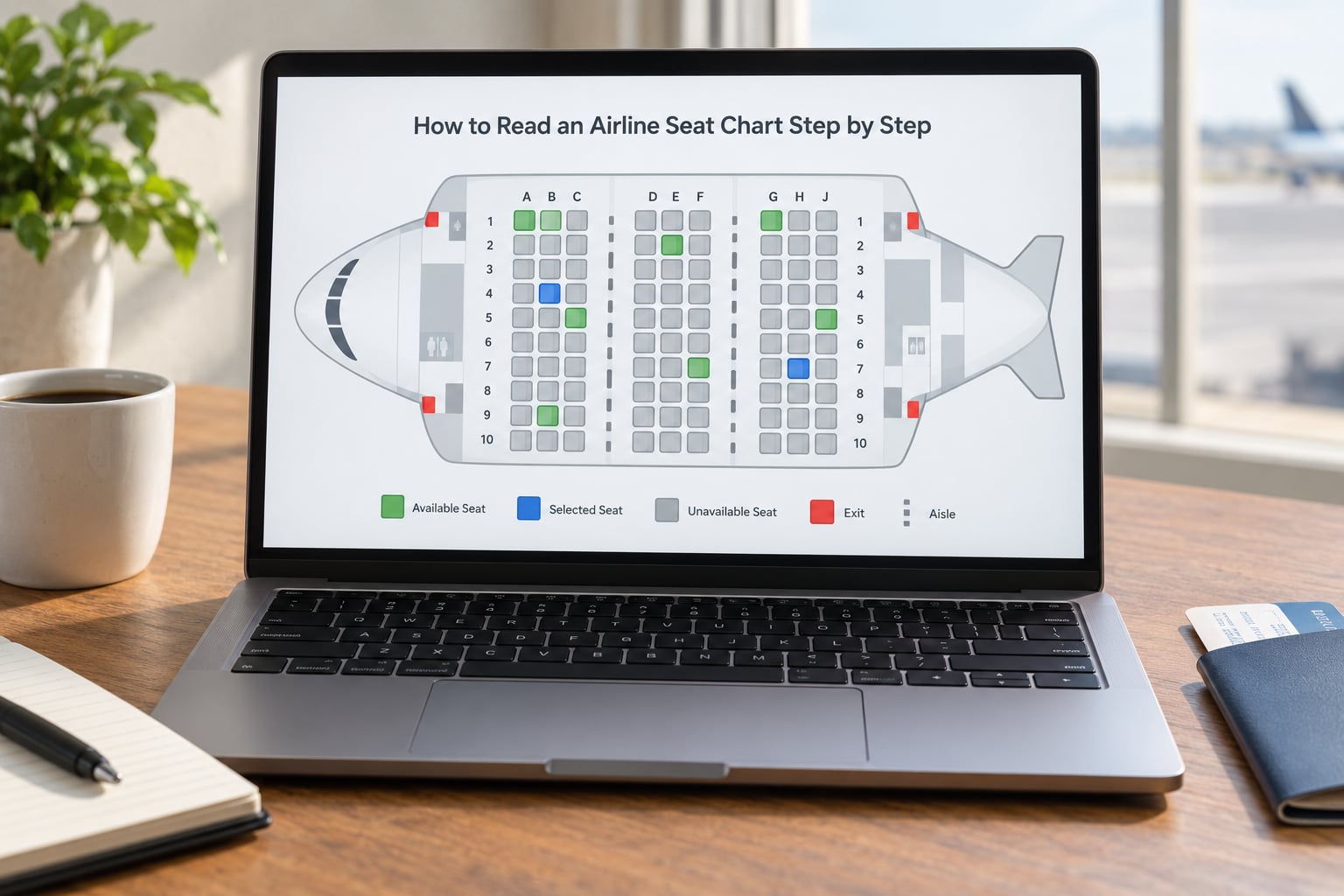
An airline seat chart is a top-down diagram of one aircraft cabin, where every seat appears as a labeled block arranged by row number and seat letter, with aisles, galleys, lavatories, exits and cabin walls drawn around them. Charts are always shown facing forward, so the top of the map is the nose of the plane and the bottom is the tail. Learning how to read an airline seat chart takes about five minutes, and it is the difference between picking a seat that works for you and one you will regret for six hours.
The tricky part is not the symbols. It is that seat letters mean different things on different aircraft, and the map you see at booking may not be the map you board. Here is how to decode both.
Table of Contents
- What You Need Before You Read the Chart
- How to Read an Airline Seat Chart Step by Step
- Start by Identifying the Aircraft and Flight
- Understand Rows, Seat Letters, and Cabin Layout
- Decode Seat Symbols and Availability
- Compare Seat Space and Comfort Features
- Check the Best Locations for Your Trip
- Verify the Exact Chart Before You Choose
- Common Mistakes
- Frequently Asked Questions
- Are airline seat charts the same for every aircraft?
- What do the letters on an airline seat chart mean?
- Is a bulkhead seat always better for legroom?
- Are exit-row seats suitable for every passenger?
- How can I tell if a seat has extra legroom?
- Why can the seat map change after I select a flight?
- Conclusion
What You Need Before You Read the Chart
You need four things, and two of them take longer to find than people expect.
- A confirmed booking or a flight lookup. A six-character confirmation code, or a flight number plus date, is enough to pull up the live map.
- The operating airline. On a codeshare the map on the ticket can belong to a different carrier entirely, and that carrier’s layout is what you will sit in.
- The aircraft type and configuration. A Boeing 737-800 and a Boeing 787 both say “narrow-body” in some apps, but the cabin arrangement is different.
- The airline’s legend. Every airline publishes a key for its symbols and colors, usually a small link or an info icon on the map itself.
That last one matters more than it sounds. A symbol that means bassinet on one map means nothing on another, and the color convention for “blocked” is not universal.
How to Read an Airline Seat Chart Step by Step
Start by Identifying the Aircraft and Flight
Before anything else, confirm the operating carrier, the flight number, the aircraft model and the cabin you booked. Most airline apps put the aircraft type at the top of the seat selection screen, and it will change when the airline swaps equipment.
That swap is real and it is common. A flight scheduled on a wide-body can go out on a narrow-body the same morning, which means a different seat count, different letters, and sometimes a different cabin layout entirely. If you are paying extra for a preferred seat, check the aircraft assignment the day before you fly.
One detail that confuses first-timers: the industry document behind these layouts is the LOPA, short for Layout of Passenger Accommodations. It is what the airline’s own map and the good third-party maps are both drawn from, and it is also where variants come from. Two aircraft with the same type code can have different seat numbers, because the airline configures them differently.
Understand Rows, Seat Letters, and Cabin Layout
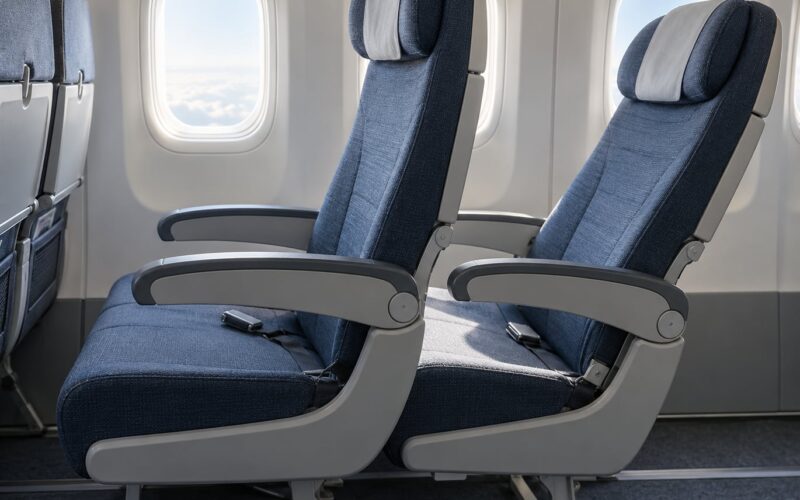
Rows are counted forward to back, and the row number tells you how far you are from the front. Seat letters run across the cabin from the first window seat to the last one, and the letter itself tells you the position: window, middle or aisle.
Letters start at A and climb. In a standard 3-3 narrow-body economy cabin, A and F are window seats, C and D are the two aisle seats, and B and E are the middle seats. That single line answers most of what people ask about seat letters.
On a wide-body the letters jump because the cabin is wider. A 3-4-3 cabin runs A, B, C, then D, E, F, G, then H, J, K. A and K are the window seats, C and H are the aisles, and the four-seat block in the middle is where the extra width goes.
| Configuration | Typical cabin | Window letters | Aisle letters | Middle letters |
|---|---|---|---|---|
| 3-3 | Narrow-body economy | A, F | C, D | B, E |
| 2-2 | Regional jet economy | A, D | C | B |
| 3-3-3 | Wide-body economy | A, F, K | C, D, H, J | B, E, G |
| 3-4-3 | Wide-body economy | A, K | C, H | B, D, E, F, G, J |
| 1-2-1 | Business class | A, F | C, D | B, E (aisle access varies) |
| 2-2-2 | Business class, reverse herringbone | A, D, G | C, F | B, E |
Now the missing letters. I and O are usually skipped because they look too much like the numeral 1 and the letter 0. You will also notice gaps in the row numbers. Row 13 is commonly omitted, and on aircraft with a premium cabin at the front, the economy rows often start at 20 or 30 rather than 1.
Those gaps are where the exits, bulkheads and galleys sit. A horizontal break in the row sequence usually means an exit row or a bulkhead, and that break is the single most useful clue on the whole map.
Decode Seat Symbols and Availability
Before you pick anything, open the legend and read it. Then work through this checklist of what you will see most often.
- Exit row marker. A gap or an arrow symbol between two rows. More legroom, but with real restrictions: armrests may not lift, there is no under-seat storage, and you are expected to assist in an emergency. Airlines will not assign these to young children or passengers who cannot meet the criteria.
- Bulkhead row. The first row of a cabin, with no seat in front of it. The most legroom in economy, and the reason experienced flyers take it. The tradeoff is the tray table and a bulkhead that is sometimes not as smooth as a seat back.
- Galley icon. A small block for a food and drink galley. Rows in front of it get service first, and rows near it get the most noise, especially at meal time.
- Lavatory icon. The same idea, and the queue. Travellers report that a lavatory-adjacent seat has a footwell traffic problem as much as a noise problem, because people step over the aisle seat constantly.
- Accessible seating and accessible lavatory. Marked with a wheelchair symbol. These sit near the doors and are often the only seats with a removable armrest and extra floor space.
- Bassinet position. Usually on a bulkhead row, where the bassinet can hang. These seats are frequently shown as blocked online because they are held for infant bookings, which is why so many maps appear full when they are not.
- Wings. Drawn as shaded shapes at the sides of the cabin. The rows level with the wings have obstructed views and a noticeably different noise profile, though some flyers like the view of the wing and the fact the row does not recline.
- X on a seat. Blocked, unavailable or already assigned. Depending on the airline and the moment, an X can be a crew seat, a blocked seat for safety reasons, or a paid seat you cannot yet buy.
- A currency symbol or a fee marker. The seat costs extra to select. The amount is not usually on the map, and the fee policy differs by route length, by carrier and by whether you booked through a third party.
- Legend colors. Available, occupied, selected, preferred and unavailable are colored differently by every airline, and the same airline may change the palette between its website and its app.
People on airline forums keep one rule about all of this: the airline’s own map tells you availability, and a third-party map tells you the physical layout. Neither one tells you both.
Compare Seat Space and Comfort Features
Two numbers decide most comfort questions, and neither is printed on the airline’s booking map. Row pitch is the distance from one row to the next, and seat width is the width of one seat. A narrow-body 3-3 typically gives you around 31 inches of pitch and 17 to 18 inches of width, while a 3-4-3 wide-body economy seat can be about 31 inches of pitch and 18.5 inches wide.
The map will, however, mark extra legroom explicitly. If a row is flagged, take the flag at face value and check the rules attached to it, because extra legroom sometimes means a non-reclining seat in front of you rather than a genuine pitch increase.
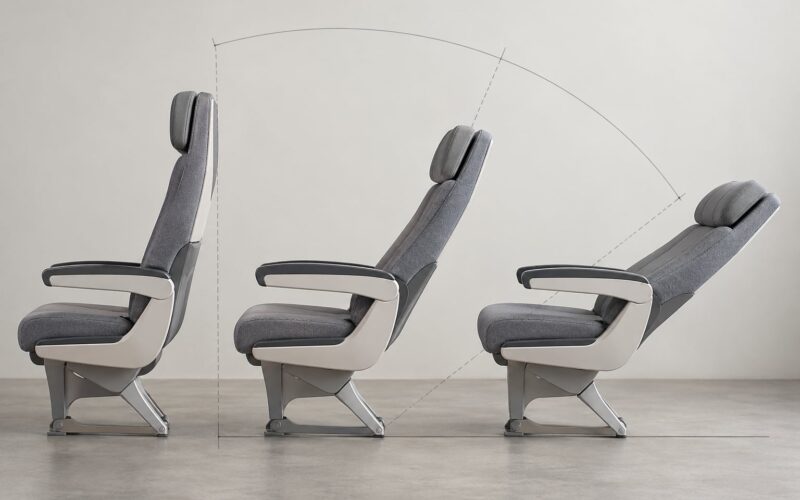
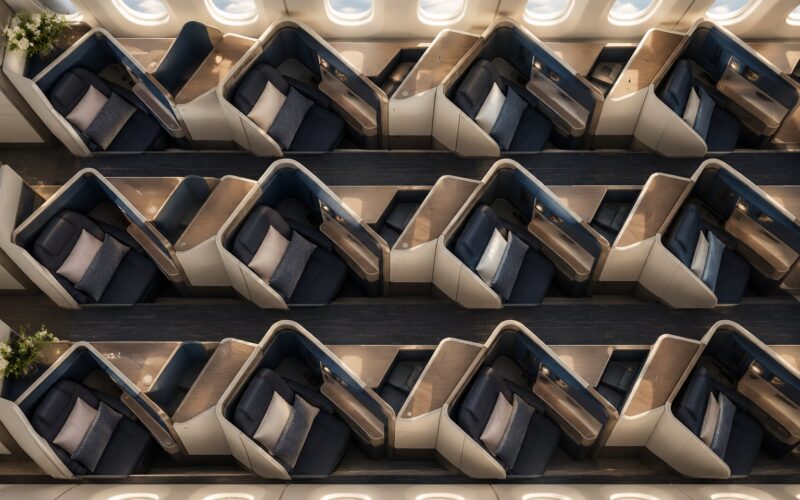
Other clues the map can give you: the seatback type, which tells you whether the tray table is in the back of the seat ahead of you or in the armrest; whether a power socket or USB port is shown; and in premium cabins, whether a seat has direct aisle access or a privacy door. A seat in the middle of a 1-2-1 business cabin with no window and no aisle access is the one layout that flyers complain about most.
Check the Best Locations for Your Trip
Once you can read the map, you can match a seat to the trip. These are the tradeoffs that matter most.
- Bulkhead. Maximum legroom and the ability to get in and out without disturbing anyone. Recline is often restricted, so the seat in front of you may not go back.
- Exit row. Roughly seven to ten inches of extra pitch on most narrow-bodies, and the first people off the plane. Check the eligibility rules before you pay for it.
- Standard middle rows. Recline more freely than the row behind usually needs, and the armrests are shared, so it is a poor choice if you are not comfortable sitting close to a stranger.
- Window. A wall to lean on for sleep, the best view, and the best chance of an empty adjacent seat. The drawbacks are the glare, the cabin service hitting you, and the need to climb over anyone asleep beside you.
- Aisle. The easiest in and out, the most likely to be the last seat to fill, and the one you want on a tight connection. You will be crossed by passengers and service carts all flight.
- Front of the cabin. Quieter and faster to board and deplane, which is the whole point when you have a 50-minute connection.
- Rear of the cabin. Usually empties out first and is furthest from the engines, so the experienced pick for a red-eye. You eat last and the lavatory queue can reach you.
- Paired seats. Two travellers in a wide-body seat pair: window plus middle, or aisle plus middle. Better than a true middle in a narrow-body, because nobody has to climb over.
One location gets a specific warning. On many aircraft, 11A sits directly behind the second lavatory, and flyers ask about that seat constantly. It is usually a tight row next to high-traffic space, and if noise is your concern, pick the same row on the other side of the aisle or move one row back.
Verify the Exact Chart Before You Choose
Run this last routine before you confirm anything.
- Check the flight date and route match the itinerary you actually booked.
- Confirm the operating carrier, not just the marketing carrier on your ticket.
- Check the aircraft version shown, and look again the day before departure for a change.
- Open the legend and read what X, the fee marker and each color mean on this particular map.
- Confirm whether your fare includes seat selection, or whether choosing a seat adds a separate charge.
- Compare the map against a detailed third-party layout for the same aircraft type, and treat any disagreement about which seat letters exist as a warning to re-check on the airline’s own site.
Re-check once more close to departure. Seats shown as blocked often open up as passengers change flights, and that is when a preferred seat quietly becomes available.
Common Mistakes
Assuming every chart is identical. Seat letters are assigned per aircraft configuration, so a codeshare or a swapped aircraft means the same flight number can use different letters. Fix: read the aircraft type every time, not just the flight number.
Confusing letters across cabins. A is a window seat in a 3-3 cabin and a window seat in 1-2-1, but in a 3-4-3 it puts two letters’ worth of people between you and the aisle. Fix: count the seats between your letter and the aisle before you assume what you are getting.
Ignoring the legend. Colors and icons are not standardized between carriers, and an app and a website can differ. Fix: find the legend first, every time, before reading anything else on the map.
Taking an exit row without reading the rules. Some armrests do not lift, there is usually no under-seat storage, and there is a duty to help in an emergency. Fix: read the eligibility note on the seat before paying, and pick a bulkhead or a front row if you want the space without the conditions.
Ignoring aircraft substitutions. The map you chose from may be out of date by the morning of the flight. Fix: check the aircraft assignment 24 hours before departure, and again at check-in.
Buying a window seat that has no window. Misaligned windows and fuselage structure mean some window-labeled seats have a blank panel instead of glass, and rows over the wing lose the view. Fix: on a detailed third-party map, check the window count per row and where the wing sits.
Two habits cover most of the rest. Pick by trip type rather than by seat number, and re-check the map close to departure when better seats often appear. Everything else is detail.
Frequently Asked Questions
Are airline seat charts the same for every aircraft?
No. Letters are assigned per configuration, so the same flight number can use different letters on a different aircraft or after a swap. A 3-3 narrow-body economy runs A to F, a 3-4-3 wide-body runs A to K, and business cabins use 1-2-1 or 2-2-2. Always read the aircraft type shown on the booking screen before choosing a seat, and re-check the day before you fly.
What do the letters on an airline seat chart mean?
The letter tells you where the seat sits across the cabin, and letters run from the first window seat to the last. On a 3-3 narrow-body, A and F are window seats, C and D are aisle seats, and B and E are middle seats. On a 3-4-3 wide-body, A and K are window seats and C and H are aisles. Letter I and letter O are usually skipped so they cannot be confused with 1 and 0.
Is a bulkhead seat always better for legroom?
Usually, yes for space. A bulkhead row is the first row of a cabin with no seat ahead of it, which usually means the most legroom in economy and easy in-and-out access. The tradeoffs are that the seat in front often will not recline, the tray table and seat-back storage are different, and bulkheads are popular, so they sell out early.
Are exit-row seats suitable for every passenger?
No. Airlines set eligibility rules, and they are not suggestions. Many passengers must be at least 15 or older, armrests may not lift, there is usually no under-seat storage, and you are expected to perform specific duties in an emergency. Check the rules on the seat listing before you pay, and choose a bulkhead or front row instead if you want space without conditions.
How can I tell if a seat has extra legroom?
Look for an explicit extra-legroom marker on the map, then check the rules attached to it, because the flag can mean a genuine pitch increase or a non-reclining seat in front of you. Bulkhead rows and exit rows are the two usual candidates. The airline’s booking map rarely prints row pitch, so for the real measurement, check a detailed third-party layout for the same aircraft type.
Why can the seat map change after I select a flight?
The map reflects live inventory, and airlines reassign aircraft as schedules change. A wide-body can be replaced by a narrow-body, which changes the seat count, the seat letters and sometimes the cabin layout. Seats also open up constantly as passengers change flights, which is why blocked seats can reappear. Check the map again 24 hours before departure and again at check-in if a specific seat matters to you.
Conclusion
Start with the operating airline and the aircraft type, because everything after that depends on them. Read the legend, work out which letters are windows and which are aisles for that configuration, use the gaps in the row numbers to find exit rows, bulkheads, galleys and lavatories, and match the location to the kind of trip you are taking. Then confirm the exact map again the day before you fly, especially if you are paying for a specific seat. That last check takes two minutes and it prevents almost every bad seat story I have heard.