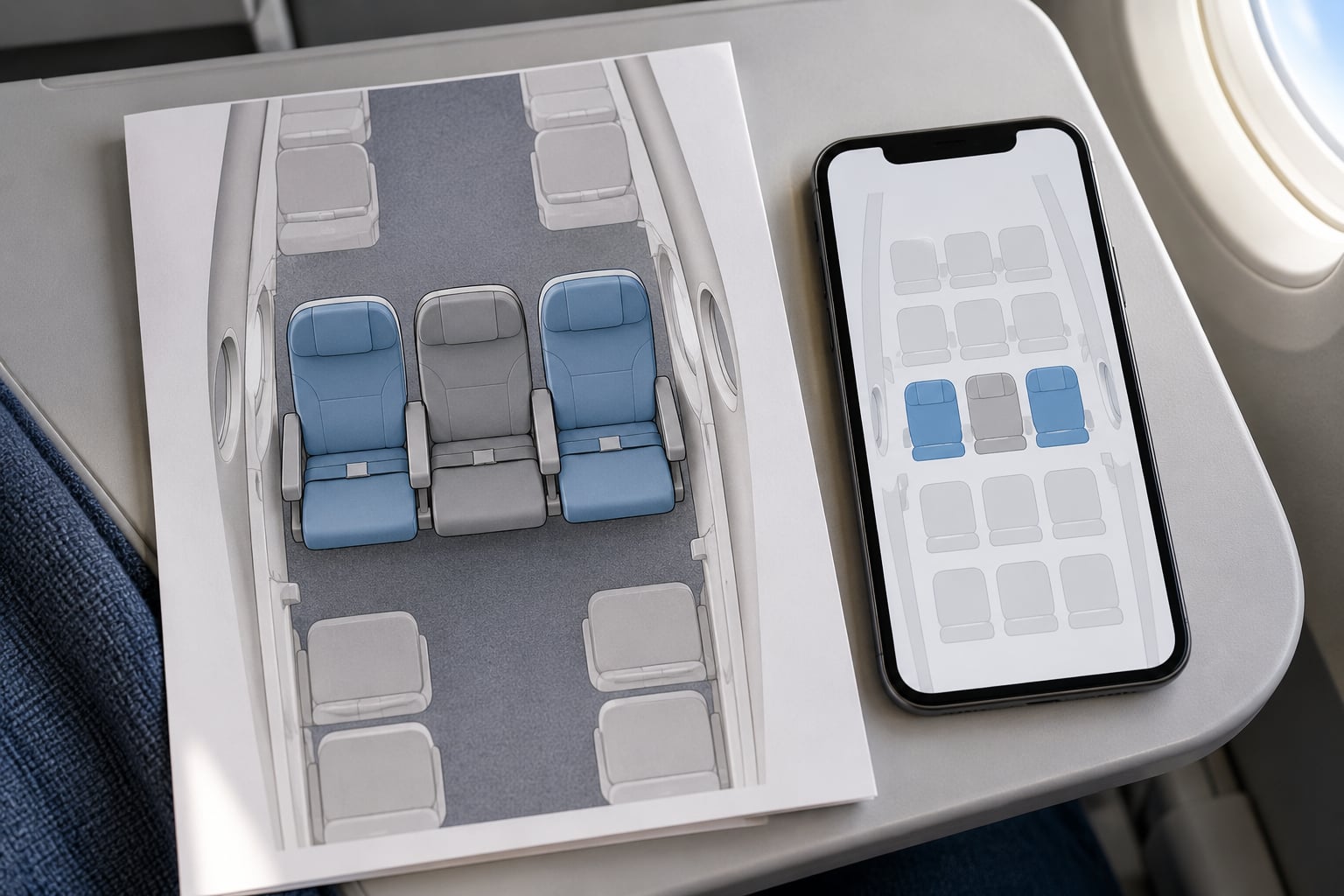
The fastest way to avoid getting a middle seat is to select every seat in your row except the one in the middle, then check in the moment your airline opens check-in and confirm the seat. Airlines hand out middle seats last, so leaving one deliberately open is the single most effective free move. The rest is the full system, including what to do when the seat you wanted is gone.
It takes about five minutes to do properly, and almost none of it is complicated. What trips people up is timing: they book, they shrug, and they find out their seat at check-in when the only thing left is the middle.
Table of Contents
- What You Need Before You Pick a Seat
- Step-by-Step: Getting an Aisle or Window Seat
- How to Avoid Getting a Middle Seat at Booking
- Choose the Right Fare and Seat Selection Rule
- Check the Aircraft Before You Pay
- Use Check-In and Seat Changes to Improve Your Odds
- What to Do if Only Middle Seats Remain
- Window vs Aisle vs Middle: Which One Should You Pick?
- Already Stuck in the Middle? How to Change Seats
- Is the Middle Seat Hack Rude?
- Common Mistakes
- Frequently Asked Questions
- Can I guarantee an aisle or window seat when I book?
- Why does the seat map show the middle seat as taken before check-in opens?
- Does checking into a flight early actually get you a better seat?
- Do I have to pay to skip the middle seat?
- What happens if I am flying with a small child and the middle seat trick fails?
- Can I change seats after I have already checked in?
- Conclusion
What You Need Before You Pick a Seat
You need five things, and four of them are already sitting in your email and your airline app.
The seat map for your exact flight number. Not a generic cabin diagram, not a picture from a review site. The map that appears when you click “choose seats” on the specific itinerary you are booking, because the same flight number can be a narrowbody on Tuesday and a widebody on Thursday.
The name of your fare family. Every airline labels its cheapest product differently. United calls it Basic Economy, American calls it Basic Economy, Delta calls it Main Basic, JetBlue calls it Blue Basic, Alaska calls it Basic. Those tickets carry the harshest seat rules, and the label tells you before you pay.
Your reservation record. The six-character confirmation code plus the passenger last name gets you into the airline’s check-in and seat-change screens, which is also how you reach an agent through chat if you need one.
Your boarding time, not just the departure time. Most middle-seat disasters are decided at the gate when a boarding group closes on people who are still queued for the lavatory.
A few minutes of patience for the selection timer. While you are choosing seats, the airline holds them for a short window while you finish checkout. That timer is why the trick in the next section works, and also why it fails if you dawdle.
Step-by-Step: Getting an Aisle or Window Seat
Work through this in order. Skipping the first step is how people end up in row 24C wondering what happened.
How to Avoid Getting a Middle Seat at Booking
- Open the seat map inside the booking flow, not a separate seat map page. The map inside the flow is the live one tied to your aircraft and flight number.
- Look at the row structure before you look at individual seats. Count the letters. A row marked 21A, 21B, 21C is a three-seat row, and the middle is 21B. A row marked 5A, 5C, 5D has no middle seat at all, so nothing to avoid.
- Select every seat you would be happy to sit in except the middle one. That means the window and the aisle, and if the selection screen allows it, seats in a second or third acceptable row as well. The more open seats you are holding, the harder it is for the system to hand one of them to somebody else before you finish.
- Complete checkout before the timer runs out. If the airline rejects too many held seats, you will see an error and you drop back to what you actually wanted. Either way, you still end up with a non-middle seat.
- Open the confirmation and check the seat printed on the itinerary. Do not assume. A surprising number of middle-seat stories start with a seat number that was never actually held.
- Look at the map again a few days before departure. Cancellations and equipment swaps show up there, and a window or aisle often reopens quietly.
One note on the popular “block the whole row” version of this: it works on some booking flows and errors out on others, and the error message can wipe your held seats entirely. The version above, holding the two seats you actually want, does the same job with less risk.
Choose the Right Fare and Seat Selection Rule
The cheapest fare is the one most likely to hand you a middle seat, because it is the one that takes seat choice away from you. Basic economy tickets usually assign a seat automatically at check-in or boarding, and the rules that govern when you can change it are deliberately vague.
Standard economy almost always includes free seat selection, either at booking or in a window that opens before departure. Flexible and refundable fares add change rights, not seat choice, because seat choice is already included at that level. Frequent flyer status is the quiet way through the same door: elite members get advance seat selection windows that open before the general public and usually pick seats without a fee.
If your trip is short and you care less, the cheapest fare plus a fast check-in is a reasonable gamble. If it is a long-haul flight, the fare difference is the cheapest comfort decision on the whole ticket.
Check the Aircraft Before You Pay
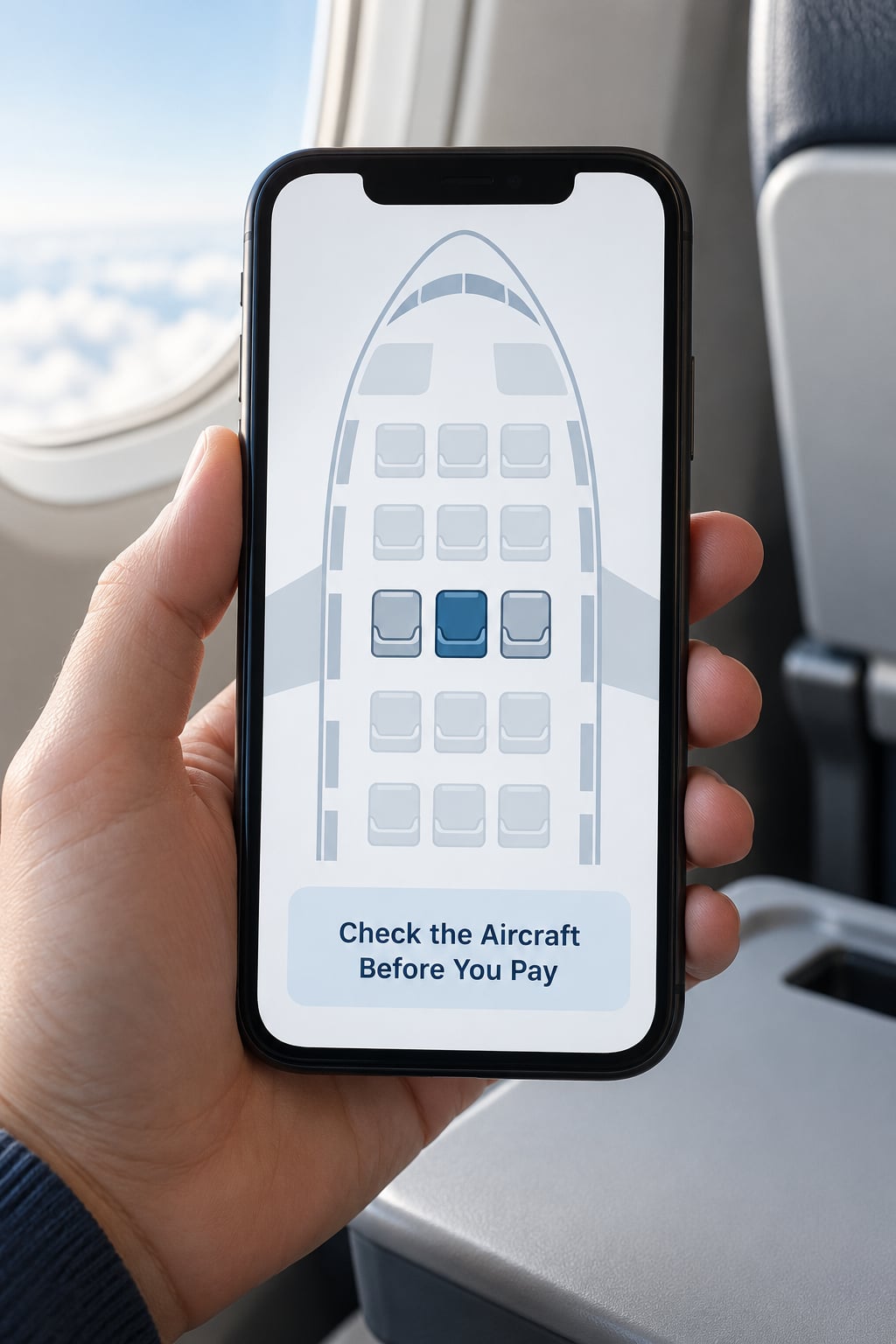
Seat maps differ by route, by aircraft and sometimes by flight number on the same day, because airlines swap equipment to cover maintenance and weather. The geometry is what matters to you, and it comes down to a handful of layouts.
Narrowbody main cabins are usually three across. Widebody domestic and most international configurations are three across in economy, sometimes with a nine-abreast upper deck on the 787. Regional jets are often two across, and some aircraft are built two-by-three, which means the worst seat in the cabin is a middle seat with only one neighbour. Either way, the number of letters in the row tells you the layout before you look at anything else.
Two things to verify before you commit. First, the flight number and date, because the same flight can be a 737 one week and a 320 the next. Second, the cabin you are actually in, since a widebody with a premium cabin between the door and your row changes which rows are the comfortable ones. If the seat map is unclear, the airline’s app or chat desk can confirm the aircraft for your specific date, and it is a ten-second question that beats a bad seat.
Use Check-In and Seat Changes to Improve Your Odds
Check-in typically opens 24 hours before a domestic departure and 48 hours before an international one, and those windows are when the free options run out. Automatic seat assignment works roughly in check-in order, so the first people through the door get the aisle and window rows that are still open, and whoever arrives last gets whatever is left, which on a full flight is a middle.
Check in the moment the window opens rather than at the last minute. If you are given a middle seat, most airlines let you change it in the same flow, often at no charge, and the good news is that the change screen shows the same map you saw at booking, with a clearer picture of what is actually open.
Stay alert after check-in too. A cancelled booking frees up both the seat and the passenger, and some people never look at the map again after they have a boarding pass. Refreshing once or twice in the 48 hours before departure is cheap and occasionally pays off.
What to Do if Only Middle Seats Remain
When the map is nothing but middle seats, work down this list.
- Pick a different flight. A middle seat on an hourly shuttle is a different problem from a middle seat on a red-eye. Later flights on the same route are often noticeably less full, and timing matters more than airline here.
- Take the middle seat and work the room. An extra-legroom middle seat, if the aircraft has one, is genuinely fine. With a middle seat you can lower the tray, rest a laptop on the seatback tray in front, and get out for a walk without squeezing past anyone.
- Ask about a swap at check-in or at the gate. A polite request when an aisle is open often works on a not-quite-full flight. See the next section for phrasing that gets taken seriously.
- Watch for an equipment change. When an aircraft is swapped for a larger one, rows get added at the front and seat numbers shift, which sometimes opens up a block you did not have before.
- Ask the airline to move you later, not sideways. Moving to a less full flight beats any seat on a full one, and many agents can do it at their discretion.
Window vs Aisle vs Middle: Which One Should You Pick?
Short version: window if you want to look out and you will not get up much, aisle if you will, middle if you want the tray table and the armrest on both sides. The table below is the honest comparison.
| Consideration | Window seat | Aisle seat | Middle seat |
|---|---|---|---|
| Getting up to use the lavatory | Awkward, may need to climb over someone | Stand up and go | Worst of the three, must disturb both neighbours |
| View and light | Window, controllable curtain, best on night flights | Bright, and looking at a seatback | No view, and lights are the neighbours’ |
| Armrests | One outer armrest to yourself | One outer armrest to yourself | Both armrests shared, the reason most people dread it |
| Legroom feel | Wall side, no one leaning past you | Legs sit under the seat in front with less angle | Trapped, and under a shared tray table |
| Tray table and work surface | Table against the wall, tablet use awkward | Easiest table for a laptop and a cup | Table in front of you with a stranger’s elbows over it |
| Best for | Sleep, long-haul, scenery, one traveller | Short flights, frequent lavatory trips, big passengers | Budget fares, solo travellers who book late, anyone it happens to |
The gauge symbols on a seat map matter more than people expect. On many maps, a small triangle or a seat outline with a narrowing shape marks a seat with reduced space, and those triangles show up on aisle and middle seats far more often than on windows, because the frame of the seat takes the space instead of a wall. Avoiding those marked seats is a free improvement wherever you end up.
Already Stuck in the Middle? How to Change Seats
If you are already holding a middle assignment, you have more options than most people realise, and the fix is usually free.
- Change it yourself in the app or on the check-in screen. Same flight, standard seat change, usually no charge. This is where a middle seat most often turns into an aisle with a tap.
- Use the airline’s chat or phone line before you leave for the airport. Agents have tools the app does not show, and they can see where an open aisle actually is.
- Ask the gate agent with this phrasing: “Hi, I have a middle seat in row 22 and I am hoping to move if there is an aisle or window open when I board. Would that be possible?” Simple, no complaint, no demand.
- Have a reason ready if the flight is tight. A connection you do not want to miss, a carry-on that needs the legroom, a long flight ahead. Agents decide faster when they have a one-line justification.
- Accept a paid change as the last resort. On a not-quite-full flight the agent may waive it, and on a busy one they will quote a fee. Decide before you board whether that flight is worth it to you.
One more lever: boarding group. Earlier groups get first pick of the overhead bins and, on some airlines, priority access when agents shuffle seats at the gate. A middle seat in an earlier group is a better middle seat.
Is the Middle Seat Hack Rude?
No, and the reason is boringly practical: nobody wants the middle, so nobody is being inconvenienced by a trick. Holding the window and aisle and leaving the middle open does not take anything away from another passenger, it simply leaves a seat unclaimed until someone who actually wants it claims it.
Travelers on the Air Travel forum at Tripadvisor describe airline staff recommending the same approach themselves, and the same thread is full of people reporting that whenever a middle passenger did show up, that passenger was glad to trade up. A poster on r/unitedairlines puts it more plainly: pick a window or aisle when the seat is already taken, because the middle is then the only thing filling last.
The one situation where the approach is awkward is a middle-seat passenger who cannot move comfortably, which in practice means a small child, an older passenger with mobility limits, or anyone larger than the armrests were designed for. In that case the polite move is to leave the swap offer open rather than push for it. On r/TravelHacks and r/childfree, parents make the same point: the trick does not work with toddlers, and there is no version of it that does.
Post-COVID loads have made the empty-middle outcome less common, and anyone who tells you the middle will be empty every time is overselling it. Frequent flyers on r/SouthwestAirlines report using the approach for years and getting a filled middle far more often on recent flights. Treat it as a way to improve your odds, not a promise.
Common Mistakes
Reading a generic seat map instead of the one for your flight. Equipment gets swapped, and a 3-3 narrowbody is not a 3-4-3 widebody. Check the flight number and date before you trust any layout.
Assuming seat letters are consistent across aircraft. A seat that is 22C on one aircraft is 22C on a different one, but a missing letter changes everything: 21A, 21B, 21C versus 21A, 21C, 21D is a completely different seat, and the one in the middle is not always the middle letter.
Buying the cheapest fare and expecting a choice. Basic economy removes the map from the process entirely. Either accept the automatic assignment and check in fast, or buy up one fare level.
Checking in late and hoping for the best. The people who check in first get the aisle rows. The people who check in at the boarding call get whatever the last person released.
Ignoring bulkheads, exit rows and the lavatory. Some people avoid all three out of fear of a bad exit-row experience. A non-middle bulkhead seat with no galley or lavatory behind you is often the best seat in the cabin, and none of the three is a middle seat anyway.
Forgetting accessibility and family needs in the strategy. If you need a specific row, if you are travelling with a service animal, or if you need bulkhead legroom, tell the airline when you book rather than after. Seats in those categories are often held out of the general map entirely, so no tactic on this page will reach them.
Forgetting to check the map again after check-in. Cancellations open up good seats quietly, and most people stop looking once the boarding pass arrives.
Frequently Asked Questions
Can I guarantee an aisle or window seat when I book?
No. Every airline sells on the assumption that the map will change, and equipment swaps, cancellations and late check-ins all move seats around. The closest thing to a guarantee is checking in the moment your window opens, holding more than one seat you would be happy with, and looking at the map again in the 48 hours before departure.
Why does the seat map show the middle seat as taken before check-in opens?
Airlines hold blocks of seats back before check-in for unaccompanied minors, group travel, crew and staff travel, and passengers who have not checked in yet. That is what you are seeing, and it is why the map can show a middle seat as unavailable hours before anyone boards. Those blocks often release once the check-in window opens.
Does checking into a flight early actually get you a better seat?
Yes, within the free window. Automatic seat assignment largely follows check-in order, so the first people through the door choose from the best open rows and the last people get what remains. Check-in usually opens 24 hours before a domestic flight and 48 hours before an international one, and free seat selection is normally free inside that window on a standard economy fare.
Do I have to pay to skip the middle seat?
Usually not. Standard economy fares on United, Delta, American, JetBlue, Alaska and Southwest include seat selection in a window before departure, and the airline’s cheapest basic fare is the one that removes the choice. Paying a seat selection fee is a shortcut that can be sensible on a long flight or when the good rows are nearly gone.
What happens if I am flying with a small child and the middle seat trick fails?
It fails more often, and there is no workaround. A toddler or young child has no interest in an aisle or window, and neither parent wants to climb over a sleeping child, so the swap never happens. If you are booking three seats, buy all three, or use two seats and accept the middle rather than gambling your whole flight on a trick that will not work for you.
Can I change seats after I have already checked in?
Yes, on most airlines and most of the time for free. Same-flight seat changes are normally handled in the app or on the airline website, and a gate agent can often do one if the flight is not full. On a busy flight the agent may quote a fee, and moving to a different flight is a separate question that some agents can help with at their own discretion.
Conclusion
Start with the flight number, not the fare. Confirm which aircraft is flying your route, pick a fare that still lets you choose a seat, then select every seat in the row except the middle one and finish checkout before the timer runs out.
Check in the instant the window opens, change it yourself if you are handed a middle, and if only middle seats remain, ask the gate agent plainly and be willing to take a different flight. That is the whole system, and it works more often than the people selling the trick will tell you.