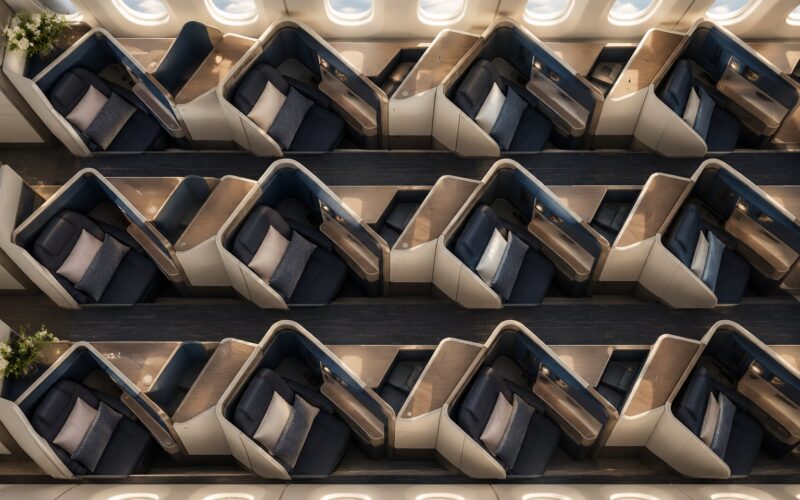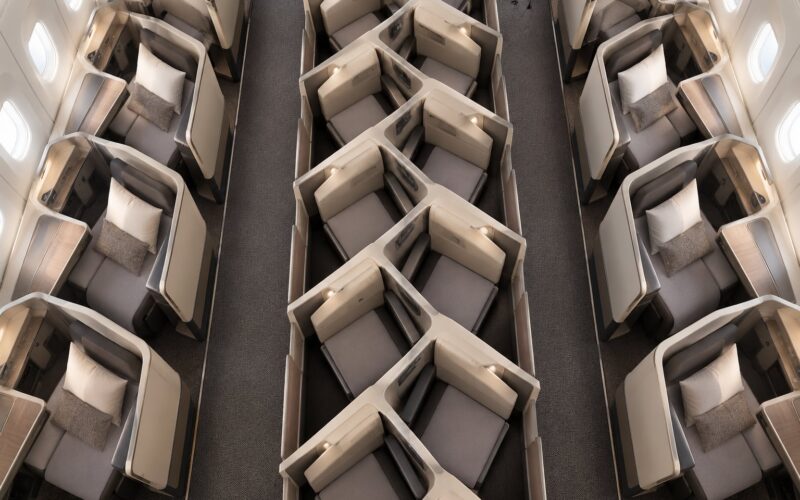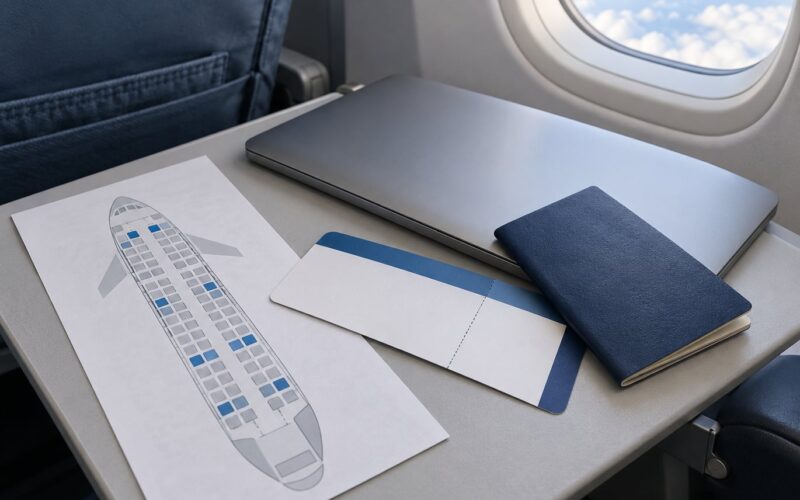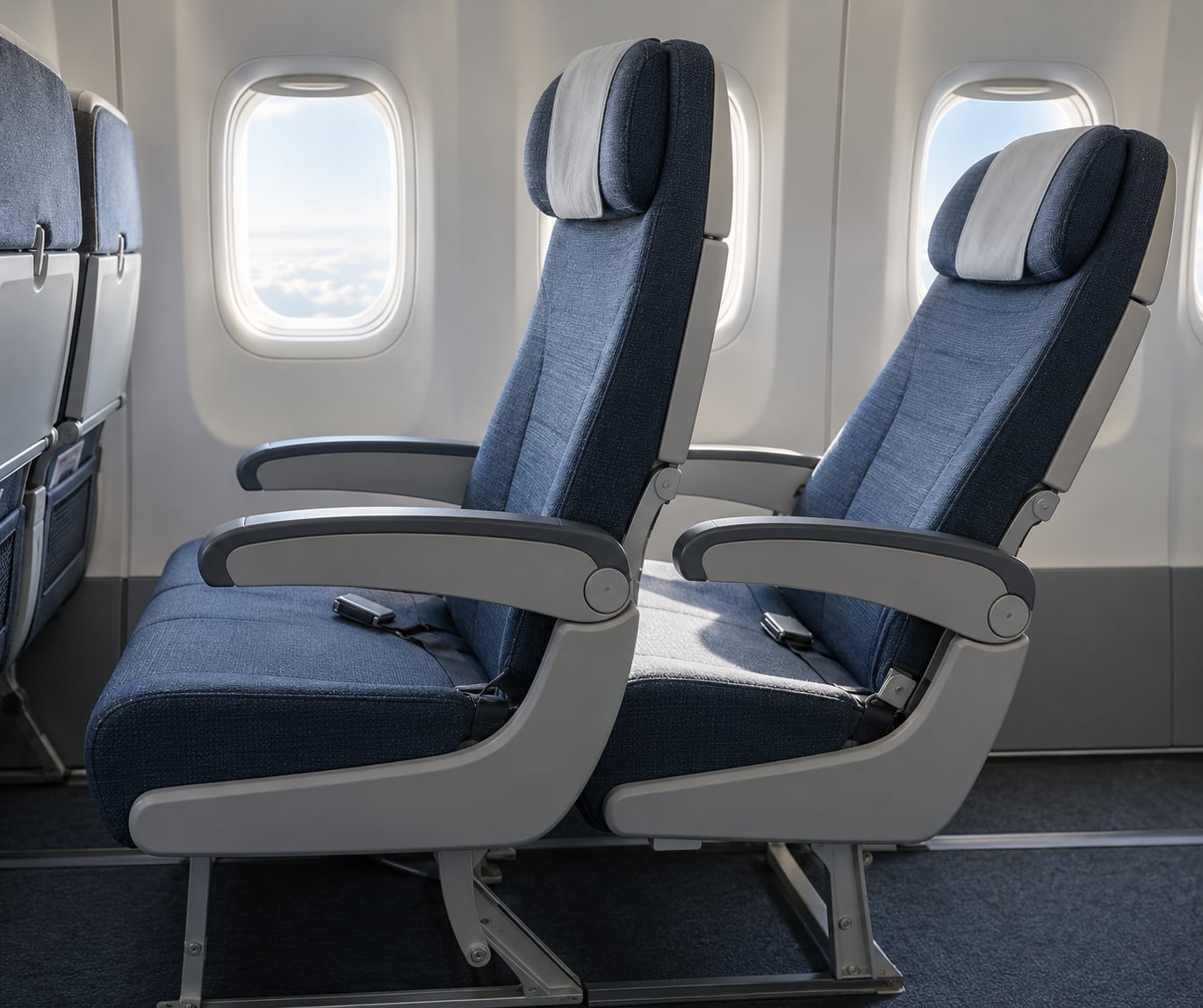
If you want the short answer: Ryanair, Spirit, Frontier, Allegiant, Breeze, Avelo and Sun Country put fixed-back, upright-only seats in their standard or basic economy product, and WestJet is rolling the same seat across its 737-800 fleet. Delta, United, Alaska, JetBlue and Hawaiian are different — they cut the amount of recline rather than removing it, and what you get depends on the fare you buy and the aircraft assigned to your flight.
That second sentence is where most people get caught. A search for which airlines have no recline seats returns a mix of carriers that never reclined at all and carriers that trimmed the recline to about two inches. Those feel completely different on a red-eye, and a generic airline list can’t tell you which one you are getting.
So this guide breaks it down case by case: what the standard cabin actually does, which fare or cabin buys you a back that moves, and the specific thing to verify on the airline’s site before you pay for a seat. Airline policies and seat hardware change with every cabin refresh, so every entry below carries a last-verified stamp of October 2026.
Table of Contents
- Which Airlines Have No Recline Seats at a Glance
- Which Airlines Have No Recline Seats right now?
- 1. Ryanair Standard Economy Seats
- 2. Spirit Airlines Economy Seats
- 3. Frontier Airlines Fare Basic Seats
- 4. Breeze Airways Basic Seats
- 5. Avelo Standard Seats
- 6. Allegiant Air Seats
- 7. Sun Country Standard Seats
- 8. Alaska Airlines Basic Economy Seats
- 9. JetBlue Blue Basic Seats
- 10. United Economy Seats
- 11. Hawaiian Airlines Main Cabin Seats
- 12. Delta Main Cabin Seats
- Frequently Asked Questions
- Which airlines have no recline seats on every flight?
- Does a seat that only reclines a little count as no recline?
- Can I choose a reclining seat without paying for a premium fare?
- How do I check whether my flight has fixed seats?
- What can I do if my airline changes the aircraft before departure?
- What to Check Before You Book
Which Airlines Have No Recline Seats at a Glance
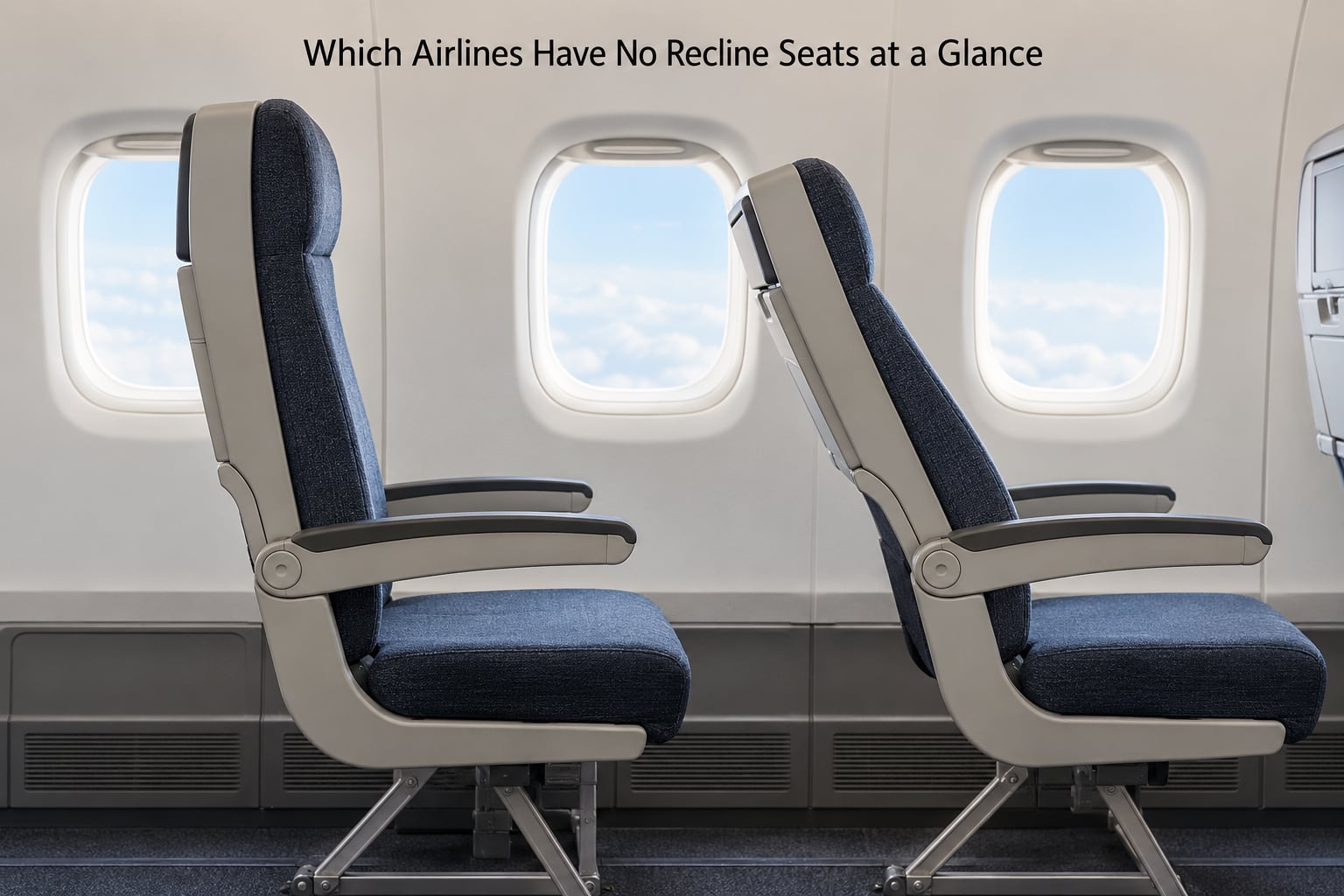
This table separates the airlines that fit genuinely fixed seats from the ones that merely limit how far a seatback travels. The third column is the part most readers miss: in several cases the same airline sells both kinds of seat on the same aircraft.
| # | Airline and seat product | Cabin or fare | Recline status | What to verify before booking |
|---|---|---|---|---|
| 1 | Ryanair Standard | Standard economy | None — fixed upright, unchanged since 2004 | Whether you paid for a Priority or Plus seat |
| 2 | Spirit Economy | Economy on 737 MAX and A320neo family | None on the base seat | Whether you bought a Fast Track or Premium Economy seat |
| 3 | Frontier Fare Basic | Economy | None or minimal, varies by seat | Seat pitch on your specific row, not the cabin average |
| 4 | Breeze Basic | Basic economy | Limited; the back moves a small amount | Whether you upgraded to Extra Legroom or First Class |
| 5 | Avelo Standard | Standard cabin | Varied by aircraft — confirm per route | Assigned aircraft type on your booking |
| 6 | Allegiant Air | Standard seat | None — recline removed outright | Whether business class is on your itinerary |
| 7 | Sun Country Standard | Standard cabin | Minimal to none; check pitch instead | Whether Premium Seatadd is worth it for your length |
| 8 | Alaska Basic Economy | Basic economy fare | Reduced — cabin seats do recline | Whether your fare allows seat selection |
| 9 | JetBlue Blue Basic | Blue Basic fare | Reduced; extra legroom is the upgrade | Whether your fare blocks advance seat selection |
| 10 | United Economy | Economy, varies by fare and plane | Limited on many 737-800 rows | Seat map description for your exact row |
| 11 | Hawaiian Main Cabin | Main Cabin | Reduced; Premium Economy reclines properly | Whether you are on a 787 or an A330 |
| 12 | Delta Main Cabin | Main Cabin | Reduced on many rows; trimmed on some retrofits | Aircraft assignment and Delta Comfort+ availability |
Which Airlines Have No Recline Seats right now?
Only some of them, and the honest answer depends on four separate things: the airline, the fare class, the aircraft type and sometimes the row. Airlines swap equipment on the same route routinely, so the seat you researched may not be the seat you board.
It also helps to know four terms before you read any seat description. A fixed seat has no recline mechanism at all — the back does not move. A pre-reclined seat is the same idea, moulded at a slightly deeper backward angle, which is why carriers market it as more upright comfort rather than less. Fixed recline means a nominal amount of movement, around 1.5 cm, that is locked in place. And reduced recline means the mechanism still works but travels only a few inches instead of a normal five or six.
1. Ryanair Standard Economy Seats
Ryanair’s standard cabin seat has not reclined since 2004. The back is moulded in a fixed upright position, and there is no mechanism to release.
The escape from it is the fare, not the cabin. Ryanair’s Fast Track and Plus bundles are sold with a reclinable seat included, which is why two passengers on the same aircraft can have completely different seat hardware. A booking example: on a 4pm Dublin to Alicante, the Standard fare gives a fixed seat, while a Plus fare on the same flight gives a back that moves.
Before you pay, open the seat map on the booking and read the row descriptions. Anything described as Fast Track, Plus or Reserved should recline.
2. Spirit Airlines Economy Seats
Spirit fits its basic economy rows with seats that stay upright, and its 737 MAX and A320neo-family cabins are where most travellers meet them. The base seat is not a reduced-recline seat; it is a fixed one.
Two products break the pattern. Premium Economy seats recline, and the Big Front seats at the front of the aircraft have both a moving back and extra width. On Spirit, the practical question is which of those you actually bought, because the airline sells them separately and the distinction is easy to miss at checkout.
Check your confirmation for the fare name, then use the seat map on Spirit’s site to see where the Big Front rows sit on your aircraft. If your flight is longer than four hours, the seat difference is worth more attention than it is on a short hop.
3. Frontier Airlines Fare Basic Seats
Frontier’s lowest fare is the one that draws the question most often, and the answer is that recline depends on the seat rather than the fare label alone. Frontier has flown both fixed and moving seatbacks within the same economy cabin.
Paid seating is where the difference shows. Frontier sells Standard and Extra Legroom seats, and the Extra Legroom rows give more pitch and a back that reclines further than the basic block at the back of the aircraft.
Check the seat map for your flight and look at the row you are assigned, not the cabin average. If you are planning anything past three hours and want a reclining back, pay for the seat rather than the fare upgrade alone.
4. Breeze Airways Basic Seats
Breeze’s Basic seat has a limited recline rather than none at all. The back moves a short distance, which is noticeably less than a conventional seat and only takes the edge off a long sit.
Extra Legroom and First Class both give a proper recline, with more pitch as well. On a 6am Nashville to Los Angeles run, sitting upright for the first hour of a Basic seat is easy to forget, then obvious at hour five.
Look at the cabin layout before you choose. If your itinerary is a red-eye or an overnight, the seat product is one of the few levers you actually control.
5. Avelo Standard Seats
Avelo’s recline varies by aircraft, which is why it is worth checking rather than assuming. The airline has operated more than one narrowbody type in its history, and the seat equipment differs between them.
Avelo has just one cabin, so there is no premium product to upgrade into on most itineraries. What you can control is the row: exit row and bulkhead rows give more space regardless of the back’s travel.
Open your reservation and confirm the assigned aircraft type before departure, then re-check the seat map if the schedule changes. Avelo has been known to swap equipment, and a change in type usually means a change in seat hardware.
6. Allegiant Air Seats
Allegiant removed recline from its standard seats altogether rather than trimming it. The standard seatback is fixed, and that has been the case across the fleet for years.
The exception is business class, which Allegiant sells on larger aircraft and which does recline further than the standard cabin. Someone who assumes the whole airline has no reclining seats has merged two very different products.
For a booking example, a 3-hour nonstop from Las Vegas to Boise in standard economy gives a fixed back, while the same aircraft’s business rows give a seat that moves. Confirm which cabin your reservation holds before you decide your expectations.
7. Sun Country Standard Seats
Sun Country’s standard cabin offers minimal to no recline depending on the aircraft, and the more practical comparison is seat pitch rather than back angle. Some Sun Country seats give generous pitch with a fixed back; that combination can be more comfortable than a moving seat in tight rows.
The Premium Seatadd product sits in rows at the front of the aircraft and brings more pitch and a back that reclines. On a Minneapolis to Honolulu overnight, that combination matters more than the airline’s name suggests.
When you book, compare the pitch of the rows you are choosing against Premium Seatadd. If the pitch is already generous and your flight is under three hours, the standard seat is probably fine.
8. Alaska Airlines Basic Economy Seats
Alaska’s basic economy fare is a fare restriction, not a seat type. The physical seat in Alaska’s main cabin does recline, so the “no recline” framing does not apply to the cabin itself.
What the basic fare restricts is seat selection. If you buy the lowest fare, the airline may assign you a seat at check-in rather than letting you pick a row with more pitch or an exit-row position.
If recline matters for your trip, the fix is to buy a fare that includes advance seat selection and choose the row you want. On a long Seattle to Honolulu flight, being assigned a middle seat in a late row is a worse outcome than the recline question ever was.
9. JetBlue Blue Basic Seats
JetBlue’s Blue Basic fare is where the confusion comes from. The seat hardware reclines, but the fare can block advance seat selection, so passengers end up in whatever row the airline assigns.
JetBlue’s extra legroom product is the practical upgrade, and it gives both more pitch and a better position in the aircraft. Standard Blue fares give you the choice of row without paying for extra space.
Check your confirmation email for whether seat selection is included. That single line tells you more about your comfort on a six-hour flight than any airline’s marketing page will.
10. United Economy Seats
United’s economy cabin is a mix. On many rows the back still moves, but the travel is short, and passengers describe 737-800 economy seats where recline barely moves at all. Fares differ too, so two people on the same plane can be in very different seats.
Economy Plus is the paid product that adds both pitch and a better row position, and United has also trimmed economy recline on parts of the fleet. Neither is automatic.
Open the seat map on United’s site for your flight number and read the row you are assigned. Forum threads on r/unitedairlines are full of people who only learned about the seat limit after boarding.
11. Hawaiian Airlines Main Cabin Seats
Hawaiian’s Main Cabin seats recline, but with less travel than a full-size economy seat on a widebody operated by a legacy carrier. Premium Economy on the same aircraft reclines properly and gives noticeably more room.
Aircraft type matters here, because Hawaiian has flown both 787 and A330 equipment on its main routes. Check which type is assigned to your inter-island or transpacific flight before you pick a row.
For an inter-island passenger who wants space on a 5-hour segment, Premium Economy is usually the easier decision than hunting for a better standard row.
12. Delta Main Cabin Seats
Delta’s Main Cabin seats recline on most aircraft, with reduced travel, and Delta has also tested deeper trims — an A320 test reduced economy recline from 10.1 cm to 5.1 cm. So the honest answer here is that it varies by equipment.
Delta Comfort+ is the paid upgrade that adds pitch and moves you forward, and it is the option worth considering when a long flight matters more than the fare difference.
Do not generalise from a single aircraft. Check the seat map for your exact flight, and re-check it if the departure shows an equipment change before you travel.
Frequently Asked Questions
Which airlines have no recline seats on every flight?
Ryanair is the clearest case: its standard seat has been fixed upright since 2004, and the carrier has never sold a reclining back in that product. Allegiant removed recline from its standard seats outright. Spirit, Frontier, Breeze and Sun Country also fit non-reclining or near-non-reclining seats in their basic products, though not on every aircraft. No US legacy carrier has gone fully fixed in main cabin; Delta, United, Alaska, JetBlue and Hawaiian all still sell seats that move, just not far.
Does a seat that only reclines a little count as no recline?
Not really, and the difference matters over five hours. A seat with 1.5 cm of fixed travel, which is what WestJet calls fixed recline in most of its economy rows, is effectively upright. A seat with two inches of travel, common on US legacy carriers, does let you change position. Neither is a full recline of five or six inches. Treat anything under three inches of travel as a restricted seat rather than a reclining one.
Can I choose a reclining seat without paying for a premium fare?
Sometimes. On carriers where recline is tied to the fare, buying the seat is what unlocks it, which is how Ryanair, Spirit and Breeze package it. On carriers where the whole cabin reclines, like Delta, United, Alaska and Hawaiian, your existing fare already includes a moving seat and the question is only how much travel it gets. On JetBlue and Alaska, the fare can block advance seat selection, so check your confirmation to see whether you get to choose the row at all.
How do I check whether my flight has fixed seats?
Open the seat map on the airline’s website for your flight number and read the row descriptions, not the cabin overview. Then confirm the aircraft type assigned to your booking, because airlines swap equipment on the same route and the seat hardware changes with the plane. If the seat map gives you nothing, call the airline before you pay and ask specifically whether the rows you want recline and how far. That one question resolves most of the ambiguity.
What can I do if my airline changes the aircraft before departure?
Re-check the seat map once the new aircraft appears on your reservation, and re-pick your seat if it is still free. If the substitute plane has fixed seats and your booking included a reclining seat, contact the airline and ask about a refund on the seat fee or a move to a cabin that does recline. Keep a screenshot of the original seat map, since the timing of the swap is often what decides who gets compensated.
A useful thread on r/aviation runs through most of these debates: the seat in front of you moving is what creates the knee-crunch argument, and fixed seats end it entirely. Passengers with back pain, recent surgery or a long flight argue just as firmly the other way. Both sides are describing a real experience, which is why row choice matters more than airline loyalty.
What to Check Before You Book
Do one thing first: find the assigned aircraft type on your booking, then open that airline’s seat map for your flight number and read the row you would get. That single check answers the which airlines have no recline seats question for your specific trip, and it takes about a minute.
Then work from there. If the flight is under two hours, the back angle barely registers and seat pitch matters more. If you are on a red-eye or anything past five hours, avoid the basic fare entirely and pick a seat product that gives real recline. If you need the back to move for medical reasons, buy the seat that moves and ask the airline to confirm it before you pay.
Finally, re-check a few days before departure. Equipment swaps happen, and a seat that reclined when you booked is not guaranteed to recline on the aircraft that turns up. Every entry in this guide was last verified in October 2026, and policies like these move with each cabin refresh.