Is premium economy vs business class worth the cost? Under seven hours, premium economy is almost always the smarter spend. On an overnight sector longer than nine hours, business class is the one that changes how you land, because premium economy cannot give you a bed at any price. Between seven and nine hours, your arrival time decides.
That is the whole answer, and the rest of this page is the reasoning behind it. The comparison matters because the fare gap between the two cabins is the largest single step on any airline’s price ladder, and the difference between the products is not spread evenly across that gap.
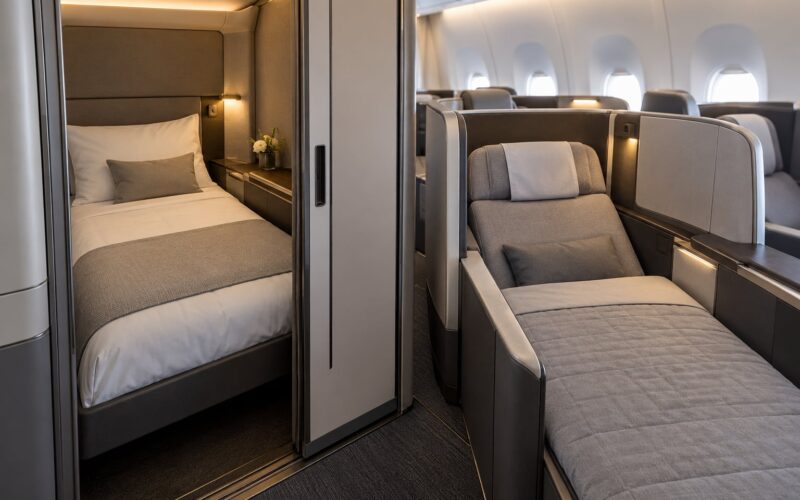
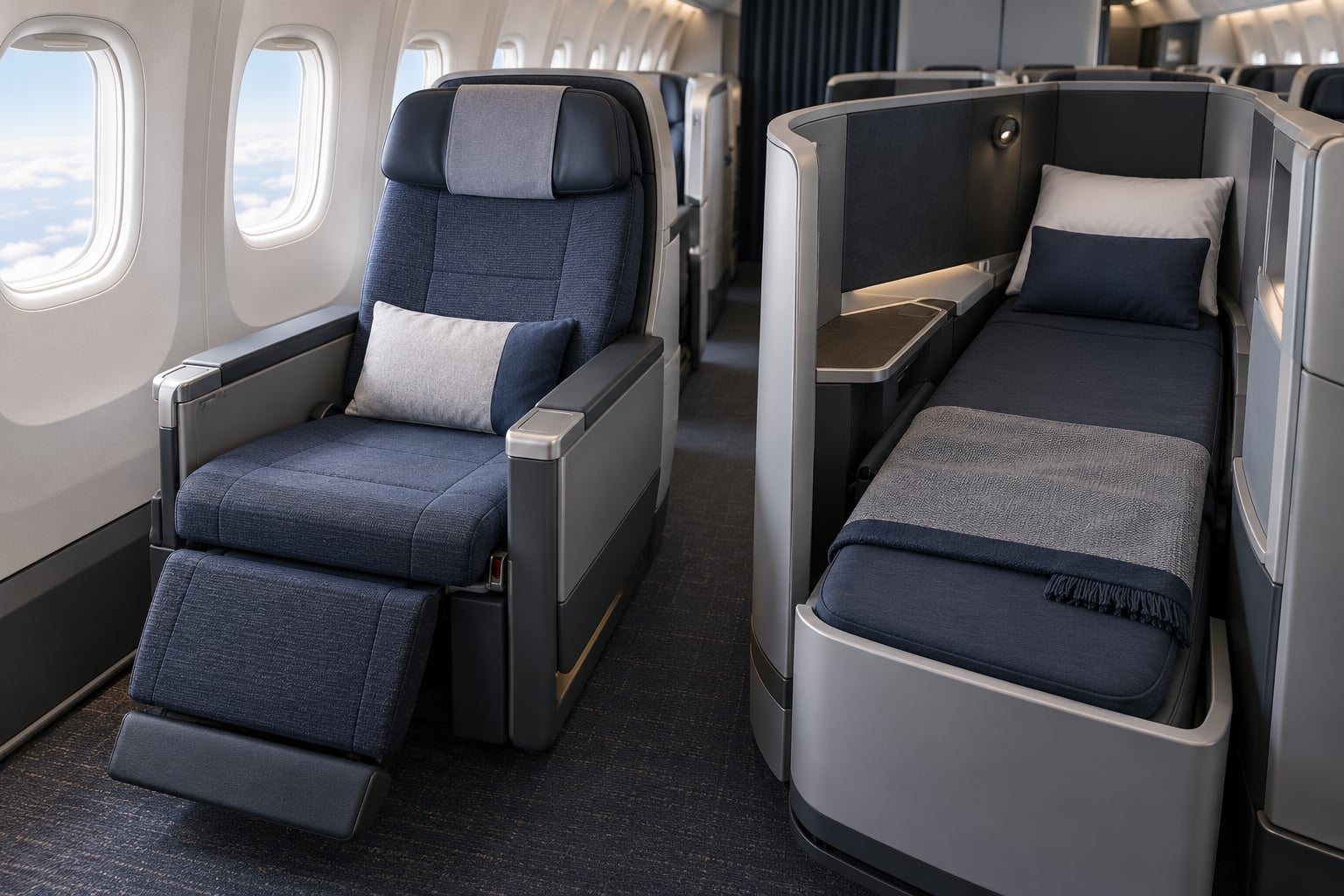
Most of what the marketing describes is incremental. A few more inches of width. Better catering. Priority boarding. Those are real but modest gains. One thing is not incremental: premium economy is a recliner built to hold you at an angle, while long-haul business class is a bed that also works as a chair, usually in a layout where every seat has direct aisle access. The bed is the gap, and it is the row that changes what you are able to do in the twenty-four hours after you land.
So the useful question is not which cabin is nicer. It is what one night of genuine sleep is worth on your specific trip, on your specific aircraft, arriving at your specific hour.
Table of Contents
- Premium Economy vs Business Class Worth the Cost at a Glance
- What is the difference between premium economy and business class?
- How much more comfortable is business class?
- Why comfort depends on the seatmap and the aircraft
- Is premium economy comfortable enough for a long flight?
- What amenities and services do the two cabins include?
- How do the fares compare and when is the upgrade worth it?
- Divide the remaining gap by the hours of sleep you would actually get
- Which should you choose?
- Frequently Asked Questions
- Is premium economy worth it for a long flight?
- Does business class always have a lie-flat seat?
- Is premium economy cheaper than business class?
- How much more does business class cost than premium economy?
- Which cabin is better for working on a plane?
Premium Economy vs Business Class Worth the Cost at a Glance
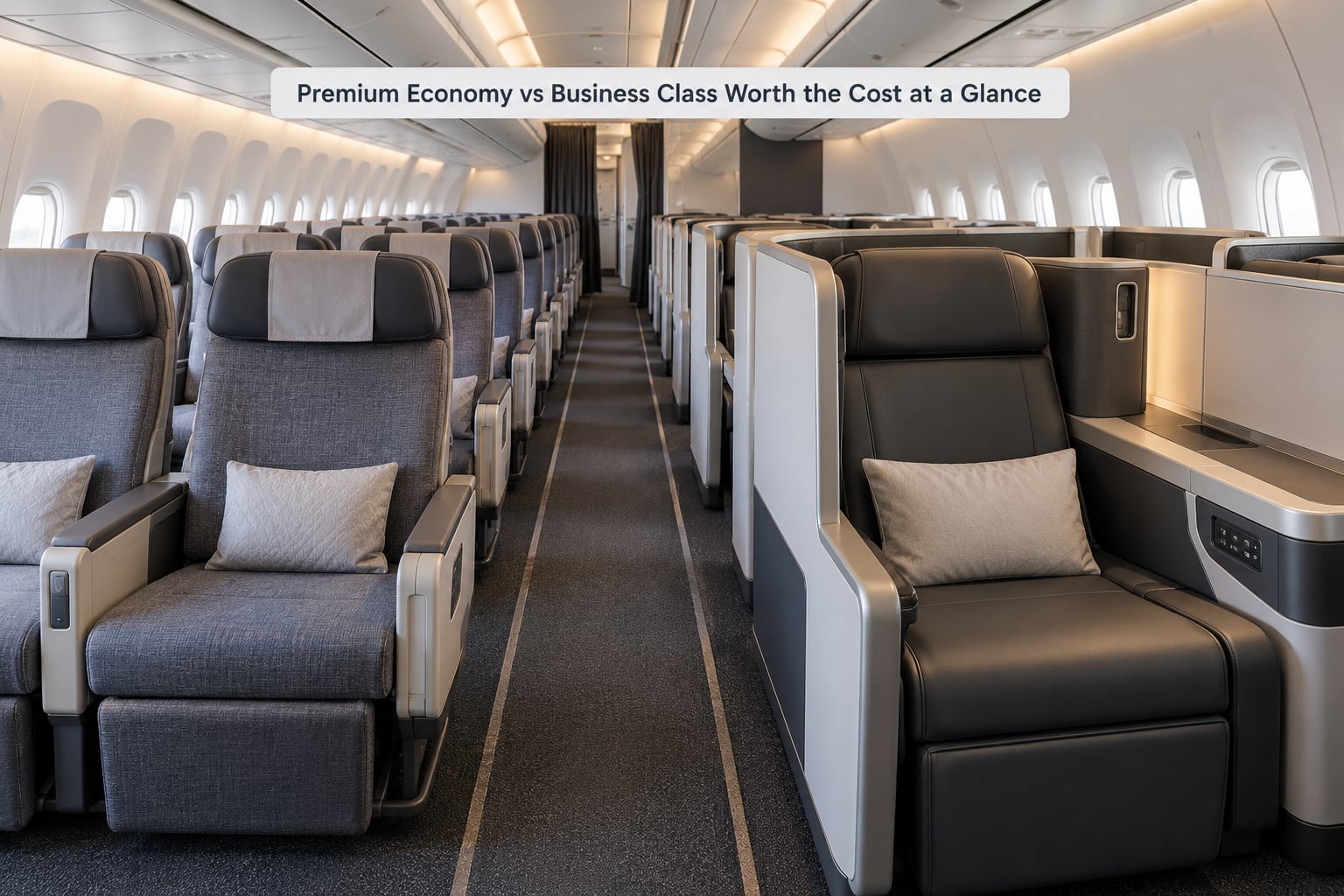
| What you get | Premium Economy | Business Class (long-haul) |
|---|---|---|
| Seat pitch | 35-42 inches | 44-60+ inches, or a 76-79 inch bed |
| Seat width between armrests | 18-20 inches | 21-28 inches, wider in some suites |
| Sleeping position | Recliner, 6-9 inches of recline, head and foot rests | Lie-flat or near-flat horizontal surface, depending on the product |
| Cabin layout | Usually 2-3-2 or 2-4-2, sometimes 2-2-2 on smaller aircraft | 1-2-1, so every seat has direct aisle access |
| Aisle access | You may need to climb over a neighbour to get out | Direct, from every seat |
| Privacy | A higher seat back, sometimes a small shell | Privacy shell, on some products a sliding door |
| Checked baggage | Usually two bags, often 23 kg each | Two to three bags, commonly 32 kg each on most carriers |
| Lounge access | Almost never included; a few carriers include it on their own flights | Usually included, though the cheapest fare brand in a cabin can drop it |
| Meal service | Improved but single-service, often the same dishes in a better setting | Multi-course, served at the seat on most long-haul products |
| Fare relative to economy | Roughly 40% to 80% more | Roughly 250% to 500% more |
| Best fit | Shorter flights, daytime sectors, families who need to sit together | Overnight sectors over nine hours, short trips, work you need to do in the air |
Those figures come from published airline seat maps and vary by aircraft type, not just by airline. The same carrier can fit two very different premium economy cabins on two aircraft it uses on the same route.
Fares move constantly with demand, booking date, route and how many premium seats a plane has, which is why the last row is a percentage band rather than a number. Anyone quoting you a fixed price for a month from now is guessing. Compare the three cabins on the same flight number, the same date and the same aircraft, or the comparison means nothing.
If you take one row from that table and ignore the rest, take aisle access. A 1-2-1 layout means nobody has to stand up and step over a sleeping stranger to reach the lavatory. On a nine-hour night that is worth more than the extra inches of width most people notice first.
What is the difference between premium economy and business class?
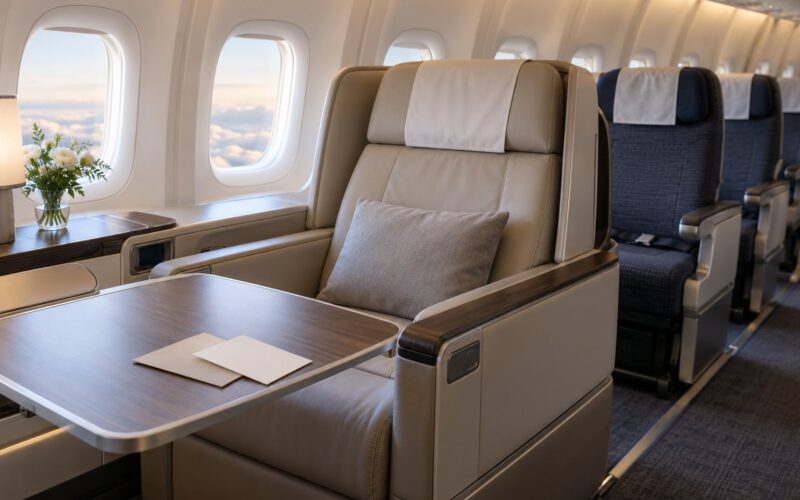
Premium economy sits directly above economy. You get more pitch, a wider seat, a deeper recline, better food, priority boarding and usually a second checked bag. That is the whole product.
It is not a small business cabin, and treating it as one is the most common mistake on this question. It remains an upright seat with a foot rest, in a dense row arrangement, served by crew who are also working a full economy cabin.
Business class, on a long-haul aircraft, is built around a different premise. The cabin is sparse enough that a seat can convert to a horizontal surface, usually with a shell or partition for privacy. The service ratio is far higher, so meals arrive at the seat in courses rather than from a trolley, and the seat itself becomes usable storage space rather than a chair you sit on for hours.
On a short-haul aircraft, business class is usually just economy with the middle seat blocked. On some carriers it is a recliner with a legrest, closer to premium economy than to a lie-flat bed. This is why cabin labels alone tell you very little, and why the aircraft matters as much as the class.
How much more comfortable is business class?
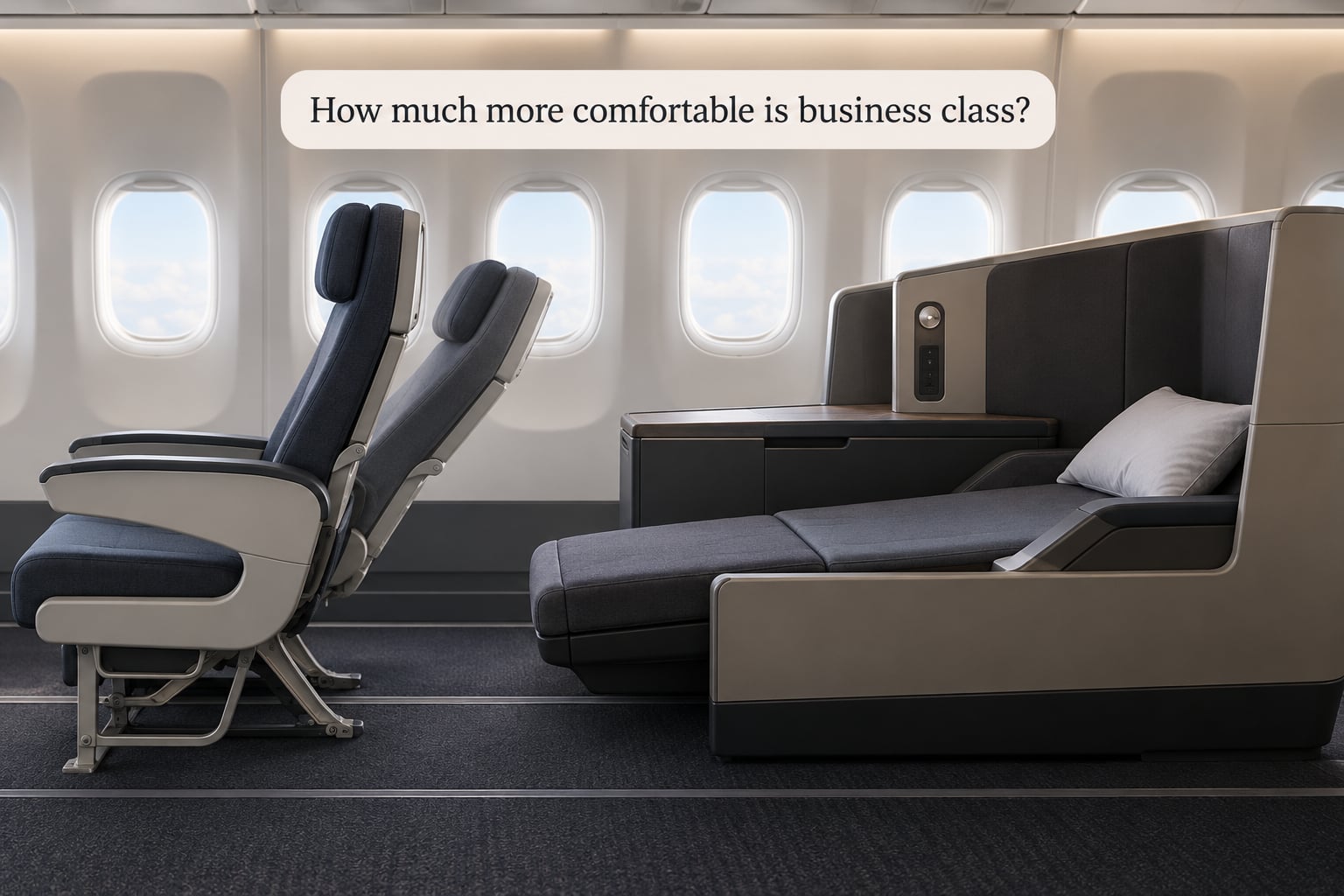
Much more comfortable, but not for the reason most people expect. The gap is not primarily width, food or service. It is whether you can lie down.
Here is what passengers actually notice, in rough order of impact on a long flight:
- Sleeping position. A recliner at 130 degrees of recline holds your torso at an angle. You can doze sitting up, which is not the same as sleeping. A flat or near-flat surface lets you lie on your side, which most adults need in order to stay asleep for more than a few hours.
- Getting up. In a 2-4-2 cabin you are in the middle of a row with two people beside you. In business class you stand up and go, without negotiating with a sleeping stranger.
- Noise and drafts. A sparser cabin is a quieter cabin. Less equipment movement, fewer knees hitting armrests, less cold air from the ceiling units directly over you.
- Storage. A side console, a shelf and a dedicated device area turn a seat into a small working desk. In a dense premium economy row, your bag lives under the seat in front of you.
- Working. A wide side surface and a stable table make laptop work realistic for an hour or two. In a recliner, a laptop on your thighs for nine hours is a specific kind of misery.
- Service. More crew per passenger means your drink order is answered when you make it, and a hot meal arrives when you are ready for it rather than when the trolley reaches your row.
Why comfort depends on the seatmap and the aircraft
Not every business seat lies flat, and the difference between a good business seat and a poor one is bigger than the difference between most premium economy cabins.
The best long-haul products fold to a fully horizontal bed of roughly 76-79 inches, with a mattress pad, a duvet and a seat you can raise and lower independently. Mid-range products stop at a steep recliner with a foot rest, which is functionally an upgraded premium economy seat with better food. Older cabins on 2-2-2 layouts offer no direct aisle access at all, which removes one of the main reasons to upgrade.
Check the seat map for the aircraft type, not the cabin name. If the product you are being offered is a recliner and you want a bed, book a different flight.
Is premium economy comfortable enough for a long flight?
On a well-built recliner, yes. On a thin one, no, and the difference is not subtle.
Premium economy earns its place on an overnight flight when the seat has real padding, a head rest, a foot rest and enough recline depth to take pressure off your lower back. You will sleep, but in fragments. Expect an hour or two of decent rest on a nine-hour sector rather than a full night.
The cases where it is not enough are specific. A red-eye domestic flight of six hours or more, where you have no way to sleep through the whole thing. An overnight transatlantic where you land and have to function immediately. Any flight with a back, knee or mobility problem, where a fixed upright seat and limited legroom become a real physical cost rather than a mild annoyance.
Two practical notes. First, seat selection matters more in this cabin than in any other, because the rows are dense and the good seats go early. Bulkhead rows give legroom, exit rows give width, and window pairs give you a wall to lean against when the recline in front of you is not generous. Second, the recline in front of you is a person making a choice about their own back, and the gentle elbow approach works better than anything else.
Traveling with children changes the maths too. If a family needs to sit together, a 2-4-2 premium economy row keeps everyone adjacent. Moving to a 1-2-1 business cabin usually means splitting up, which is harder to manage than a few extra inches of legroom.
What amenities and services do the two cabins include?
Some of the perceived upgrade is services, and services are where fare-brand differences bite hardest. A premium economy fare buys you the seat and the catering. Almost everything else on this list depends on the airline, the route, the fare brand you booked or the status you hold.
Meals. Premium economy usually gets an upgraded main course and better drinks service, often presented in proper crockery. Business class gets multi-course dining on most long-haul products, frequently served at the seat. The food gap is real but modest, and on a nine-hour flight it matters far less to most people than the seat does.
Lounge access. This is the cleanest split between the two cabins. Business class usually includes it, subject to the fare brand; the cheapest business fare on some carriers drops to a single bag and no lounge, so read the fare rules before assuming. Premium economy almost never includes it, though a small number of carriers include it on their own operated flights. If lounge time is the main thing you want, buy a day pass or a single-visit lounge membership instead of upgrading the seat. It costs a fraction of the fare gap and the two decisions are independent.
Boarding and ground service. Priority security and boarding come with most premium economy fares, and with most business fares. In practice, that priority is worth more than it sounds on a long check-in line.
Baggage. The common step is from two bags at 23 kg each to two at 32 kg, sometimes three. On any trip where you are checking more than a suitcase, read the allowance on the business fare carefully, because the lightest fare brands in that cabin can be worse than a full premium economy ticket on baggage alone.
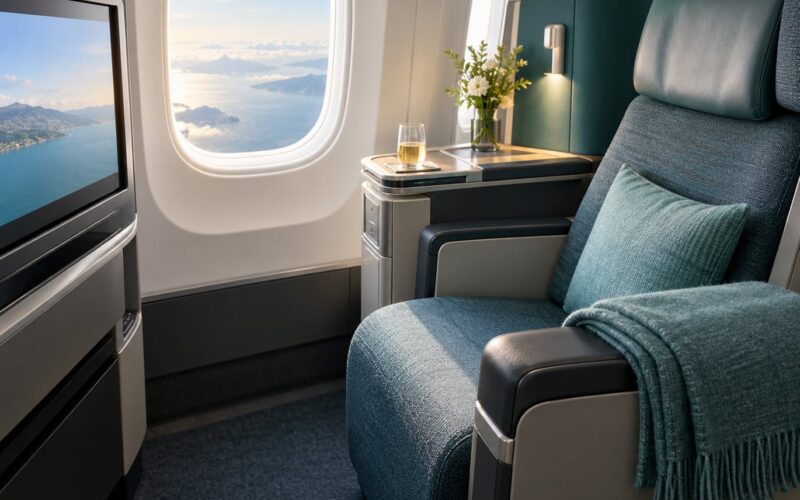
Onboard. Screen size, power outlets at every seat, bedding and amenity kits all improve as you move up, and the entertainment screen is often a large part of why the cabin feels different. Wi-Fi quality is a separate matter entirely: it varies by aircraft, cabin and how many people are online, not by cabin class, and no upgrade fixes a crowded sky.
Things business class does not include. A guaranteed lie-flat seat, a private bathroom, a lounge on every airport, immunity to jet lag, or any real control over the arrival time. It buys you a bed and an easier trip, and that is all it buys.
How do the fares compare and when is the upgrade worth it?
On long-haul, premium economy usually sits 40% to 80% above the economy fare on the same flight, and business class runs roughly 250% to 500% above it. Measured against premium economy directly, business commonly lands at about 1.8 to 3 times the price.
That gap exists for a structural reason, not a marketing one. A lie-flat seat takes about three times the floor space of an economy seat, which means fewer rows of seats and fewer passengers. More crew per passenger costs money. Premium food, bedding and lounge access cost money. You are paying for cabin density and service ratio, and those two things are the fare.
There is one structural trick worth more than any fare-hunting. On a round trip, book business class on the overnight leg and premium economy on the daytime leg. You get your bed on the flight where you will actually use it, and on the daytime flight you were never going to sleep anyway. That structure typically lands meaningfully below a round-trip business fare, and it is the answer most people never consider because they assume the cabin has to match on both legs.
The gap also narrows in predictable windows: shoulder season departures, one-stop routings that pass through a hub, secondary-city origins rather than major gateways, and mid-week departures on routes that fill up at the weekend. Premium cabin fares also behave differently from economy as departure approaches, tending to get more expensive rather than less, so the last-minute cheap window that economy has often does not exist up top.
Divide the remaining gap by the hours of sleep you would actually get
This is the calculation that turns an opinion into a decision, and it takes three steps.
- Price all three cabins on the same flight number and date. One search result showing a business fare is meaningless if it is on a different aircraft from your premium economy fare.
- Subtract what the business fare already gives you elsewhere. Lounge entry you would have bought as a day pass, the extra checked bag you were going to pay for anyway, the seat selection fee, any status benefits you already hold. These reduce the real gap.
- Divide what is left by the hours of sleep you would actually get. An overnight sector might yield six to seven usable hours in a lie-flat seat and two at a stretch in a premium economy recliner. That final figure is what a night of sleep costs you on this trip, and it is the only number here that is specific to you.
Run it for a seven-hour daytime flight and the answer is obvious: divide by zero useful sleep hours and premium economy wins. Run it for a ten-hour overnight arrival with a meeting the next morning and the arithmetic tends to move the other way.
If you are paying in points rather than cash, the same logic applies in cents per point. Take the fare the award would have cost in cash, subtract what the award gives you elsewhere, divide by the points required. Transatlantic award bookings also carry carrier surcharges and taxes that sit on top of the points, and those need to be in the calculation or the redemption value is overstated.
Which should you choose?
Choose premium economy when: the flight is under seven hours; the sector is in daylight and you have no intention of sleeping; you are travelling with children and need a row together; you want space, better food and priority boarding rather than a bed; or the business fare on that specific flight sits more than double the premium economy fare.
Choose business class when: the sector is overnight and longer than nine hours; you land into a meeting, an event or a holiday you cannot afford to waste; the trip is short enough that losing day one is expensive; you have a back, knee or mobility issue that a fixed upright seat will punish; or it is a milestone trip where the memory of the journey matters as much as the destination.
Do neither when: the flight is under five hours. In that case buy an exit row or a bulkhead seat in economy, choose an aisle over a window, and keep the difference. On a short sector the cabin gap is compressed and the fare gap is not.
Split the trip when: the itinerary has one overnight leg and one daytime leg. Take business on the night, premium economy on the day. It is the single best value structure in premium travel and almost nobody uses it.
One last variable that is easy to ignore. Some experienced long-haul travellers simply have a high tolerance for a bad seat and will work through twelve hours in economy without regret. If that is you, the calculation is not worth running, because you already know the answer for yourself.
Frequently Asked Questions
Is premium economy worth it for a long flight?
Premium economy can be worth it on overnight or lengthy flights when the seat has noticeably more legroom, a better recline, a head and foot rest, and improved service. It is less compelling on a short daytime sector, where the extra comfort barely registers and the money buys you a couple of inches. Check the seat map for the specific aircraft before paying, because premium economy quality varies widely by carrier and by aircraft type.
Does business class always have a lie-flat seat?
No. Business class products vary widely by airline and aircraft. Some seats fold to a fully horizontal bed of roughly 76-79 inches, while others are angled recliners with a foot rest or only partially flat. Look for the exact seat product and aircraft type on the airline’s seat map. On a 2-2-2 layout you also lose direct aisle access, so check that too before booking.
Is premium economy cheaper than business class?
Usually, yes, but the amount varies by route, airline, demand and seat availability. On long-haul, business commonly costs about 1.8 to 3 times the premium economy fare on the same flight. The right comparison is the extra cost for your specific itinerary against the improvements you will actually use, not a general ratio taken from another route.
How much more does business class cost than premium economy?
On long-haul routes, business class typically runs about 1.8 to 3 times the premium economy fare. Premium economy itself usually sits 40% to 80% above the economy fare, while business runs roughly 250% to 500% above it. The gap exists because lie-flat seats take several times the floor space, which means fewer rows, and because service ratios in the cabin are far higher.
Which cabin is better for working on a plane?
Business class is generally better for focused work because it offers a wider side surface, a real table, a large screen, more storage and fewer people around you. Premium economy can be enough for light work like email or reading, especially on a daytime flight. Neither cabin fixes weak Wi-Fi, which depends on the aircraft and how many passengers are online, not on the cabin you booked.
So: premium economy below seven hours, business class on an overnight sector over nine, and the arrival time breaking the tie in between. The biggest win is usually structural rather than a cabin label, which means shifting a date, changing an origin, taking a one-stop routing or splitting the cabin between the two legs. Before you spend, divide the remaining gap by the hours of sleep you would actually get. That number decides it faster than any rule of thumb.