Most people who cannot sleep on airplanes are not simply tired. The cabin works against sleep from several directions at once: it is dry, pressurized, loud, lit, cold, moving, and completely unfamiliar. Understanding why you cannot sleep on airplanes matters because five of those causes are adjustable and one or two are not.
Your body settles into sleep when the room around it is dark, quiet, cool, physically supported and safe. A plane breaks all five conditions and keeps breaking them for the entire flight, so most passengers drift into light sleep and then get pulled out of it every twenty minutes.
Here is the honest version: some people sleep fine on planes, and some genuinely cannot, no matter what gear they pack. The goal is not perfect sleep. It is fewer interruptions and a stretch of real rest long enough to feel better on arrival.
Table of Contents
- Why You Cannot Sleep on Airplanes: Common Causes at a Glance
- How Cabin Noise Disrupts Your Sleep
- What Does Dry Air Do to Your Body?
- How Light, Temperature, and Cabin Pressure Affect Rest
- Why an Airplane Seat Can Make You Feel Awake
- How posture and legroom break up sleep
- Which seat helps when you cannot sleep on airplanes
- How Turbulence and Movement Trigger Anxiety
- Easy Fixes Before Your Flight
- Shift your body clock before a time zone change
- Choose the seat that solves your specific problem
- Build a small sleep kit
- Set expectations honestly
- Easy Fixes While You Are on Board
- Block light first, then noise
- Hydrate and move
- Ask your neighbours once, early
- Know when not to sleep
- Know the medication question
- Frequently Asked Questions
- Is it normal to not be able to sleep on a plane?
- Can you sleep during takeoff and landing?
- Will Benadryl make me sleep on a plane?
- Does alcohol help you sleep on a flight?
- What does airplane cabin pressure do to your body?
- Why am I exhausted after a flight even though I slept?
- What to Do First
Why You Cannot Sleep on Airplanes: Common Causes at a Glance
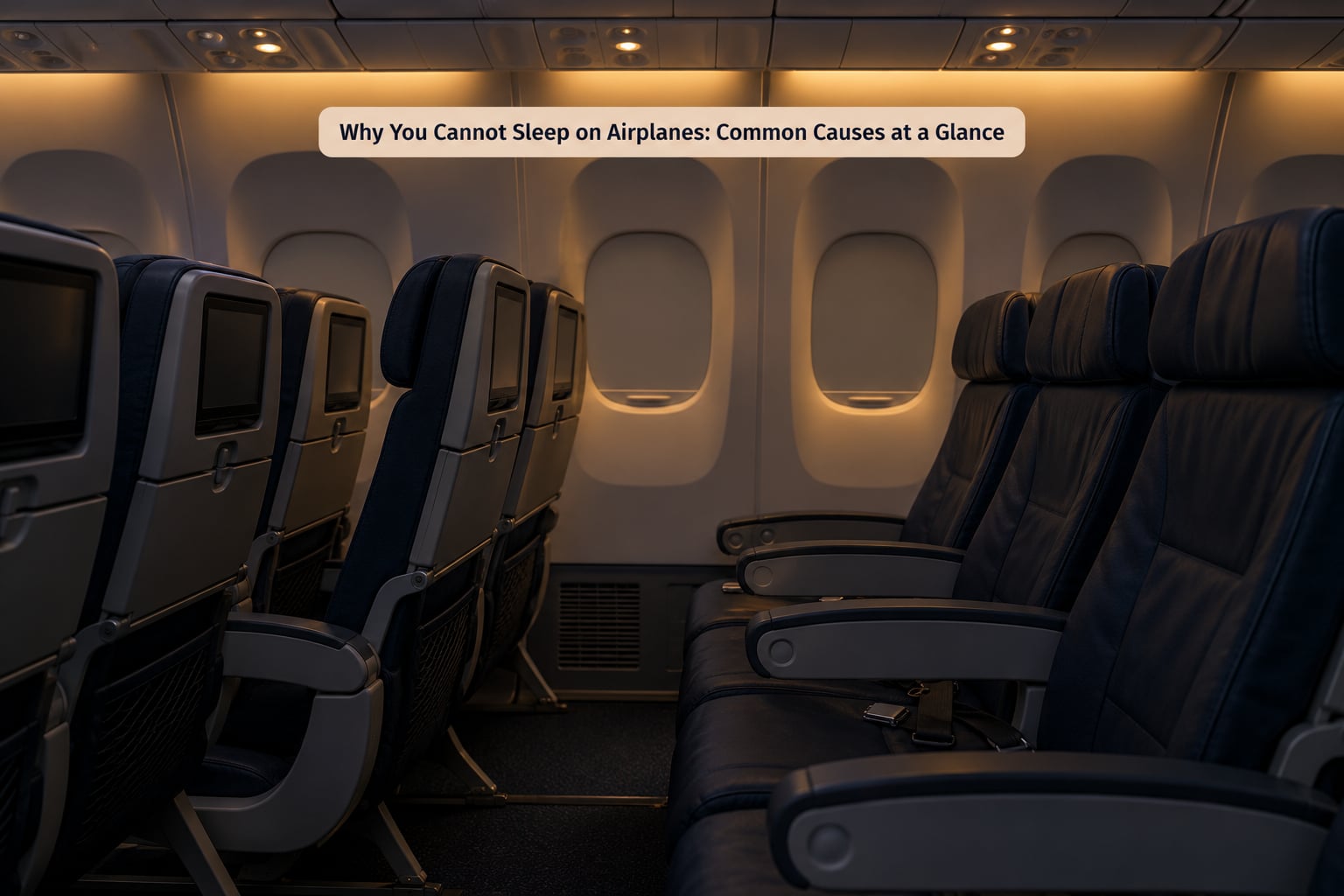
Nine things account for nearly all of it. They usually arrive together rather than alone, which is why fixing one of them rarely transforms the flight.
| Cause | What it does to sleep | Can you change it? |
|---|---|---|
| Cabin altitude near 8,000 ft | Slightly lowers blood oxygen, causing light drowsiness but more frequent micro-awakenings | No |
| Dry air, often 10-20% relative humidity | Irritates the nose and throat, dries skin, adds to dehydration and general discomfort | Partly |
| Continuous engine noise, roughly 75-85 dB at cruise | Masks the quiet cues your brain uses to stay asleep and pulls attention to unexpected sounds | Yes |
| Cabin and window light | Suppresses melatonin, especially the short wavelengths from screens and overhead LEDs | Mostly |
| Upright posture and limited legroom | Back and neck tension build quietly and pull you out of deep sleep | Partly |
| Constant small movement | Every air pocket and cabin jolt triggers a brief arousal you may not notice consciously | No |
| Temperature swings and drafts | Cold feet and shivering fragment sleep; a warm cabin does the opposite | Partly |
| An unfamiliar place | The first-night effect keeps part of the brain watchful in any new bed or room | No |
| Anxiety and a shifted body clock | Alertness from nerves, plus jet lag timing, works against your own bedtime | Yes |
That last row deserves attention. Sleep researchers have documented a consistent pattern where people sleep worse in a new environment than in a familiar one, even in comfortable conditions, and studies of brain activity suggest one hemisphere stays more active during the first night in an unfamiliar place. A plane is about as unfamiliar as a sleeping environment gets, and you only get one night.
How Cabin Noise Disrupts Your Sleep
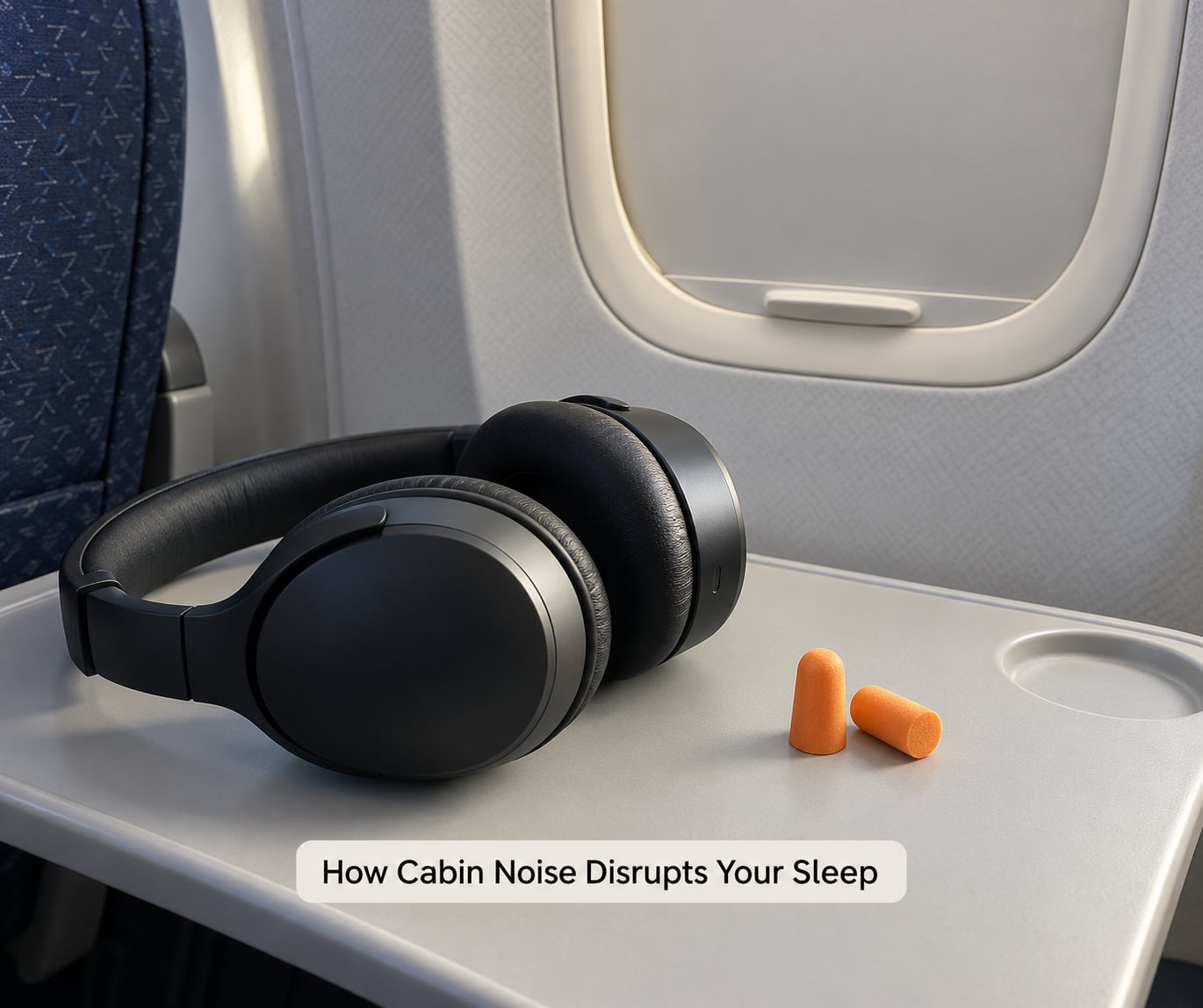
Cruise noise is the quietest reason to fail and the most underrated one. A steady bedroom sits around 30 decibels, while a cruising cabin measures roughly 75-85 dB. You stop hearing that sound after a few minutes, but your brain keeps tracking it.
What harms sleep is rarely the constant engine roar. It is the change: a cabin conversation starting two rows back, a service cart rattling, a crying infant, the lavatory flush, the chime for the seat belt sign. Each one is loud against a background you had stopped noticing, and each produces a small arousal you wake from without ever knowing you woke.
| In-flight sound | How disruptive it tends to be |
|---|---|
| Engines and airflow at cruise | Steady and dulling rather than startling, but it masks everything quieter |
| Galley and cabin crew service | Sharp and intermittent, concentrated near the front and back of the aircraft |
| Seat belt chime and announcements | Unexpected and attention-grabbing, which is exactly the problem |
| Crying infant, conversation | The most disruptive category, because it is irregular and human |
Two fixes handle most of it. Foam earplugs or noise-reducing earplugs damp the sharp irregular sounds without cutting the engine hum that would otherwise feel wrong. Noise-cancelling headphones handle steady low-frequency noise well and handle a crying baby not at all.
Seat choice matters as much as gear. Galleys, doors and lavatories generate predictable noise, so rows near them suit a passenger who wants to be woken up by a stewardess with coffee rather than a passenger who wants to sleep. Ask the crew before you commit; aircraft layouts differ, and so do airline rules about who can recline.
What Does Dry Air Do to Your Body?
Aircraft cabins are pressurized for safety, not for comfort, and they run very dry. Relative humidity often sits between 10% and 20%, while most bedrooms sit near 40-50%. That gap pulls moisture out of your eyes, nose and throat within the first hour.
The result is not sleep deprivation by itself, but discomfort that makes staying asleep harder. A dry nose and throat, contact lenses that turn to sand, and tight skin all compete with the boring business of falling asleep. If you are dehydrated, low blood volume also produces headaches and restlessness, and caffeine withdrawal adds a second headache on top.
Sensible measures: drink water steadily rather than in large amounts at once, skip alcohol early since it dries you further, and choose a saline nasal spray over a medicated decongestant if your nose feels blocked. Add a moisturising layer on your face and lips if you are the type who notices it.
Masks need a caveat. A mask that pinches your nose, leaks at the sides or makes your ears pop is worse than no mask, so test one at home first. If you have asthma, sinus problems, heart or lung conditions, or take regular medication, ask a doctor or pharmacist before adding anything, including anything sold as a sleep aid.
How Light, Temperature, and Cabin Pressure Affect Rest
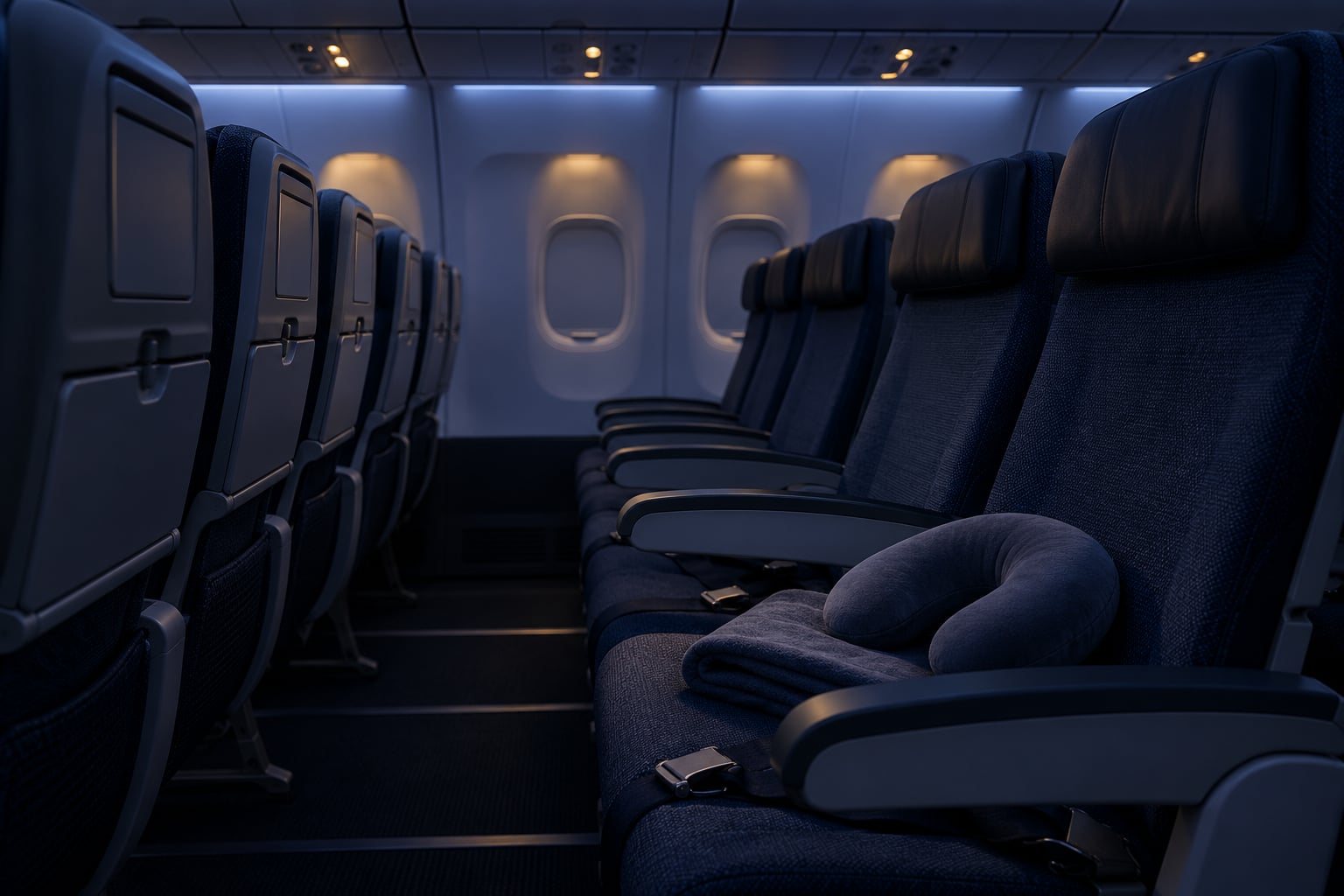
Light is the factor most passengers control well and most often fail to control completely. Cabin lighting is kept dim for night flights but is rarely dark, and any overhead light or screen reading light switched on by a neighbour cuts straight through the shade line.
Use a blackout eye mask that covers the nose bridge and the sides of the face, since a lot of light leaks in at the edges. Fit it before you are tired, because a mask that needs adjustment is not helping. If you plan to watch anything, deal with it before you settle.
Temperature works on the same principle of physical comfort. Cabins are kept cool to suit the majority of passengers, so a passenger who is cold cannot get warmer without layers. Bring a long-sleeved shirt you can roll up and a socks layer, and put shoes under the seat rather than your feet during the coldest hours.
Pressure is the one that can end a flight early rather than a nap. A cabin pressurised to the equivalent of about 8,000 feet shifts gas in your ears and sinuses. The discomfort that follows is called airplane ear, and it shows up most often during descent.
It is worth knowing that a research survey of air travellers found roughly 84% reported some ear discomfort on at least one flight. Yawning, swallowing, chewing gum and equalising your ears during descent help. Passengers who get severe ear pain should talk to a flight attendant rather than pushing through it, and anyone with an existing ear or sinus condition should ask their doctor before flying.
Why an Airplane Seat Can Make You Feel Awake
An aircraft seat holds you upright, angled slightly back, with no way to change position freely. Sleep needs support, and a standard economy seat removes most of the options.
How posture and legroom break up sleep
An upright or slightly reclined position leaves your neck and lower back working to hold you there. That low-grade muscular effort is easy to ignore while awake and impossible to ignore once you are asleep, because tension signals keep nudging you toward wakefulness. A rolled blanket behind your lower back and a small cushion under your neck go a long way for very little weight.
Recline angle also has evidence behind it. A positional imaging study of how the spine behaves in different seats found that a recline of around 135 degrees offered the best balance, with much less strain than sitting fully upright and far less neck flexion than dropping flat. Practical takeaway: recline as far as the person behind you can tolerate, and stop before you feel you are going to be kicked.
Which seat helps when you cannot sleep on airplanes
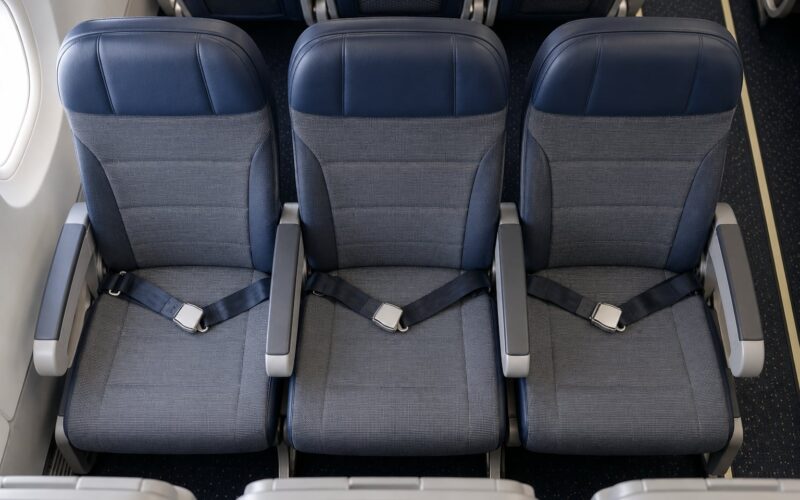
A window seat gives a wall to lean against and a reliable wall for the eye mask, but you will be disturbed every time someone uses the lavatory. An aisle seat is good for movement and stretching but has no side support and constant foot traffic. A bulkhead row gives legroom and no one behind you, and comes with a wall-mounted tray table that is unusable when the seat reclines. Seat 11A and similar numbered rows are not universally bad; it depends on the aircraft, so check the seat map for your airline and plane type before deciding.
For a night flight, match the choice to flight length. Long haul rewards a window seat and a support setup. Shorter flights are often better in an aisle seat, where you can stand and walk every hour or so. No seat guarantees sleep, and one flyer on an Australian Frequent Flyer forum thread put it plainly: even in a premium cabin, noise, activity and a new environment make sleep not an easy option.
How Turbulence and Movement Trigger Anxiety
Takeoffs, landings, go-arounds and air pockets produce movement your body registers before your mind does. For a nervous flyer that response is larger, and the adrenaline costs sleep for a long time afterward.
It helps to know what normal flight feels like. Bumps are common and usually brief, and the cabin crew are trained to assess conditions they do not want you to worry about. Routine cabin altitude is deliberately kept at a safe level and has nothing to do with a pressure failure; a genuine loss of cabin pressure is rare, and crews respond by descending to a lower altitude where the situation is manageable.
Techniques that work while seated: slow breathing with a longer exhale than inhale, unclenching the jaw and shoulders, and a body scan from feet to head. Anyone with severe anxiety or a diagnosed fear of flying does better with preparation than with in-flight improvisation, and that conversation belongs with a professional.
Easy Fixes Before Your Flight
Most of the useful work happens before you board, and it is mostly about three things: light, timing and comfort.
Shift your body clock before a time zone change
For a long time zone crossing, start moving your sleep and wake times a few days ahead in the destination direction. Research that modelled close to 55,000 flight itineraries found that shifting your schedule before departure shortens the recovery period afterwards, with the size of the benefit depending on direction and number of zones crossed. The effect is not instant, and it depends on how many zones you are moving.
Choose the seat that solves your specific problem
If noise ruins your sleep, pick a mid-cabin row away from the galley and lavatories. If you need to walk during the flight, take an aisle. If light is your problem, take a window seat on the shaded side of the aircraft and bring a mask that fits. Check the seat map for your specific flight rather than trusting a rule of thumb.
Build a small sleep kit
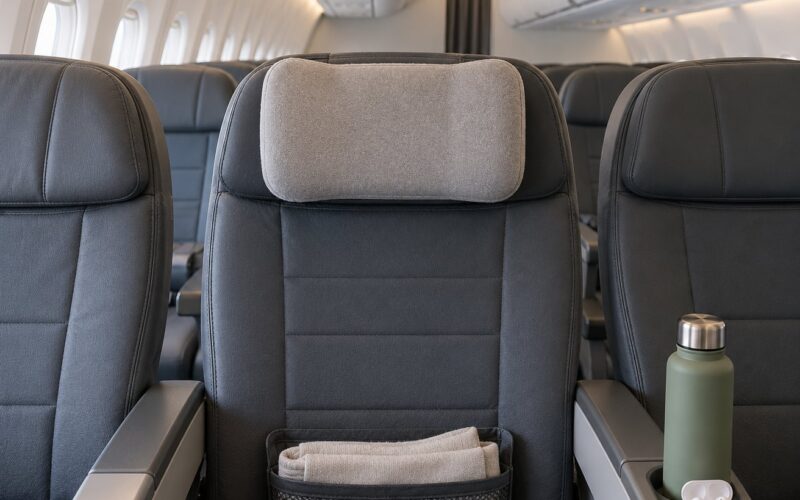
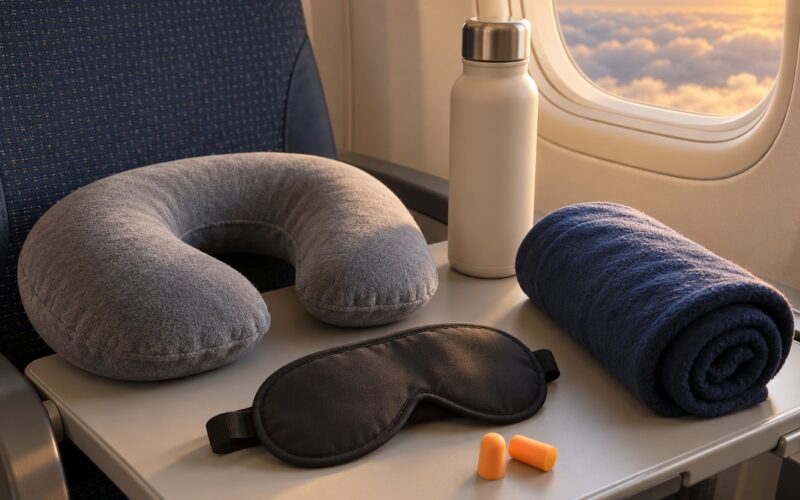
A blackout eye mask, earplugs, a neck pillow, a rolled blanket for lumbar support, layers for your feet, and a refillable water bottle covers most of it. Wear loose clothing rather than jeans, since denim restricts hip and knee movement and makes it harder to find a comfortable position over several hours.
Set expectations honestly
Aim for rest, not eight hours of sleep. On an 8-hour flight you will probably complete one or two full sleep cycles at best, and you may wake during each one, which leaves you groggy rather than rested.
Easy Fixes While You Are on Board
Once the doors close, the order of operations matters more than the number of tricks you try.
Block light first, then noise
Fit the eye mask before you settle, then add ear protection. Light has a direct effect on melatonin, while noise works through your attention, and handling them in order gets the biggest gain for the least effort.
Hydrate and move
Sip water through the flight and get up at least once an hour. Long seated stretches feel uncomfortable rather than dangerous in most passengers, but pain, swelling or redness in one leg, or chest pain and breathlessness, are reasons to speak to a crew member immediately rather than to work through it.
Ask your neighbours once, early
A short request at boarding, when people are still settling, works better than a whispered complaint at three in the morning. Many travellers find that a simple mention of the reading light gets it switched off.
Know when not to sleep
Stay awake for takeoff and landing, and for any announcement you need to hear. Crew cannot reliably wake every sleeping passenger, which is exactly why your seat belt needs to be on before the sign comes back on. If you plan to sleep on a short flight, ask a flight attendant at boarding to wake you, and set two alarms rather than one.
Know the medication question
Melatonin is widely used to move sleep timing for travel, with studies supporting doses well below the common retail amounts, in the 0.5 to 5 mg range. Sedating antihistamines such as diphenhydramine make many people drowsy, and they also cause grogginess, dry mouth and reduced alertness after waking, which is a poor trade in a place where you may need to respond quickly.
Either way, talk to a doctor or pharmacist before you fly, particularly if you take other medications, and never combine sedating medication with alcohol on board.
Frequently Asked Questions
Is it normal to not be able to sleep on a plane?
Yes, more than most travellers expect. Fragmented sleep is the usual pattern rather than no sleep at all, and most passengers describe dozing in short stretches rather than sleeping continuously. Even travellers in premium cabins report that noise, movement and an unfamiliar environment make real sleep difficult. Treat the goal as restful hours rather than a full night, and accept that short flights rarely deliver real sleep at all.
Can you sleep during takeoff and landing?
Stay awake for both. Crew cannot wake every sleeping passenger if something needs an immediate response, and ear pressure equalisation is easiest while you are still awake during descent. On a longer flight, ask a flight attendant at boarding to wake you before the seat belt sign comes on, and set more than one alarm so you are not relying on a single one.
Will Benadryl make me sleep on a plane?
Diphenhydramine makes many people drowsy, so yes, you will probably feel sleepier. The catch is what happens after: grogginess, dry mouth, confusion and slowed reactions, all of which last well past the landing. Melatonin at low doses timed to destination bedtime is usually better tolerated. Check with a doctor or pharmacist before taking either, especially alongside other medication.
Does alcohol help you sleep on a flight?
Alcohol makes you feel drowsy quickly, which is why it is a common trap. It suppresses REM sleep early, then fragments the second half of the night, so you wake tired rather than rested. It also increases dehydration and worsens ear pressure during descent. Skip the first drink, drink water instead, and treat any nightcap as a mood decision rather than a sleep aid.
What does airplane cabin pressure do to your body?
Cabins are pressurised to the equivalent of about 8,000 feet rather than sea level, so blood oxygen saturation sits slightly lower than normal. That mild reduction can bring on drowsiness but also causes more frequent micro-awakenings. Pressure changes shift gas in your ears and sinuses, which is the source of airplane ear, and surveys suggest most air travellers report ear discomfort on at least one flight.
Why am I exhausted after a flight even though I slept?
Because sleep that is repeatedly interrupted rarely reaches the deeper stages, so the hours you spend on board count for less than they should. On an eight-hour flight you may complete only one or two full cycles, and waking partway through leaves you disoriented rather than restored. Poor in-flight sleep also arrives with jet lag already starting, so the tiredness compounds before you reach the hotel.
What to Do First
Start by naming your biggest problem, because the fixes are not interchangeable. When you cannot sleep on airplanes, the cause is usually two or three of these stacked on top of each other, and the answer changes depending on which one is loudest for you. If noise ruins your nights, pick a mid-cabin row and get earplugs. If light is the issue, take a window seat and a blackout mask that fits properly.
Then handle your body before boarding: consistent sleep for a few nights before, no excess caffeine, no alcohol, loose layers, hydration on board. In the air, work through the four controls in order: light, noise, posture, hydration.
Follow crew instructions at all times, stay awake through takeoff and landing, and treat everything here as general comfort guidance rather than medical advice. If sleep problems are affecting your travels regularly, a conversation with your doctor is a better first step than a stronger sleep aid.