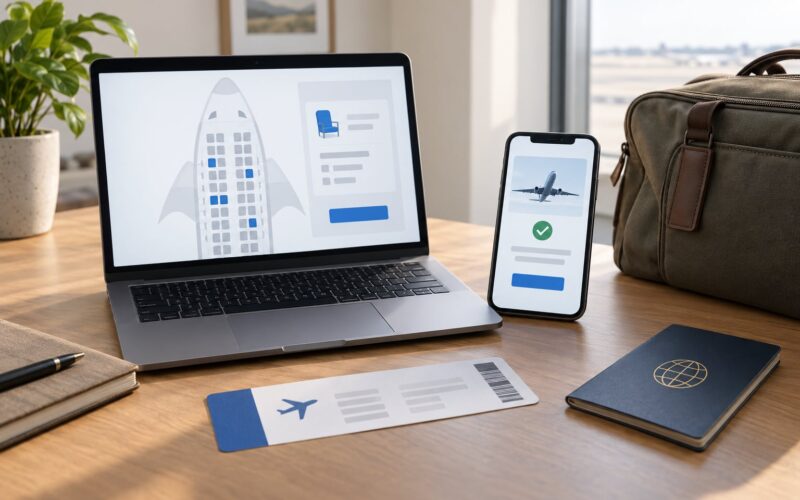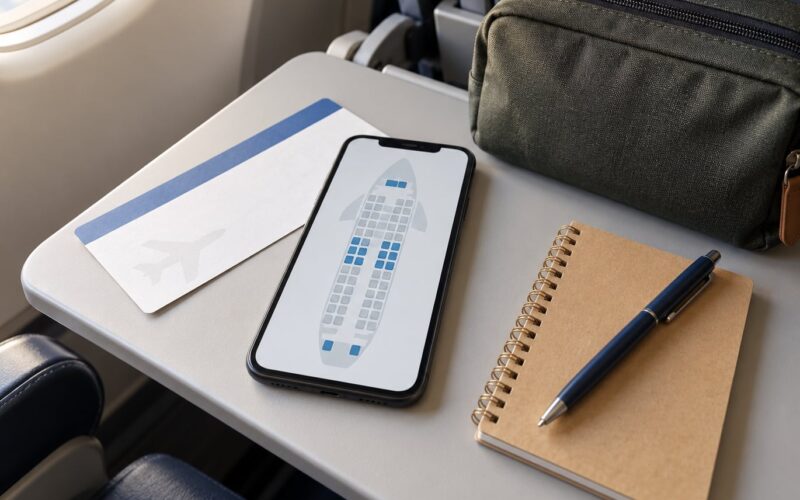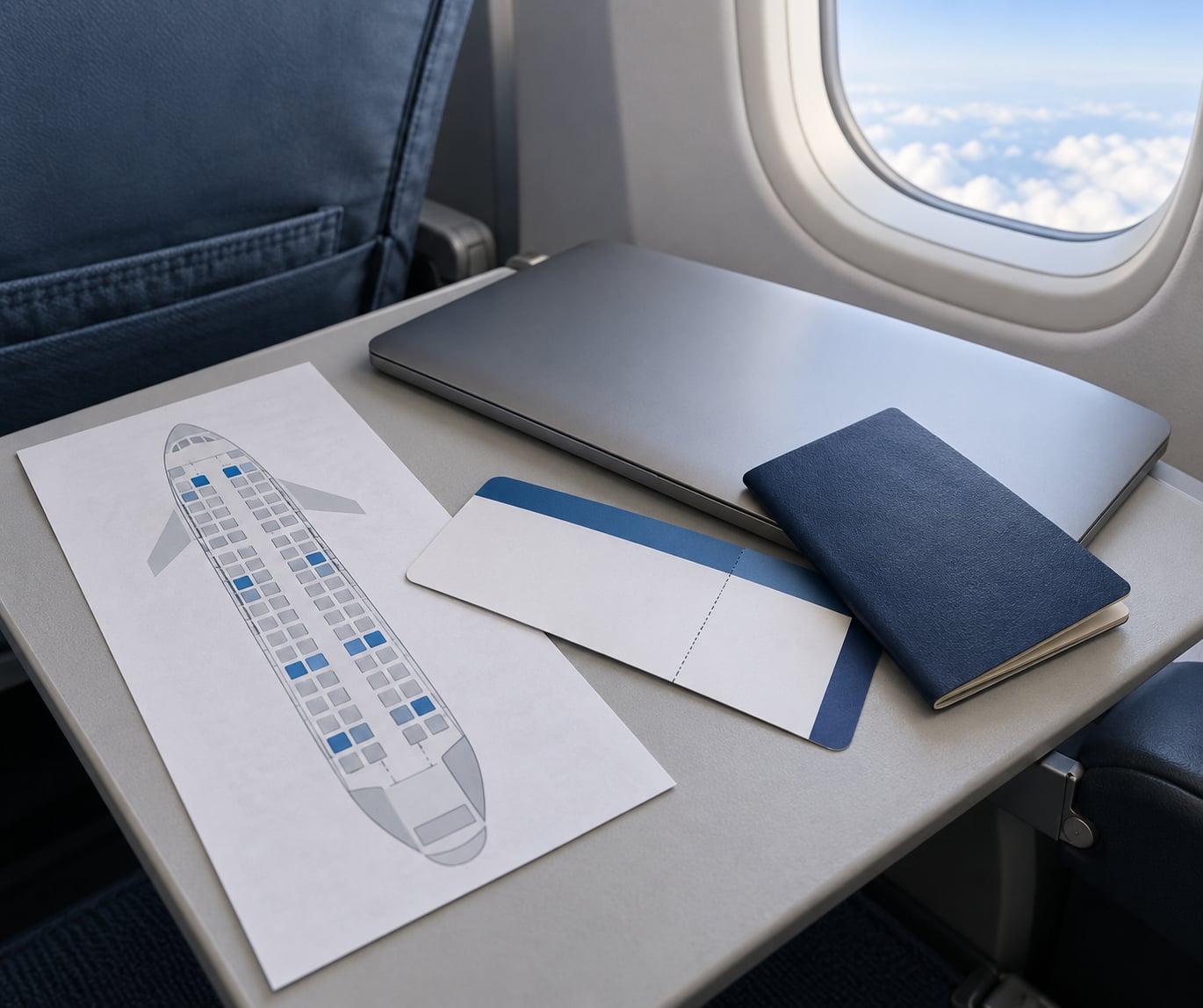
If you book a flight and never touch the seat map, the airline assigns you a seat anyway, usually when you check in online and sometimes only at the gate. You are not taking a risk of flying without a seat, and you are not being bumped for skipping the choice. What you do give up is control over which seat you get.
So what happens if you do not pick a seat comes down to four things: which airline you fly, which fare you bought, which aircraft is assigned to your route, and how full the cabin is when check-in opens. Those four variables decide whether you land in a window seat or wedged in the middle of a row for six hours.
I have watched this play out enough times to know the pattern. Most people who skip selection get a perfectly workable seat and think about it again only when they are climbing over a stranger in the middle. A smaller group ends up split from the people they traveled with, which is the outcome people actually complain about later.
Table of Contents
- What Happens If You Do Not Pick a Seat?
- When Does the Airline Assign You a Seat?
- Is an Assigned Seat Random?
- What Happens With Basic Economy and Other Restricted Fares?
- Will the Airline Try to Keep You in the Same Seat Number?
- Can You Choose a Seat During Check-In or at the Gate?
- Window, Aisle, or Middle: What Should You Look For?
- What Can You Do If You Do Not Like the Assigned Seat?
- A Quick Guide to Automatic Seat Assignment
- Frequently Asked Questions
- Do airlines randomly assign seats if you do not make a choice?
- Why did the airline give me a different seat from the one I selected?
- Can I change my seat at the airport if I skipped selection?
- Is seat selection included with every economy fare?
- What happens if no preferred seats are left during check-in?
- Should I ask the gate agent to change my assigned seat?
- What to Do First If You Skipped Seat Selection
What Happens If You Do Not Pick a Seat?
The short version: the airline places you in whatever seat is still open once it has allocated the seats it wants to sell or protect. That usually happens at check-in, which for most US carriers opens roughly 24 hours before departure for domestic flights and a bit sooner for longer international itineraries.
Automatic assignment does not mean a slot machine. Most systems work from what is not yet sold. Premium seats, exit rows, extra-legroom rows and paid seats are allocated first, and whoever is left without a choice gets assigned from the remainder. On a full flight, that remainder can be all middle seats in the middle of the cabin.
Two more things shape the outcome. Airlines usually keep certain rows in reserve for crew, unaccompanied minors, passengers with accessibility needs and last-minute operational changes. And a boarding pass without a seat number, or with one marked as a placeholder, is a signal to ask at the counter rather than a signal that something is wrong with your ticket.
Nothing here is a universal airline policy, and that is the part travelers get wrong most often. The same booking behaves differently on a full flight than on an empty one, and differently again the morning after the aircraft was swapped.
When Does the Airline Assign You a Seat?
It depends on the carrier, but the sequence usually follows a recognizable order.
At booking, most airlines give you a seat map and many let you skip it. Pay attention to whether the fare you bought includes selection, because some fare products deliberately remove the map from the checkout flow.
When check-in opens, the airline assigns a seat and prints it on the boarding pass. This is the moment most automatic assignments happen, and it is also the moment you still have meaningful choices if the flight is not full.
At the gate, if you fly a carrier that holds assignment until later or if you bought a fare that only guarantees a seat at boarding, the gate agent handles it. Gate assignment tends to mean the good seats are already spoken for.
During boarding, remaining passengers are seated by a gate agent or by cabin crew, and this is where families are usually put together for free rather than left scattered across the cabin.
There is one category of traveler who should ignore all of this: if you need assistance boarding, a wheelchair, or a specific seat for mobility or medical reasons, go through the airline’s assistance channel or accessibility desk when you book. Random assignment does not reliably account for those needs, and the special assistance request does.
Is an Assigned Seat Random?
Partly. The word “random” describes the outcome better than the mechanism, because most airlines assign unselected passengers using rules rather than pure chance.
Common inputs include the order your booking was made, your fare class, your check-in timing, whether you are connecting, and whether you are traveling with a minor or need extra legroom. Some systems will deliberately spread passengers from a group so a later request for a specific seat has a better chance of being fulfilled.
That is why two people who skipped selection on the same flight can end up at opposite ends of the economy cabin. Nothing random happened. Their bookings, their fares and the seats already sold simply differed.
Other airlines describe the process more loosely. A carrier running a first-come-first-served cabin assigns nothing until you board, which is a different system entirely from an assignment at check-in and produces a very different result for someone hoping for a window.
What Happens With Basic Economy and Other Restricted Fares?
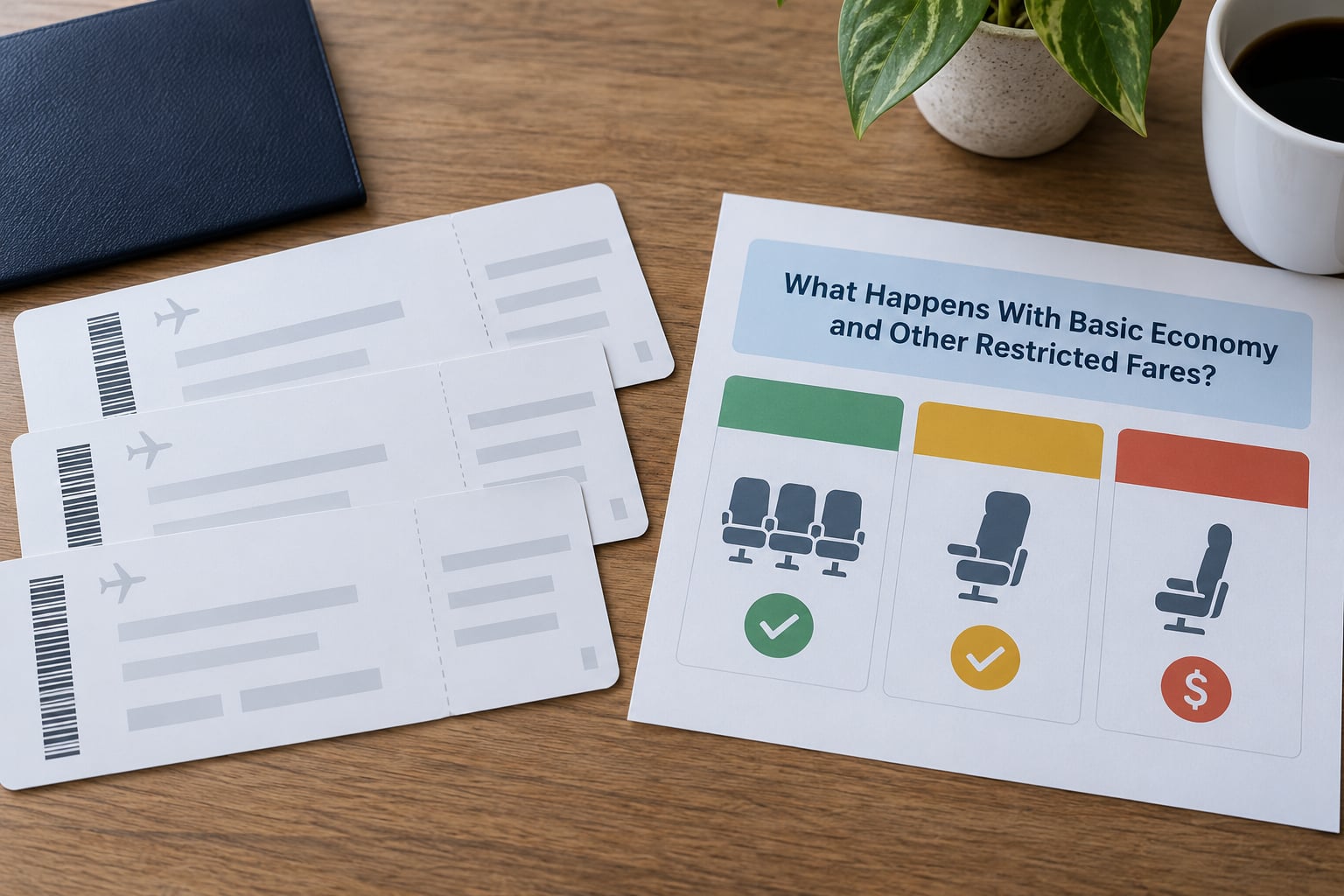
This is where skipping selection actually costs you something, and it is the part that surprises people.
A standard main-cabin fare on most major carriers usually includes seat selection at no extra cost, either at booking or at check-in. Basic economy, and the equivalent lowest tier at other airlines, is sold on the promise of a lower base fare in exchange for restrictions. Seat choice is one of the restrictions that shows up most often.
Typically the lowest fare works like this: no seat assigned until check-in, no seat map during booking or online check-in, and a separate charge if you want to change the seat later. Some carriers will assign a seat at check-in for free and then charge a fee to move to a different row. Which of those three applies depends entirely on the airline, so read the fare rules before assuming.
There are also fare families that guarantee a seat regardless. A few products in the US market bundle a seat assignment with the ticket, and in Europe some carriers treat seating differently as a matter of regulation rather than fare design. The UK and EU frameworks that cover denied boarding and rerouting generally deal with the passenger getting on the aircraft, not with which seat they sit in, so the seat question stays with the airline’s own rules.
My advice is straightforward. If the fare comparison shows basic economy is meaningfully cheaper and your trip is two hours or less with no children involved, skipping selection is a reasonable gamble. If either of those conditions fails, the difference rarely pays for itself.
Will the Airline Try to Keep You in the Same Seat Number?
No. A seat number on a boarding pass is a plan, not a promise, and the airline can change it for reasons that have nothing to do with you.
An equipment change is the big one. Your route was sold on a narrow-body jet and the airline swaps in a different aircraft with a different layout. Row 22 might now exist, might not exist, and might be a window row instead of a middle row. The map you studied at home describes an airplane that is not the one you board.
Cabin remapping happens closer to departure too. Seats get blocked for crew rest, for accessibility equipment, for extra baggage, or to keep groups together when the flight is oversold. Rows that were available at booking can be dark on the map a few hours before departure.
Unaccompanied minors are usually seated near the front or near a crew member rather than where a parent would have picked. Families traveling with young children are usually moved next to each other, which is a change in the airline’s favor even though nobody asked.
Forum discussions on r/unitedairlines and r/travel make the same point from the passenger side: travelers who paid for a specific seat and then found themselves elsewhere treat the seat fee as refundable, and report that asking at the gate is the step that works. Whether that request succeeds depends on how full the aircraft is and how the gate agent reads the situation.
Can You Choose a Seat During Check-In or at the Gate?
Yes, usually, with shrinking odds. If you skipped selection, this is your window.
Step one is timing. Check in as soon as the airline opens check-in, which is commonly 24 hours before departure domestically and 48 hours or more for some international itineraries. Early check-in is the single thing that most reliably improves your odds, because the seat map is at its widest at that moment.
Step two is to look at the aircraft, not just the seat map. Airlines are increasingly showing which plane is assigned to your flight, and a different tail number means a different layout. Confirm your row exists before you commit to it.
Step three is to use any family or group seating option the interface offers. Most apps will seat a booking reference’s passengers together if you select them together, and that is worth more than the individual seat preference.
Step four is to pay if the fare allows it. On restricted fares a change may cost extra, and paying at check-in is often cheaper than paying at the gate.
Step five, if nothing in the app or on the kiosk gives you control, ask the gate agent before boarding. The later you ask, the fewer choices remain, and gate agents are working from whatever the cabin looks like at that moment.
Window, Aisle, or Middle: What Should You Look For?
There is no universally better seat. What you want depends on the trip, and the assigned seat is only a starting point for that judgment.
A window seat gives you the wall for a headrest, easy leaning out to look at the wing in bad weather, and one fewer person climbing past you all flight. The trade-off is that you cannot get up for a walk without disturbing someone, which matters on long-haul more than people expect.
An aisle seat means you can stand, stretch and reach the lavatory whenever you want. The cost is being next to the most active aisle on the plane, with a stranger’s elbow and a cart hitting your knee on every pass.
A middle seat is the one people try hardest to avoid. You share the armrest with two people, you have no view and no easy exit, and the person in front of you reclining is a genuine problem on anything over four hours.
Rows to treat carefully: the bulkhead behind a galley or lavatory carries noise and a smell, and exit rows have strict eligibility rules that the airline will usually enforce at boarding rather than at check-in.
Think about the people with you. An infant bassinet needs a bulkhead row and must usually be requested in advance. A traveler with a knee that locks needs an aisle, not a middle. A child who might get sick mid-flight should not be next to a stranger. Any of these can justify paying to move once you see what you were assigned.
What Can You Do If You Do Not Like the Assigned Seat?
Work fast and work in this order.
Open the airline app or website right after check-in and change the seat yourself. This is the cheapest and most reliable option because it uses the same inventory the gate agent sees. The airline app is usually faster than the website on a phone.
If the app hides the map because of your fare, use the kiosk or counter at the airport, where staff can often see options your app does not show.
Ask the gate agent, and ask specifically for what you need rather than vaguely requesting a change: aisle rather than middle, away from the lavatory, closer to an empty row, next to your companion.
Check the boarding pass after any change. A change confirmed verbally at the gate but missing from your pass can cause a problem in the cabin, and it is much easier to fix at the podium than at row 22.
Know when to stop. Every change here is best-effort. Once the cabin is full and the door closes, your options shrink to asking politely at the door and, in the worst case, accepting what you were given.
If you paid for a seat and were moved involuntarily, ask about a refund of that fee. Travelers report mixed results, but the request costs nothing and the fee is refundable in some situations, including when the seat you bought was not available on the aircraft you actually flew.
A Quick Guide to Automatic Seat Assignment
The table below separates what is broadly true across airlines from what is decided by your fare. Read the second column for the carrier’s habit and the third for your specific ticket.
| Situation | What usually happens | What you control |
|---|---|---|
| Standard main-cabin fare | Seat assigned at check-in, selection usually included | You can change it free until the cabin fills |
| Lowest fare (basic economy or equivalent) | Assigned at check-in, selection may not be available before then | Changing later may carry a separate fee |
| Fare that bundles a seat assignment | Seat held from booking through boarding | Little, since the fare price reflects the guarantee |
| Open or first-come-first-served cabin | Nothing assigned until boarding | You choose from whatever is open when you board |
| Connecting itinerary | Each segment can be assigned separately | Check every segment, not just the first |
| Flight with an equipment change | Seat number may not exist on the new aircraft | Recheck the map once the tail is confirmed |
| Unaccompanied minor | Seated separately, near crew by policy | None; the airline decides |
| Oversold flight | Seating order can change late | Check in early, boarding order matters more |
Two tools are worth knowing. ExpertFlyer and similar seat-monitoring services show seat maps and pricing history for most carriers, so you can watch when a window seat drops to a price you like. Beyond that, the airline app’s notification settings are genuinely useful, since they flag schedule changes and equipment swaps earlier than email does.
Frequently Asked Questions
Do airlines randomly assign seats if you do not make a choice?
Usually the airline assigns a seat at check-in from whatever inventory remains after premium and paid seats have been allocated. The result can feel random, but most systems use rules rather than chance, weighing booking order, fare class, connections and accessibility needs. If the flight is nearly full, the leftover seats are often middle seats in the middle of the cabin.
Why did the airline give me a different seat from the one I selected?
Equipment changes, cabin remapping and operational needs all move passengers. If the aircraft was swapped, your row number may not exist or may have a different layout. Seats also get blocked for crew rest, accessibility equipment and family grouping. Rules vary by airline and fare, so check the carrier’s current policy before assuming a specific seat is protected.
Can I change my seat at the airport if I skipped selection?
Yes, in most cases. Change it yourself in the airline app, website or airport kiosk as soon as check-in opens, then confirm it appears on your boarding pass. If the interface gives you no options, ask the gate agent before boarding. Changes are best-effort and get harder as the aircraft fills, so act early.
Is seat selection included with every economy fare?
No. Standard main-cabin fares on major carriers usually include selection, while the lowest fare tiers often assign a seat at check-in, remove the seat map from booking, and charge a separate fee to change it. A few products bundle a guaranteed seat assignment. Check the fare rules on your booking, since each carrier names and structures these tiers differently.
What happens if no preferred seats are left during check-in?
You are still assigned a seat, and it will usually be a middle seat in a less convenient row. Treat the check-in seat map as your last easy chance to move, since later changes depend on what opens up or on gate agent discretion. If you need an aisle for mobility reasons or are flying with an infant, tell the airline through its assistance channel rather than hoping.
Should I ask the gate agent to change my assigned seat?
It is worth asking, and it costs nothing, but go in with a specific request such as aisle instead of middle or a row away from the lavatory. Gate agents work from the cabin as it stands at boarding, so success depends on what is still open. Confirm any change on your boarding pass before you walk to the aircraft.
What to Do First If You Skipped Seat Selection
Check in the moment your airline allows it. That is the single highest-value step, because the seat map is widest before anyone else has claimed the good rows.
Then look at the assigned aircraft, not just the map, so you are not picking a row that does not exist on the plane you actually board.
Request a seat that fits your trip before you reach the gate, and pay if the fare requires it, because gate changes depend on what happens to be open.
Finally, verify the seat number on your boarding pass. That is the version the crew works from, and it is the one that tells you where you are actually sitting.