Seat pitch on an airplane is the straight-line distance from one fixed point on a seat, usually the back of the seat or headrest, to that same point on the seat directly in front of it, measured in inches. That single number decides most of what you can do with your legs for the next four hours.
It is also the number most often explained badly. Plenty of travel pages treat seat pitch as a synonym for legroom, which is not quite right, and a few treat it as a comfort score, which it is not. Pitch is a distance measurement, nothing more. What you feel in the seat depends on that distance plus the thickness of the seat in front of you, how wide your seat is, and where in the cabin you are sitting.
This guide covers what seat pitch actually is, how it is measured, what the typical numbers look like in each cabin, how to convert them to centimeters, and how to check the pitch on a specific flight before you pay for it.
Table of Contents
- What Is Seat Pitch on an Airplane?
- How Is Seat Pitch Measured?
- Nominal pitch versus the space you actually get
- Why one aircraft is not one pitch
- Why Does Seat Pitch Affect Comfort?
- What Is a Good Seat Pitch for Different Travelers?
- How Does Seat Pitch Compare Across Cabins?
- What is seat pitch on an airplane in centimeters?
- Why two airlines can differ by four inches on the same route
- Is there a legal minimum seat size?
- How seat pitch has shrunk over time
- How Can You Find the Seat Pitch for a Flight?
- What Is the Difference Between Seat Pitch and Legroom?
- Bulkhead and exit rows break the rule
- Seat width is the other half of the equation
- Row position matters more than seat letter
- Frequently Asked Questions
- Is 31 inches the average legroom in economy class?
- Is seat pitch the same as legroom?
- How is seat pitch measured on an airplane?
- What is a good seat pitch for a long flight?
- Is there a legal minimum seat size on airplanes in the US?
- Where is seat F on a plane?
- Conclusion
What Is Seat Pitch on an Airplane?
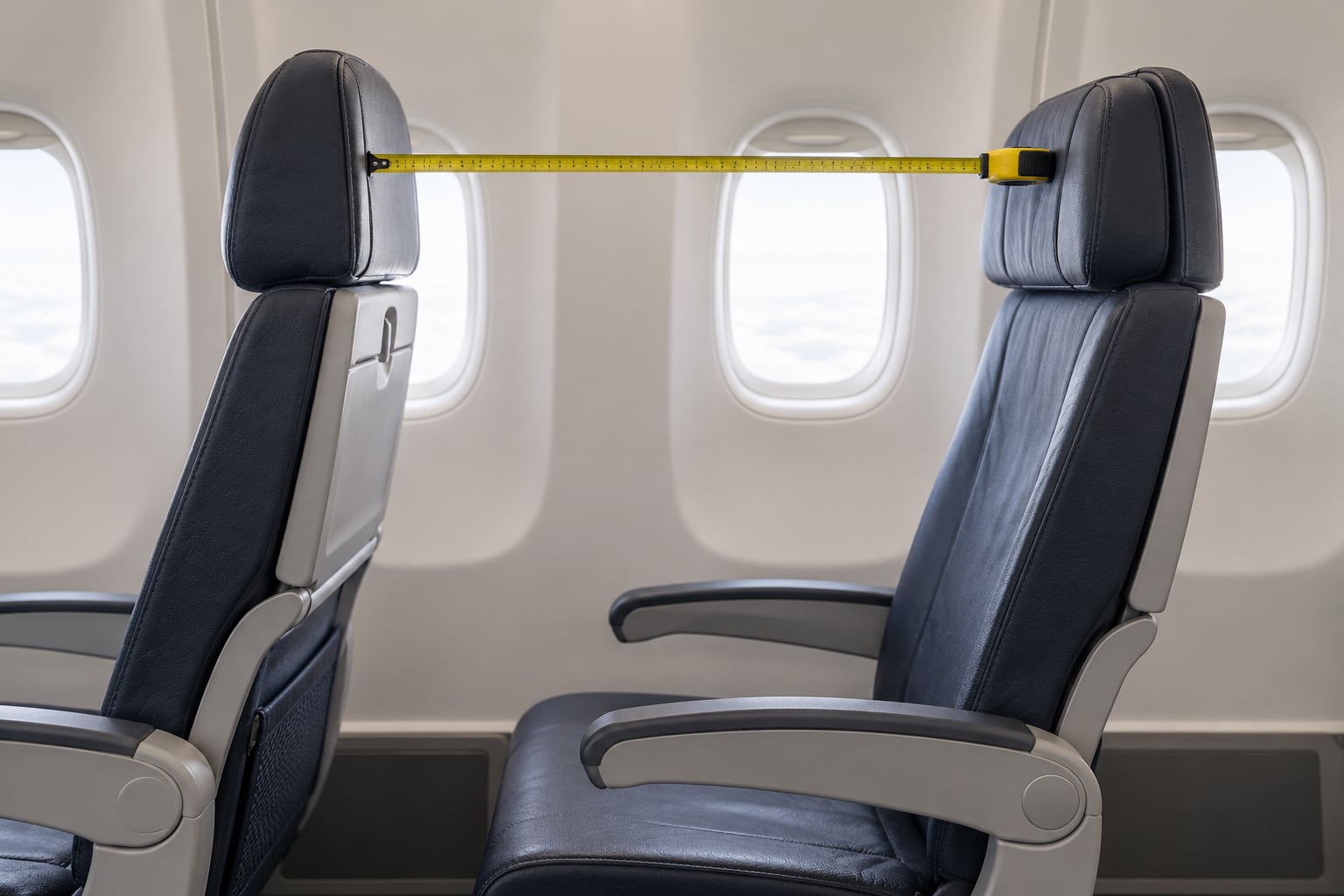
Seat pitch on an airplane is the distance from a specific point on one seat to the matching point on the seat ahead, usually measured from the back of the headrest to the back of the headrest in front. It is quoted in inches, or in centimeters in most of Europe and Asia.
Three different measurements get confused with one another, so it is worth keeping them apart from the start:
- Seat pitch is the row-to-row distance. It is the industry-standard number and the one airlines publish.
- Seat width is how much horizontal room you have, measured across the cushion between armrests. Typical economy widths run from about 17 to 18.5 inches.
- Legroom is what you actually get, which depends on pitch, seatback thickness, seat width, where your knees land and how tall you are.
Because pitch is measured from one seat to the next, the thickness of the seat in front of you sits inside the number. That is the whole reason two seats with identical pitch can feel completely different.
How Is Seat Pitch Measured?
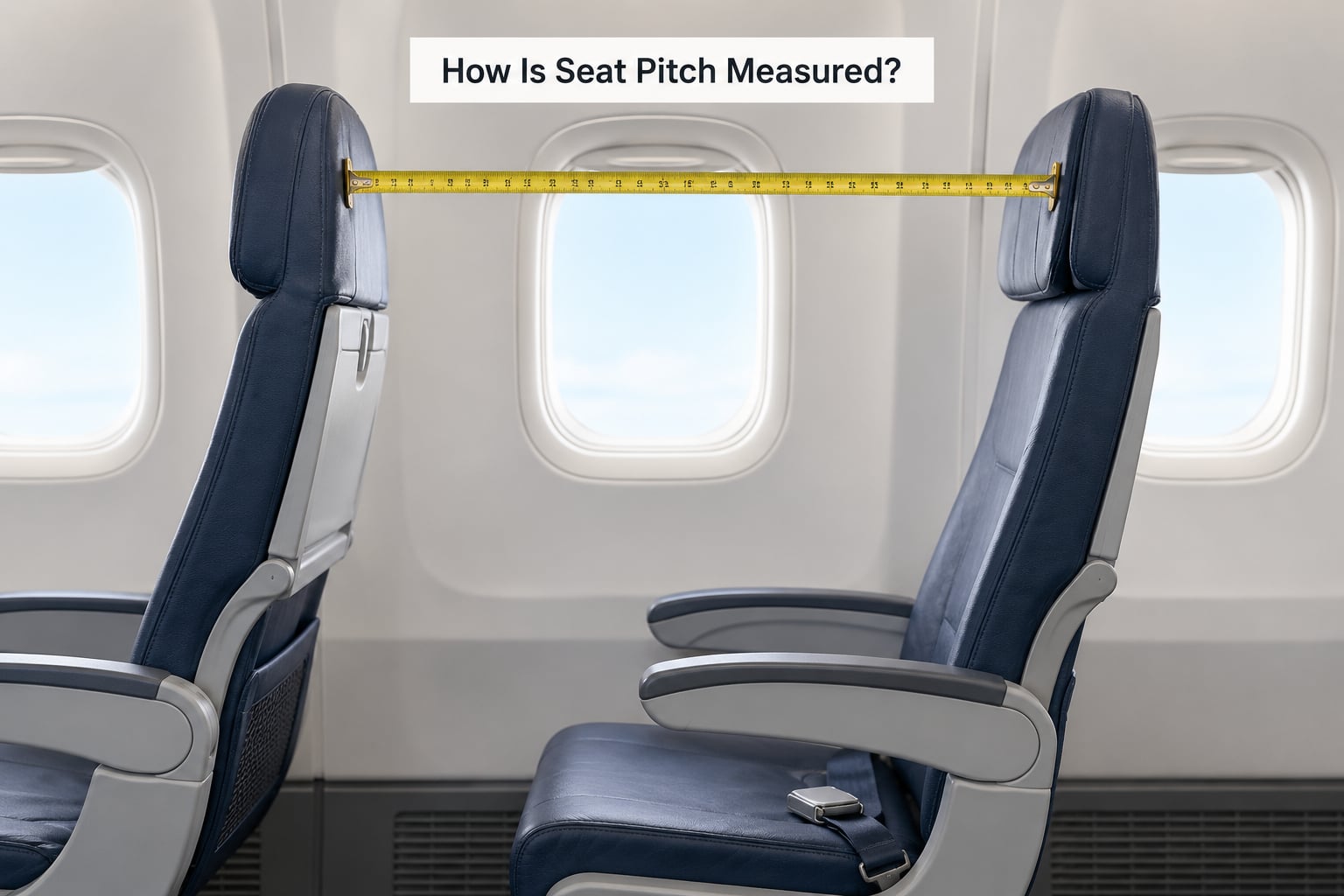
Measuring seat pitch takes three steps. First, pick a reference point on the seat, usually the back of the seat back where the headrest attaches or the front face of the cushion. Second, run a tape measure straight along the floor or across the cushion to the same point on the seat ahead. Third, read the distance in inches.
The measurement is taken seat back to seat back, so any material in between counts toward the total. That includes the headrest, the seat back shell, the seat pan, the structure that holds the screen and tray table, and sometimes a gap built in for wiring and ducting.
Nominal pitch versus the space you actually get
Nominal pitch is the design figure for the aircraft. A cabin laid out at 31 inches in every standard row is a 31-inch cabin, even when the row behind a galley divider has twice the space. The number describes the repeating pattern, not every row on the plane.
Actual space at your seat can differ from the nominal figure for three reasons. Some rows are physically longer, bulkheads and exit rows being the obvious ones. Some seats are physically thinner, so the same 31 inches leaves more room between your knees and the seat in front. And the seat ahead may recline during the flight, which takes clearance away from you at exactly the moment you want to stretch.
Why one aircraft is not one pitch
Airlines publish aircraft-level figures, not booking-class-level ones. On a widebody, the same airline can run 31 inches in economy, 38 inches in premium economy and a full bed length in business, all in the same fuselage. On a narrowbody, a single economy cabin may be sold as a basic product on one fare and as a full-width product on another, but the pitch stays the same.
That is also why pitch figures attached to an airline rather than an aircraft can mislead you. The same carrier may fly the route on a narrowbody with 28 inches and a widebody with 34 inches, and you will have booked the airline, not the aircraft.
Why Does Seat Pitch Affect Comfort?
Knee room is the first thing. When pitch is short, your knees reach the seat back or the tray table arm of the row ahead, and no amount of shifting fixes it. When pitch is generous, you can angle your legs, cross nothing, and change position without rearranging your whole body.
Recline clearance comes next. Reclining needs room behind the seat in front of you. In a tight row, the seat in front reclines into your knees and your tray table gets in the way, so the recline angle that the seat is designed to achieve rarely happens in practice.
Sleeping depends on both. Flat-ish sleeping needs enough pitch that you can recline without being pinned, and enough width that you are not pressed against a neighbor. People who plan to sleep through a red-eye care about this more than the average passenger, and it is the strongest argument for paying more for a wider row or an exit seat.
| Seat pitch | What it feels like | Best for |
|---|---|---|
| Under 30 inches | Cramped. Knees contact the seat in front, recline is minimal, no real ability to cross legs | Short trips, smaller passengers |
| 30 to 31 inches | Tight but workable. Knees may touch on a bad day of travel | Short to medium flights under about three hours |
| 32 to 33 inches | Comfortable for most adults. Feet can move and recline functions properly | Standard long-haul economy, most body sizes |
| 34 to 36 inches | Generous. Real stretching room and a better chance of sleeping | Long flights, taller passengers |
| 38 inches and above | Premium-economy territory. Noticeably a different product | Overnight flights, 6-foot-2 passengers and up |
There is a movement argument too, but it is small. In a narrow pitch you cannot stand to use the lavatory without shoving past two rows, which matters on a six-hour flight far more than on a one-hour hop.
What Is a Good Seat Pitch for Different Travelers?
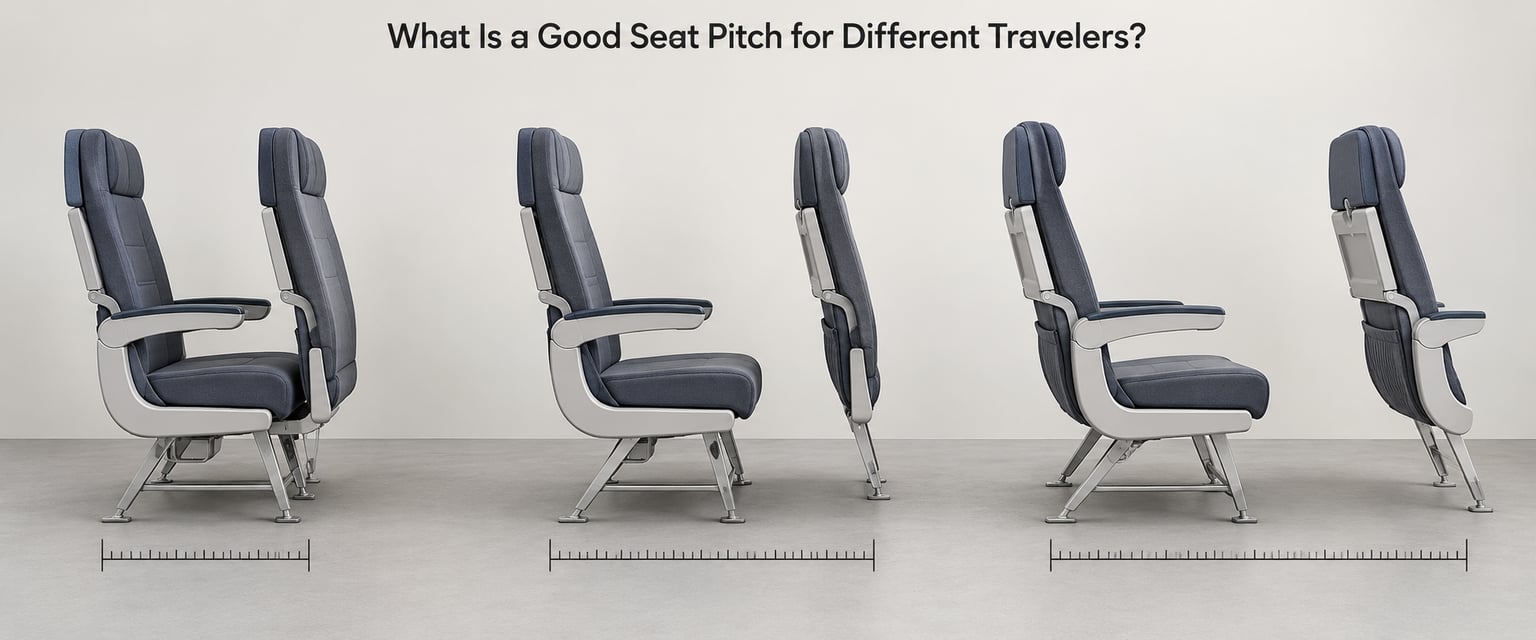
Short trips under two hours barely register pitch, because you spend most of the time looking at your phone. Past three hours it becomes the dominant physical fact of the flight, and past eight hours it decides whether you arrive able to walk.
The benchmarks most people quote are reasonable. Below 30 inches is cramped for most adults. 31 to 32 inches is average economy. 33 inches and up is generally called good legroom. 34 inches and up is the target for a long flight where you want to sleep or work. Anything under 30 inches is genuinely tight, and no amount of positive thinking changes that.
Height matters more than the average suggests, and most of the useful guidance on this topic stops before it gets personal. The table below is a practical starting point rather than a hard rule, built from what tall passengers report about where the squeeze starts.
| Your height | Pitch you will get along with | Pitch worth paying for or waiting for |
|---|---|---|
| 5 ft 6 in and under | 28 to 30 inches | Anything above 30 inches |
| 5 ft 6 in to 5 ft 10 in | 30 to 31 inches | 32 inches or more |
| 5 ft 10 in to 6 ft | 31 to 32 inches | 33 to 34 inches |
| 6 ft to 6 ft 3 in | 32 to 34 inches | 34 to 38 inches, or premium economy |
| 6 ft 3 in and over | 34 to 38 inches | 38 inches or more, or an exit row |
Passengers above roughly 6 ft 2 in consistently report that 31 to 32 inches leaves their knees against the seat back no matter how they sit, and that premium economy at 38 inches is the first product that feels like a real upgrade rather than a wider version of the same seat.
Plus-size passengers face the width constraint more than the pitch one. A 17- to 18-inch economy cushion is narrow no matter how generous the row spacing is, and the practical fix is usually a seatbelt extender plus booking a wider cabin, rather than chasing a single extra inch of pitch.
How Does Seat Pitch Compare Across Cabins?
Typical ranges by cabin, kept deliberately broad because airlines, aircraft and cabins within one aircraft all differ. Treat these as orientation, not a promise.
| Cabin | Typical width | Typical pitch | Where you find it |
|---|---|---|---|
| Economy, dense layout | 17 to 18 in | 28 to 30 in | Low-cost carriers, 3-4-3 widebody rows |
| Economy, standard layout | 17 to 18.5 in | 30 to 32 in | Most narrowbody and long-haul economy cabins |
| Economy plus, extra legroom rows | 18 to 19 in | 34 to 38 in | Purchased row upgrades on carriers like JetBlue |
| Premium economy | 18.5 to 19 in | 38 to 42 in | Widebody cabins between economy and business |
| Domestic first class | 19 to 20 in | 37 to 39 in | Recliner-style seats on short and mid-haul routes |
| Business, angled or partially flat | 20 to 22 in | 55 to 65 in | Widebody and long narrowbody business cabins |
| Business, fully flat | 22 to 26 in | Bed length 76 to 82 in | Sliding-pan and herringbone seat products |
| First class suite | 26 in and above | Bed length 76 in and above | Enclosed suites on intercontinental routes |
What is seat pitch on an airplane in centimeters?
International travelers usually think in centimeters, and almost every source mixes units. Here is the conversion set worth remembering, because roughly 79 centimeters is the number that keeps showing up as average economy.
| Inches | Centimeters | Where you meet it |
|---|---|---|
| 28 in | 71 cm | Densest economy |
| 30 in | 76 cm | Tight standard economy |
| 31 in | 79 cm | Most common economy figure |
| 32 in | 81 cm | Comfortable long-haul economy |
| 33 in | 84 cm | Good legroom |
| 34 in | 86 cm | Ideal for long flights |
| 38 in | 97 cm | Premium economy |
| 42 in | 107 cm | Generous premium economy |
| 76 in | 193 cm | Business-class bed length |
| 82 in | 208 cm | Longest flat beds |
Why two airlines can differ by four inches on the same route
Part of the gap is physics. A Boeing 737 has a narrower interior than an Airbus A320, roughly eight inches less usable cabin width, and that width has to come from somewhere. A seat row that is too wide crowds the aisle or forces a middle seat to shrink. Narrower aircraft therefore tend toward 3-4-3 layouts on widebodies and tighter pitches everywhere.
Layout matters as much as the airframe. A 3-4-3 economy row on a widebody puts four seats across the middle, and those four seats come out close to 18 inches wide. A 3-3-3 layout gives every seat roughly 18 inches and adds a middle seat nobody wanted. The Airbus A220 sidesteps the whole problem with a two-abreast and three-abreast layout, which is why flyers keep praising its 18.5-inch economy seats as the only narrowbody without a middle seat.
The rest is business model. Low-cost carriers optimize for seats per square foot, so density is the product. Legacy carriers carry a premium mix, where business and premium economy revenue can justify a 34-inch economy row without hurting the economics. Seat pitch is one of the few comfort measures where the purchase is a repeated decision by the airline, and an inch of pitch across a fleet is a real line item.
Is there a legal minimum seat size?
No. There is no US federal minimum for seat pitch, seat width or seat dimensions on commercial aircraft, and there has not been one. Congress told the FAA to explore a minimum seat size rule in the 2018 Reauthorization Act, the agency ran a public comment round on the idea in 2022, and a later reauthorization pushed the work again.
As of 2026 the result is still no rule. It is not an oversight so much as a persistent standoff between passenger advocates, who want a hard number, and airlines and the FAA, who argue that a prescriptive standard is difficult to write for hardware that varies this much between aircraft. The one federal rule that does exist near this territory concerns exit-row eligibility, under 14 CFR 121.585, which is a safety rule about who may occupy a row rather than a comfort rule about how much room anyone gets.
That absence is the reason seat pitch has moved without resistance. A published number can be changed in the next cabin configuration update, and passengers notice it mainly by comparing photos.
How seat pitch has shrunk over time
Economy pitch was around 35 inches in the 1970s, when the industry had room to give. On a typical long-haul widebody today the standard economy figure is about 31 inches, and the densest low-cost configurations sit at 28. Premium economy at roughly 38 to 42 inches is the clearest market proof that passengers will pay for pitch when it is offered as a separate product.
How Can You Find the Seat Pitch for a Flight?
Four steps, in order of usefulness. Start with the aircraft type, read the seat map, check the carrier’s own specification, and use passenger reports as a reality check rather than as a measurement.
- Find the aircraft type first. Pitch is an aircraft attribute. On the booking page or confirmation, look for the aircraft code and look up its cabin layout. Seat pitch for “this airline” is not a real number; seat pitch for a 737 MAX 8 is.
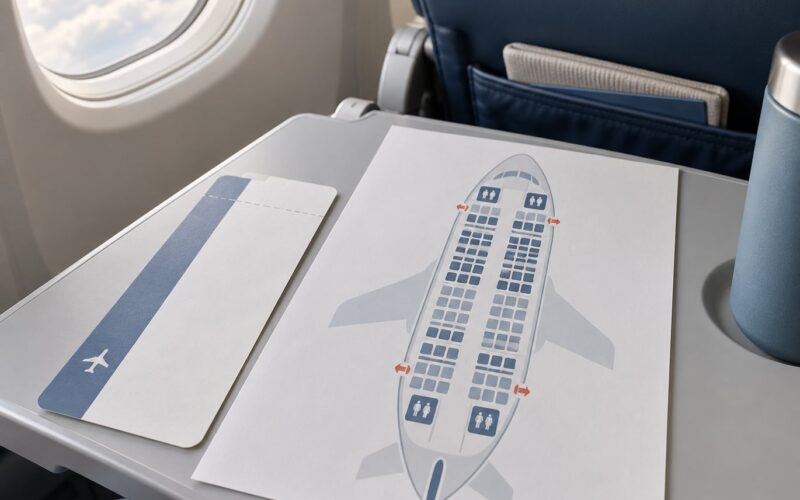
- Read the seat map before you choose a row. The map shows where the exits, galleys and lavatories sit, which reveals exactly which rows break from the standard spacing. It also shows the seat letters, and counting how many seats sit in each row tells you the layout, which tells you roughly how wide each seat is.
- Check the carrier’s published aircraft specification. Most airlines list seat pitch and seat width for each aircraft they operate, usually on a fleet or on-board page. These figures are the closest thing to an official number and are generally consistent within one configuration.
- Read recent passenger reports for the route. Search the route and aircraft combination on a passenger forum and look for repeated comments about the specific seats you are considering. This is not a measurement, but it is the only way to learn that a particular plane has its extra-legroom rows blocked by a fixed divider or that the last row has no recline.
What you cannot do is expect exactness. Aircraft get reconfigured, cabins get swapped for a denser or roomier product, and figures are sometimes inherited from a previous layout. Treat any single source as a strong hint rather than a guarantee.
What Is the Difference Between Seat Pitch and Legroom?
Seat pitch is a standardized distance between rows, while legroom is what you personally experience, which depends on pitch plus seatback thickness, seat width, recline, tray table position and your own size. The two are related, and they are not the same thing.
A thin 30-inch seat can leave more usable legroom than a thick 32-inch seat, because roughly 4 to 5 inches of a pitch measurement is the seat in front of you. Slimline composite shells, now standard on new-build economy cabins, are engineered specifically to reclaim knee clearance without giving up pitch. Flyers comparing an older thick-backed aircraft to a newer one with a lower number often find the newer one more comfortable, and that is the explanation.
Bulkhead and exit rows break the rule
A bulkhead row has no seat in front of you, so the pitch figure describes open floor rather than usable legroom. You gain space, lose the seatback to lean against, lose under-seat storage because there is no floor space beneath, and lose the footrest some carriers fit there. Experienced flyers regard the space as real and the inconvenience as worth it on a long flight.
Exit rows give the most knee room of any standard row, and come with conditions. Recline is restricted or absent in many designs, the armrest tray table is often fixed, and eligibility rules under 14 CFR 121.585 apply, including age and ability requirements. Best practice is to sit within about five rows of an exit if safety is your priority, rather than believing any particular seat letter is the safest one. The famous row 11A argument is a myth built on old accident data.
Seat width is the other half of the equation
Pitch gets advertised and width gets ignored, which is backwards for anyone over 6 feet. A 17-inch cushion makes 32 inches of pitch feel cramped because you are wedged sideways in it. Seat width is measured across the cushion between armrests, and the layouts that produce the narrowest seats are the ones with the highest seat count per row. Where you can choose, width often matters more than the last inch of pitch.
Row position matters more than seat letter
Window, aisle and middle describe lateral position, not comfort from the row in front. The middle seat wins on width, since it has an armrest on one side only, but every time the armrest drops you get elbows. The aisle seat gives you the widest usable space and the ability to cross your legs, at the cost of being bumped during service and having to get up for a lavatory run. Where you sit in the row barely registers in the pitch measurement, but it changes the flight considerably.
Tight clothing is worth a mention too, since it comes up in searches on this topic. At 31 inches of pitch, restrictive clothing limits the only adjustment most passengers have, which is shifting position. It is a comfort note, not a rule anyone enforces.
Frequently Asked Questions
Is 31 inches the average legroom in economy class?
Roughly, yes. Standard economy seating on most narrowbody and long-haul widebody aircraft runs between 30 and 32 inches, so 31 inches is the figure you will meet most often. Denser low-cost configurations drop to about 28 inches, and wider premium-economy rows reach 38. Remember that pitch includes the seat back in front of you, so 31 inches is usable legroom plus a few inches of seat.
Is seat pitch the same as legroom?
No. Seat pitch is the measured row-to-row distance, while legroom is what you feel in the seat. Pitch includes the thickness of the seat in front of you, so a slim 30-inch seat can offer more usable space than an older 32-inch seat with a thick back. Seat width, recline and your height also change how much legroom you get from the same number.
How is seat pitch measured on an airplane?
Pick a reference point on one seat, usually the back of the seat or the headrest, then measure in a straight line to the identical point on the seat directly ahead. Airlines measure seat back to seat back across the floor or cushion, so everything in between counts toward the figure. That is why seat design, tray table and monitor placement change the space you get from the same pitch.
What is a good seat pitch for a long flight?
For a flight over four hours, 33 inches is generally considered good and 34 inches or more is the ideal target. Below 30 inches is cramped for most adults, and 31 to 32 inches is workable but tight for anyone around six feet tall. On an overnight route, spending up to premium economy at 38 inches is the change travelers notice most.
Is there a legal minimum seat size on airplanes in the US?
There is no US federal minimum for seat pitch, seat width or seat dimensions on commercial aircraft. Congress directed the FAA to study a minimum seat size rule in the 2018 Reauthorization Act, the agency collected public comments in 2022, and a later reauthorization renewed the push, but no binding rule has been issued. That absence is a main reason pitch has declined over the decades.
Where is seat F on a plane?
On a narrowbody in a three-abreast layout, seat F is the middle seat of the three-seat block on the same side as the window seats, with E beside the window and D beside the aisle. Seat letters skip I and O in aviation convention, and they run along the letter toward the back of the aircraft, not down the aisle. On a widebody in 3-4-3 the lettering restarts, so F falls in a different position.
Conclusion
Start with the aircraft type, not the airline name, then read the seat map to find the rows that deviate from standard. If you are around six feet tall or above, target 34 inches or move up a cabin, and treat any published pitch below 30 inches as a short-haul product.
To get a genuinely useful answer, tell me the airline, the route, and your height. Aircraft swap, so I would rather check the specific flight than quote a number that turns out to be from the wrong plane.