Airline cabin classes are named by three overlapping systems at once: a loose industry ladder of tiers (economy, premium economy, business class, first class), each airline’s own marketing label for those tiers, and a single fare class letter on your ticket that governs the rules rather than the seat. Understanding how airline cabin classes are named takes a few minutes and stops you paying business class money for a fare that behaves like the cheapest seat on the plane.
No regulator tells an airline what it may call its cabins. IATA publishes a set of one-letter cabin codes for industry paperwork, but the name a passenger sees on the booking screen is chosen by the airline’s marketing team. That is why one carrier’s Main Cabin is another carrier’s economy, and why two products both called premium economy can be nothing alike.
Table of Contents
- What Are Airline Cabin Classes?
- How airline cabin classes are named, layer by layer
- The Main Airline Cabin Classes Explained
- Economy: the mass-market default
- Premium economy: the middle tier that arrived late
- Business class: created in the 1970s for the corporate traveller
- First class: the prestige label, and what it covers now
- How Premium Economy Differs From Economy
- Why Do Airlines Use Different Cabin-Class Names?
- Where the names come from
- How carriers rename the same four products
- A Quick Cabin-Class Comparison
- How to Choose the Right Cabin Class for Your Trip
- What to Check Before Booking a Higher Cabin
- Frequently Asked Questions
- What are the different types of airline cabin classes?
- Why is business class called J?
- What is booking class L?
- What is first class on a plane called now?
- What was the first airline to introduce business class?
- Is J a window seat?
- What To Do First
What Are Airline Cabin Classes?
A cabin class is the name an airline gives to a travel product: a type of seat in a part of the aircraft, sold with a set of service standards and a set of fare rules. It describes what you get and what you are allowed to change, not just where you sit.
Because the label is a marketing choice, there is no global standard saying that economy must have a particular legroom, or that business class must have a lie-flat seat. Two airlines can sell products with identical seats under different names, and the same name can cover a recliner on one route and a private suite on another.
How airline cabin classes are named, layer by layer
When you look at a ticket, five naming layers are stacked on top of each other. Confusing them is the root of most cabin class mix-ups, so it is worth separating them once.
- The cabin tier — the physical cabin and service level: economy, premium economy, business, first.
- The marketed product name — the airline’s brand for a fare or seat, such as Main Cabin, Blue Basic, Premium Select, Comfort+, Polaris or Mint.
- The fare class letter — the one-letter booking class on your ticket (F, J, Y, B) that decides which fares you are allowed to buy and how flexible they are.
- The fare basis code — the longer string of letters and digits that identifies one specific fare inside that booking class, and where the fare rules are written down.
- The IATA cabin code — the single-letter industry shorthand (Y, C, J, F) used on schedules, timetables and airline systems rather than on marketing material.
Two related terms sit alongside these. Premium cabin is the umbrella airlines use for business and first together. And a fare class, sometimes called a fare bucket or booking class, is the inventory bucket a fare sits in, which is why airlines talk about how many seats they have left in Y.
The Main Airline Cabin Classes Explained
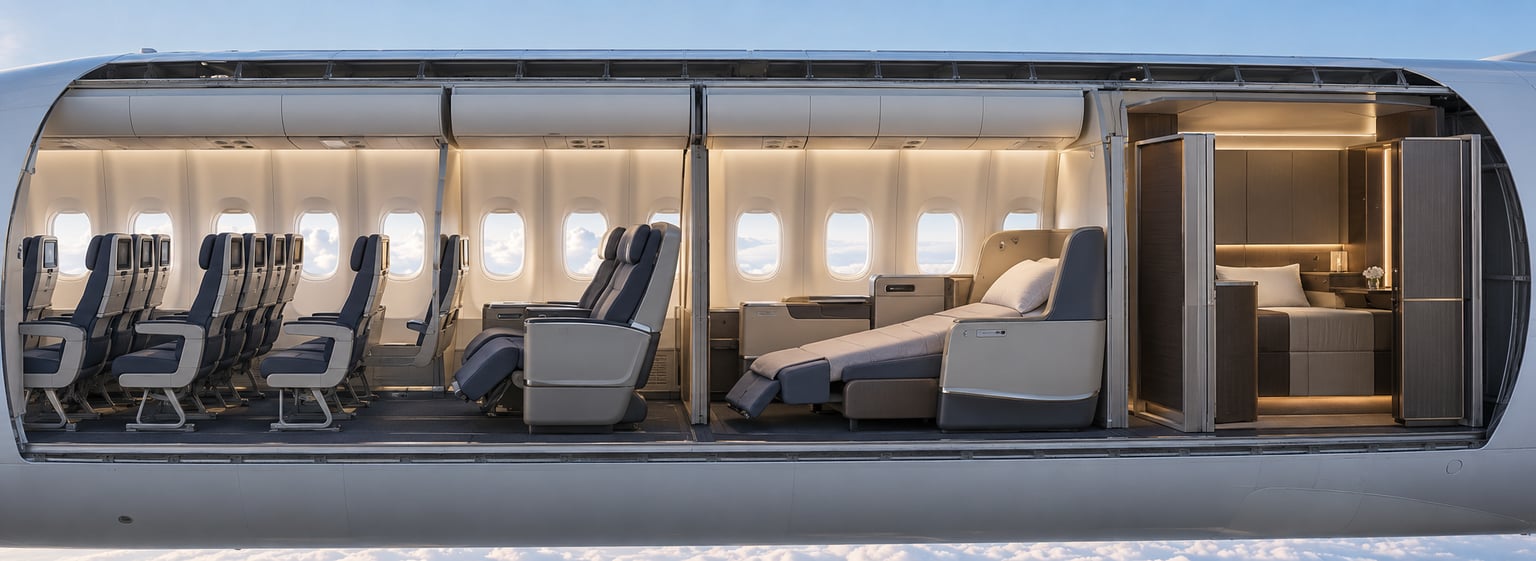
Four tiers cover almost every ticket sold worldwide. The order is consistent; the contents are not.
Economy: the mass-market default
Economy is the cabin the majority of seats on any aircraft belong to, and it is the tier every other name is measured against. Seats are typically upright or lightly reclining with limited legroom, meals are usually included on longer flights but often simple, and boarding is by group rather than by cabin.
Inside that single tier, airlines now sell several very different fares. A restricted basic fare can carry no free seat selection, no free changes and a bag that travels only if you pay for it. The seat, the meal and the cabin are broadly the same; the fare rules are not.
Premium economy: the middle tier that arrived late
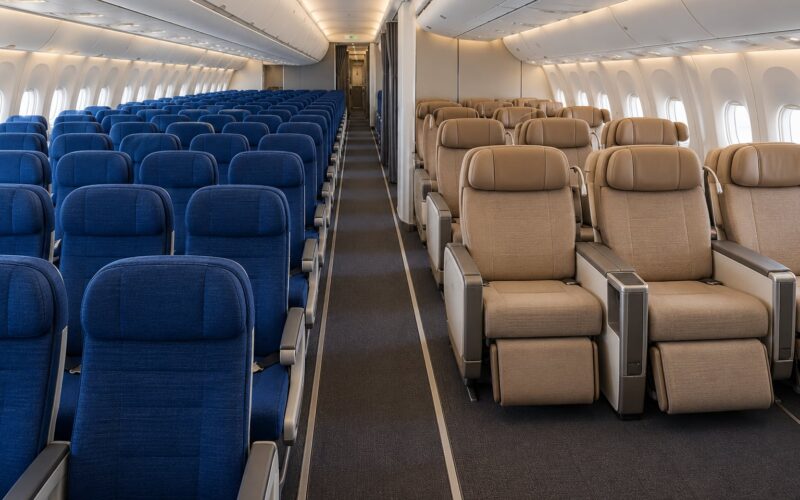
Premium economy sits between economy and business. It usually means more seat pitch and width than the economy row behind it, a larger recline, priority boarding, and a meal served in a proper tray rather than from a bag. On many aircraft it also brings a personal screen and power, plus a slightly larger baggage allowance.
It is a recent arrival. The name describes a product that did not exist in most fleets before the 1990s, and that many narrowbody aircraft still do not have.
Business class: created in the 1970s for the corporate traveller
Business class did not exist as a cabin before the 1970s. It was introduced by a handful of carriers, among them KLM, Air Canada, American and Air France, as a middle product aimed at business travellers whose employers would pay for a flat bed on a long flight.
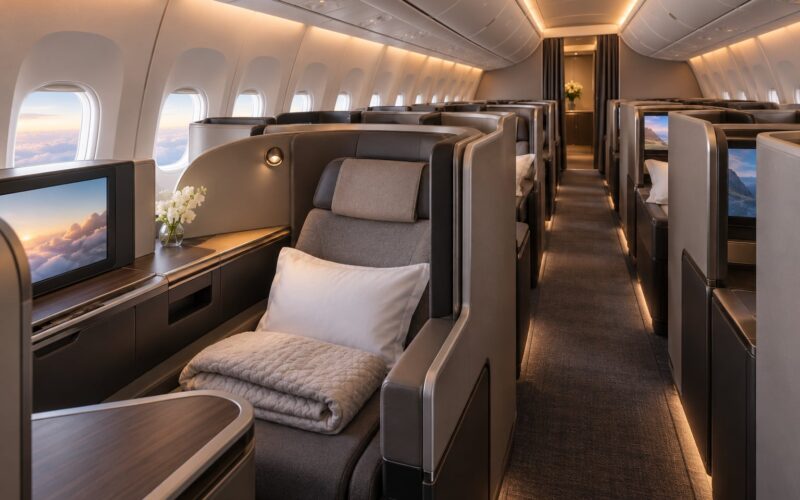
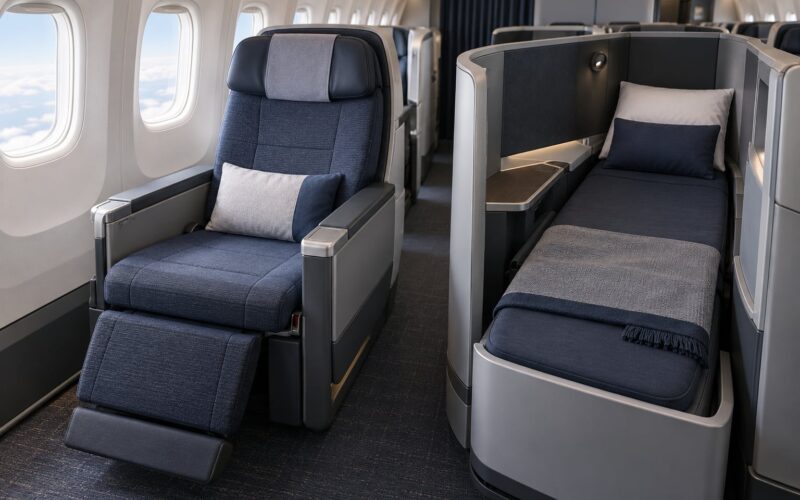
What sits behind the name today varies enormously. At one end it is a recliner with a footrest and a hot towel; at the other it is a lie-flat seat with a door, a window and a bed made for overnight work. Both are sold as business class.
First class: the prestige label, and what it covers now
First class is the oldest of the names, back when the cabin ahead was simply called first and everything behind it was called tourist or coach. Airlines kept the word because it signals status even as the product has narrowed.
Some carriers now sell suites under their own names instead, or run a two-cabin aircraft where the front cabin has only a handful of seats. In the United States, first class on many domestic routes means a lie-flat recliner rather than a separate cabin, which is exactly the kind of thing the label does not tell you.
How Premium Economy Differs From Economy
The gap between premium economy and economy is a physical one first: more room in the seat. Everything else usually follows from that extra space and from the airline deciding to sell a better product.
- Seat pitch and width. Typical economy pitch on a narrowbody is around 30 to 31 inches. Premium economy commonly adds several inches of pitch and a seat a few inches wider, which is the difference you feel after three hours.
- Recline. Premium economy seats usually tilt back further, and some airlines restrict recline in economy rows behind them.
- Meals. A hot meal in a tray, sometimes with a drink included, replaces the sandwich or snack that economy passengers may get.
- Boarding and deplaning. Priority boarding and earlier deplaning are standard, so you are not queueing for the overhead bin with the whole aircraft.
- Bags and change rules. A higher allowance and freer changes are common, though they follow the fare rather than the cabin, so check the rules attached to your specific ticket.
- Devices and power. A personal screen, a power outlet and sometimes in-flight Wi-Fi at no charge.
- Lounge access. Sometimes included, sometimes sold separately, and often a pay-as-you-go lounge at the gate.
The catch is availability. A premium economy cabin does not exist on most regional jets and many narrowbodies, so a booked premium economy seat on a multi-sector itinerary can become a regular economy seat on the short leg. Forum threads on airline and travel boards keep running into this: the same airline, the same booking, a different product on one sector.
Why Do Airlines Use Different Cabin-Class Names?
Two forces explain most of the variety. The first is history, because the tiers were added one at a time and each addition carried the name of its moment. The second is marketing, because carriers compete on labels as much as on seats.
Where the names come from
The split cabin is older than most people assume. In 1952 IATA allowed airlines to sell several different fares inside the same cabin, and Pan American split its DC-6B into a first section and a lower section sold under the Rainbow fare name. Everything since then has been a variation on that move: adding a priced tier and naming it.
Economy is simply the word that stuck for the mass cabin, the same way coach stuck in the US. Business class is the most interesting name, because the alternative candidates were rejected: club, executive, premium and first all existed as cabin labels in the 1970s and 80s. Business class won on clarity. It told the passenger who the product was built for. Marketing names have been catching up ever since.
First class survived because it costs nothing to keep and still reads as the top of the ladder, even where the seat underneath it is only a good recliner. Premium economy, by contrast, describes itself by comparison, which is why every airline gives it a slightly different product to justify it.
How carriers rename the same four products
Once the four tiers were settled, airlines competed on naming. Some rebranded their bottom cabin to imply less restriction; others created a house name for the top cabin so the word business could be freed up for the tier above.
| Carrier | Its names for the four tiers |
|---|---|
| Delta | Main Cabin, Comfort+, Delta Premium Select, Delta One, First |
| United | Economy, Economy Plus, Premium Economy, Polaris, First |
| American | Basic Economy, Main Cabin Extra, Premium Economy, Flagship Business, First |
| Alaska | Saver, Main, Premium, Business, First |
| JetBlue | Blue Basic, Blue, Blue Extra, Mint, First |
| Southwest | Single cabin, sold as fare names rather than classes |
| Lufthansa | Economy, Premium Economy, Business Class, First Class |
| Air France | Economy, Premium Economy, Business, La Première |
| KLM | Economy, Premium Economy, Business Class, First Class |
| Qatar Airways | Economy, Business, Qsuite First |
| Etihad | Economy, Premium Economy, Business, Diamond, First, The Apartments |
| Singapore Airlines | Economy, Premium Economy, Business, Suites, First |
| Air India | Economy, Premium Economy, Business, First |
| Ethiopian Airlines | Economy, Premium Economy, Business, First |
Non-US carriers lean on a different trick: a hotel-style name for the top cabin. Air France calls its top tier La Première, Qatar calls its suite Qsuite, and other airlines use Diamond or Pearl for first. These names deliberately break the ladder, because a named product can be sold at a price that generic business class cannot.
A Quick Cabin-Class Comparison
Read this table as a typical pattern rather than a promise. Every column has outliers, and the aircraft matters as much as the airline.
| Cabin | Seat expectation | Service and boarding | Meals | Lounge |
|---|---|---|---|---|
| Economy | Upright or light recline, roughly 30 to 31 inches of pitch on a narrowbody | Group boarding, standard service | Snack or simple included meal | Paid or none |
| Premium economy | Wider, more recline, extra legroom | Priority boarding, priority deplaning | Hot meal in a tray, drinks may be included | Often included or discounted |
| Business | Recliner with footrest up to lie-flat, sometimes a door | Priority boarding, dedicated cabin crew, lounge usually included | Multi-course service, wide choice | Usually included |
| First | Lie-flat seat, or a private suite with a door | Fastest boarding, highest priority, dedicated crew | Dine-on-demand on many carriers | Included, sometimes with a guest |
Two rows in that table deserve a warning. First class can be a recliner on a US domestic route and a walled suite across the Pacific, under the same name. And premium economy often does not exist on the aircraft at all, so an itinerary that promises it on one sector may not deliver it on another.
How to Choose the Right Cabin Class for Your Trip
Match the tier to the trip rather than to the label. Most people overpay by upgrading a two-hour hop and underpay by leaving a twelve-hour overnight in economy.
- Start with flight length. Below roughly three hours, the seat difference matters less than whether you can get work done. Above eight hours, sleep wins, and that means a lie-flat seat or a flat-bed premium economy seat.
- Compare against the fare, not the name. Look at what the fare adds: a checked bag, a seat choice, a change fee waived. Sometimes a standard economy fare with free changes and bags beats a premium economy seat with none of that.
- Check the aircraft, not just the cabin. The same ticket can be operated by a different aircraft type, and the seat map may change. Seat pitch figures published for a premium product often assume a widebody.
- Count what is bundled. Lounge access, a hot meal and priority boarding can add up to the same comfort as moving up one tier on a short route.
- Weigh upgrade earning. On long-haul routes the gap between premium economy and business is where airlines price hardest, so paying for the upgrade directly is often cheaper than using miles or a lounge-and-dinner pass.
- Account for how you will work. A lie-flat seat is transformative if you plan to sleep and miserable if you need a stable table and a screen angle for six hours of calls.
If you fly often, status matters more than any single upgrade. Elite tiers usually bring a guaranteed cabin on a popular route, priority boarding and extra baggage, which on a busy day is worth more than the seat.
What to Check Before Booking a Higher Cabin
Spend two minutes on these before you pay, because a label can hide almost anything.
- The exact name on the booking page. Comfort+ and Main Cabin Extra are not automatically better than standard economy; on some routes they buy a seat near the front and little else.
- The aircraft type. Check the flight number for the aircraft and note whether it has a premium economy or business cabin at all. Regional jets frequently do not.
- The fare rules, not the cabin name. Seat selection, bag allowance, changes and refunds are set by the fare, not by the cabin. Look at the fare basis code if you want the detail.
- Your booking class letter. The letter on your ticket tells you which fares you can be upgraded into and how your priority list is treated. A lower bucket in a good cabin is harder to move up than the same cabin bought at full fare.
- Whether the product is sold as a separate fare. Basic economy and similar names are restricted fares dressed in a cabin name. No free seat assignment, no free change, and sometimes no bag unless paid.
- Multi-sector itineraries. On connections, the long leg can carry the cabin you paid for while the short leg is operated in a lower cabin. That is common and generally allowed, and it is worth reading the airline’s policy before you assume the worst.
- Seat map availability. If a specific seat matters, check it before paying for the cabin, and pay attention to rows marked as having reduced recline or restricted legroom.
Frequently Asked Questions
What are the different types of airline cabin classes?
Most airlines sell four tiers: economy, premium economy, business class and first class. Inside economy they often add restricted fares with names like Basic Economy or Blue Basic, and some carriers add a fifth product such as a suites cabin. Because names are marketing choices, the label alone does not guarantee a particular seat, meal or service level.
Why is business class called J?
J is the booking class letter airlines most often use for full-fare business tickets, sitting just below C and D, which are restricted business fares. The letter is a bucket in the airline’s reservation system, not a description of the seat, and it decides which fares you can buy and whether you are eligible for upgrades. It has nothing to do with the cabin’s marketing name.
What is booking class L?
L is a discounted economy booking class. On many airlines it is the bucket behind M, sold with tighter change and refund rules than a full Y fare, and often attached to a fare that includes fewer extras. Letters are not universal, so L can mean something slightly different on each carrier. Check the fare basis code to see the exact rules you bought.
What is first class on a plane called now?
On long-haul aircraft it is often a lie-flat seat or a private suite, and carriers increasingly brand it instead of using the generic word, with names like La Première, Diamond, Qsuite or The Apartments. On many US domestic routes first class is a lie-flat recliner in a premium cabin rather than a separate front cabin. Always check the seat map and aircraft type.
What was the first airline to introduce business class?
No single airline gets clean credit. Business class appeared in the 1970s, when carriers including KLM, Air Canada, American and Air France introduced a middle cabin for corporate travellers who wanted a flat seat overnight. The tier grew out of the earlier move to price a cabin separately, which IATA permitted in 1952 and Pan American put into practice on the DC-6B.
Is J a window seat?
No. J is a fare or booking class code, not a seat position. Window, aisle and middle seats are described with letters such as A, C, D, E, F and K, and those letters conflict with the fare class letters, which is exactly why tickets print them in separate fields. J is a single letter in the fare class box, not in the seat map.
What To Do First
Open one recent booking confirmation and find three things: the cabin name exactly as printed, the fare class letter, and the fare basis code. Seeing all three on the same document is the fastest way to understand how airline cabin classes are named, and it takes about a minute.
From then on, treat every cabin name as a marketing claim to check rather than a specification. Compare pitch, baggage, lounge and change rules for the route you are actually flying, and confirm the aircraft before you pay for anything above economy.