Premium economy gives you a noticeably bigger seat with more legroom, a deeper recline, a leg and foot rest, better food and priority boarding. You do not get a lie-flat bed or lounge access. Whether the upgrade is worth paying for depends mostly on flight length and the fare gap.
This guide covers the economy vs premium economy difference with numbers rather than adjectives: pitch, width, recline, bags, boarding order and the fare multiple to compare before you book. Seat figures and fare ranges are checked as of October 2026.
Table of Contents
- Economy vs Premium Economy What You Get at a Glance
- How Much More Space Do You Get?
- Why premium economy exists: seven across instead of nine
- Can you sleep in premium economy?
- What Economy vs Premium Economy Changes On Board
- How Do Meals and Drinks Compare?
- What Are the Differences in Boarding and Service?
- United Premium Plus vs Delta Premium Select vs American Premium Economy
- Four things premium economy does not give you
- Which Amenities Are Usually Better?
- Is Premium Economy Worth the Extra Cost?
- Getting premium economy for less
- Which Should You Choose?
- Frequently Asked Questions
- Is premium economy always worth the extra cost?
- Does premium economy give you a lie-flat seat?
- How much more legroom do you get in premium economy?
- Are meals and drinks included in premium economy?
- How can I tell exactly what premium economy includes?
- Conclusion
Economy vs Premium Economy What You Get at a Glance
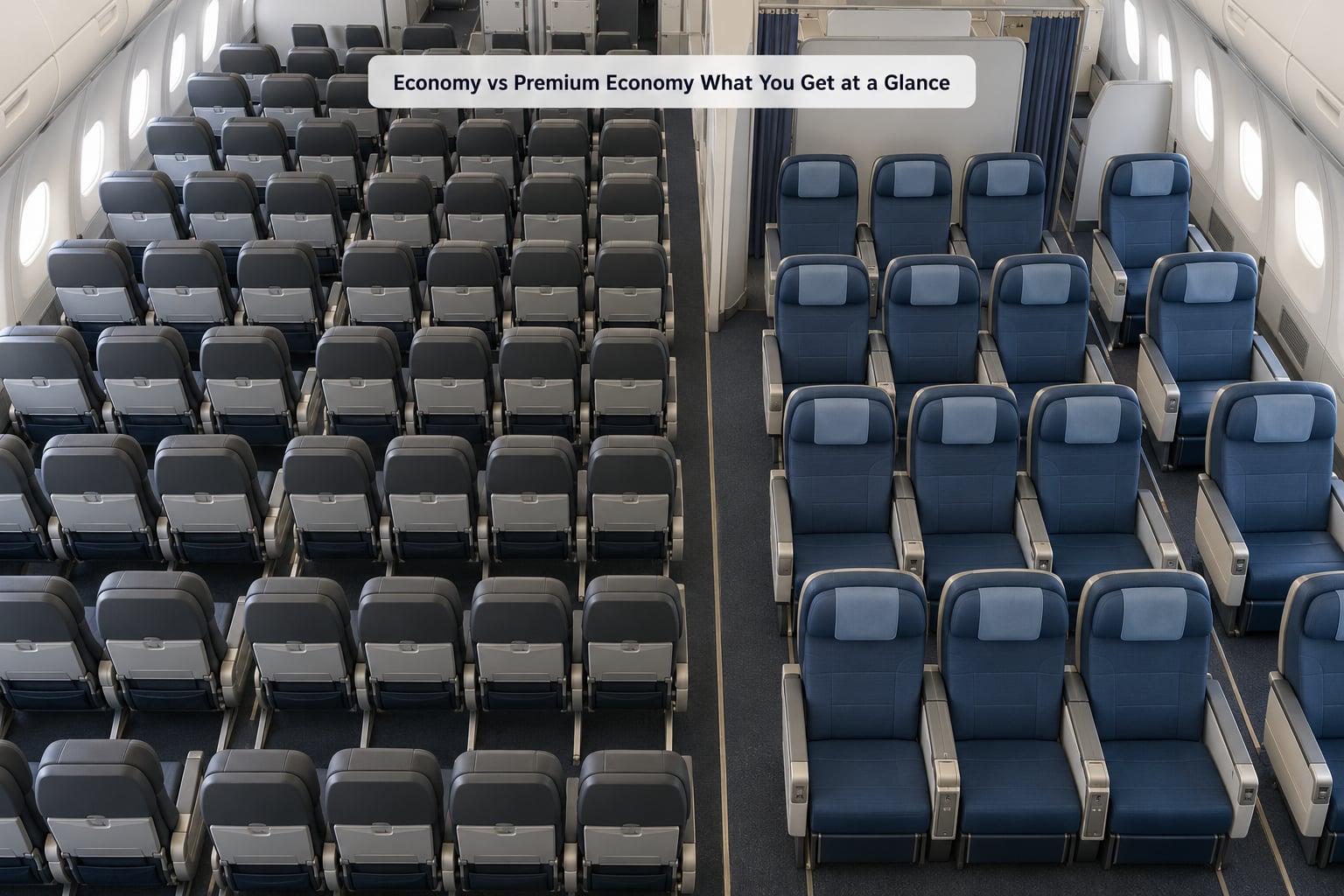
The table below covers what a standard main cabin fare includes against a typical premium economy fare on the same widebody. Every airline builds its premium cabin differently, so treat these as the normal range rather than a promise.
| What you get | Economy | Premium economy |
|---|---|---|
| Seat pitch | 30-34 inches | 36-42 inches |
| Seat width between armrests | 17-19 inches | 19-21 inches |
| Recline depth | 3-5 inches, sometimes fixed | 8-10 inches, usually adjustable |
| Leg and foot rest | Rare | Common, but not on every aircraft |
| Seats per row | Usually nine in 3-3-3 on a widebody | Usually seven in 2-3-2 |
| Meals | Included, tray service | Choice, better dishware, sometimes pre-order |
| Drinks | Paid, with free water and coffee | Complimentary bar service on most carriers |
| Boarding | General or SkyPriority group | Priority boarding and earlier check-in |
| Checked bag | Often a paid bag | Usually one bag included |
| Lounge access | No | Almost never |
| Typical fare gap | Baseline | Roughly 1.4 to 2 times the economy fare |
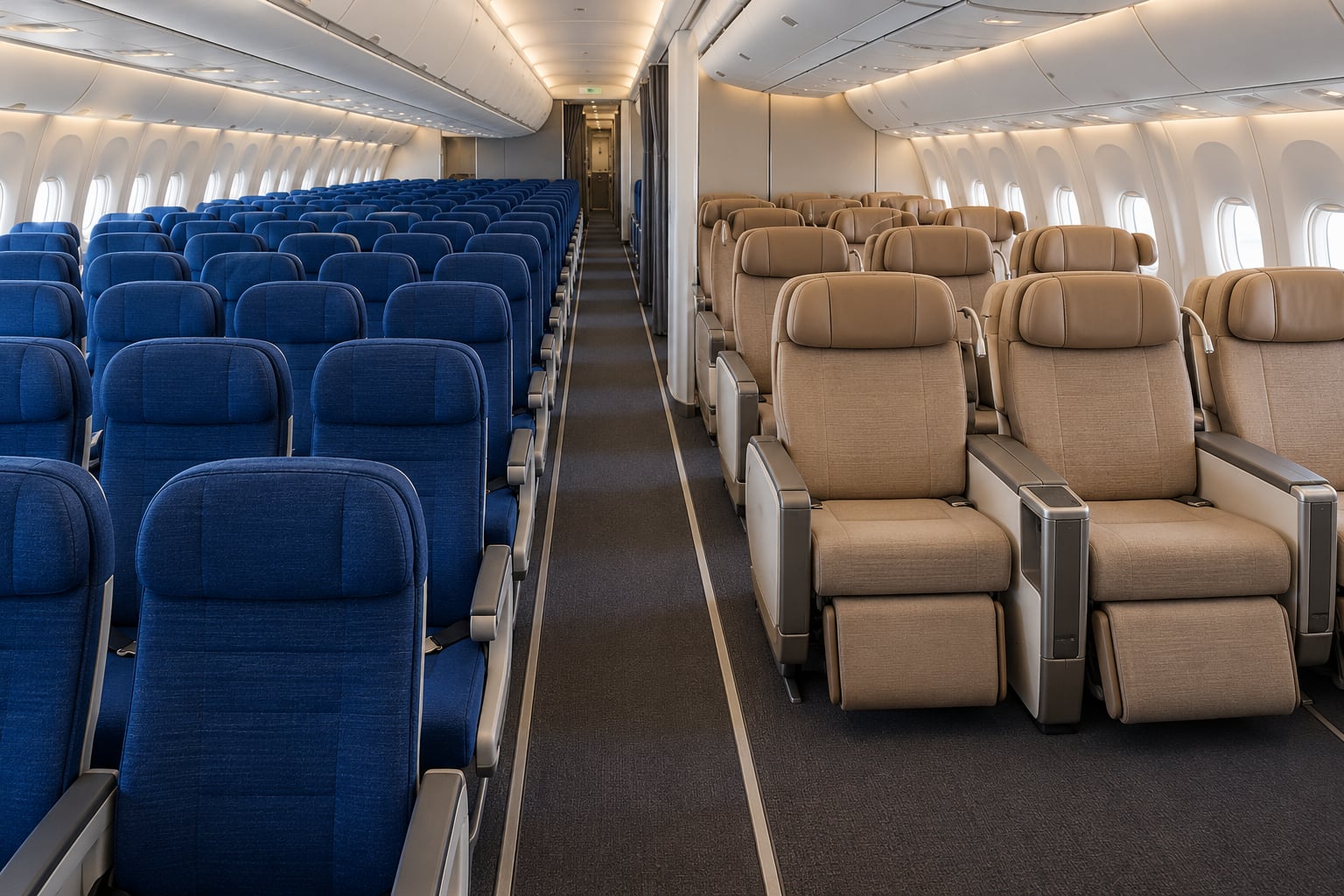
The reason the two cabins feel so different is simple arithmetic. Premium economy cabins are built by taking seats out of the row, seven across instead of nine, which widens the seat and its armrests. The rows sit further apart too, so pitch grows as well.
How Much More Space Do You Get?
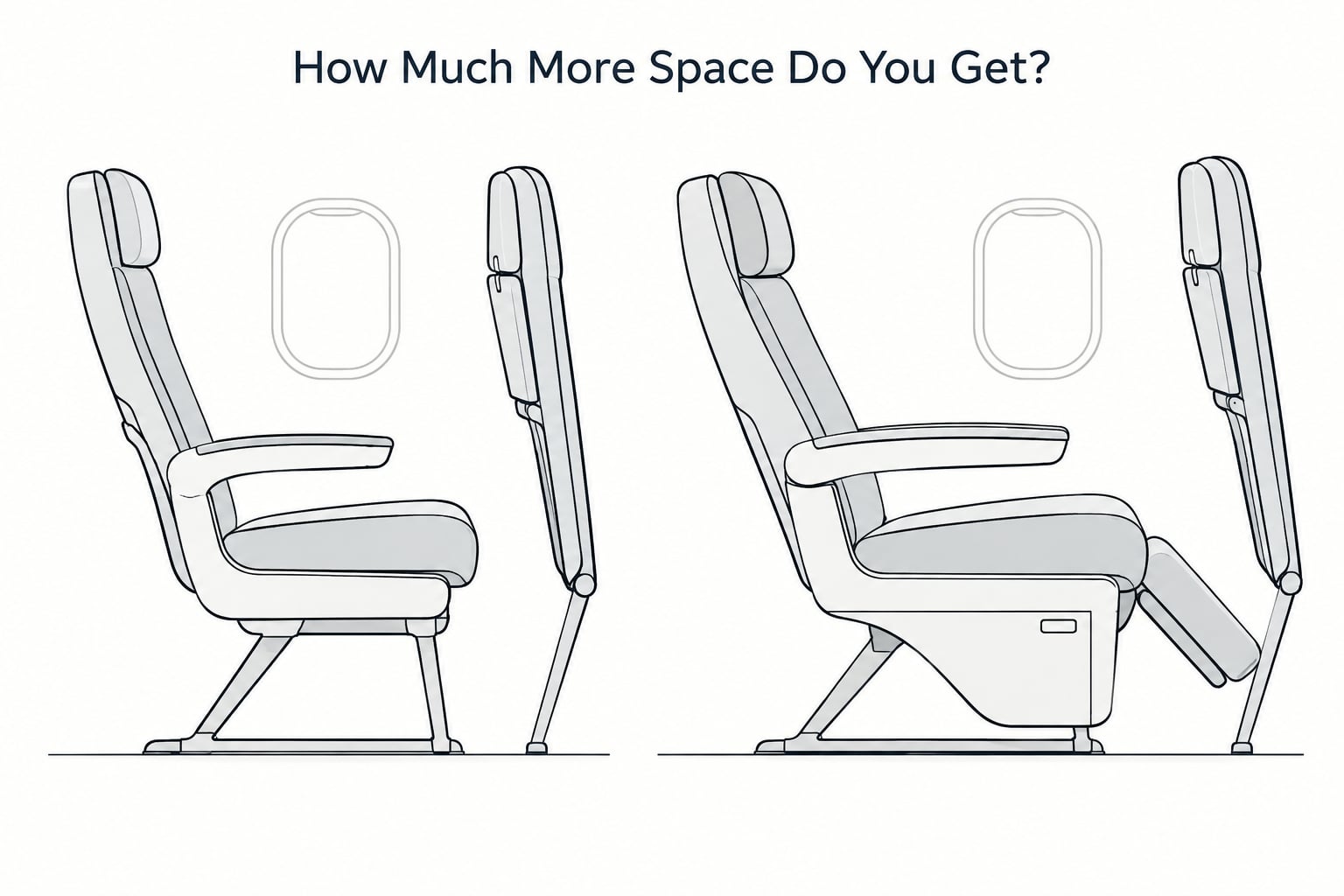
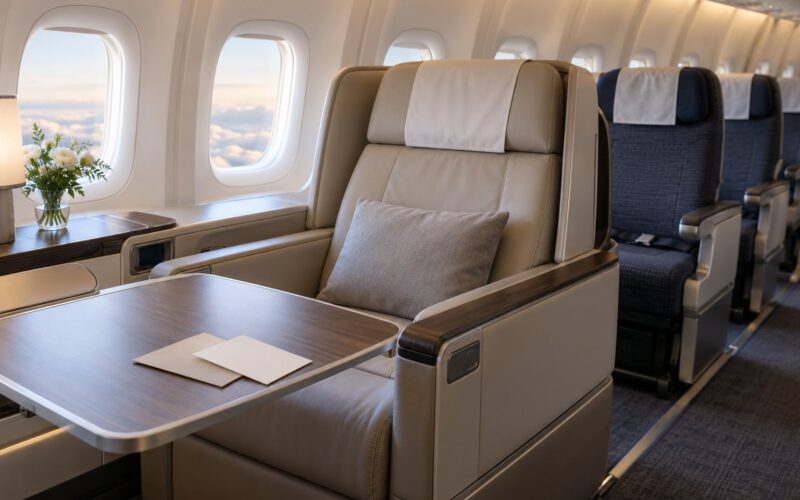
Roughly six to eight more inches of seat pitch, one to two more inches of width, and about twice the recline. Multiply width by pitch and a 19-by-32-inch economy seat gives you about 608 square inches of personal space, while a 20-by-38-inch premium seat gives you about 760.
Pitch is the distance from the back of your seat to the back of the one in front, and it is the number that decides whether your knees clear. Width is measured between armrests, which is what you feel when you fall asleep or try to work. Recline is how far the backrest goes down, and it is the difference between dozing upright and actually resting.
Iberia publishes 94 centimeters of pitch and 18 centimeters of recline for its premium economy, roughly 37 and 7 inches. That is a fair example of the middle of the range, and it is a useful reality check against marketing language about business-class-style comfort.
One caveat matters here. Some carriers fit premium economy with a fixed shell seat that slides forward instead of reclining backward. Air France and Aeroflot are the names travelers mention most. The cabin is labeled premium economy, the space is real, and the seat still will not let you lie down.
Why premium economy exists: seven across instead of nine
Nobody adds legroom by magic. The standard widebody main cabin is laid out three seats, aisle, three seats, aisle, three seats, so nine people share a row that is about 34 inches wide. Take two of those seats out and you get a two-three-two layout with seven seats across. The same row now holds two fewer bodies, each armrest is wider, and the seat track itself is spaced further apart.
Narrowbody aircraft with a premium economy cabin do it differently, usually by removing one seat from each row and re-pitching the rest, which gives a smaller gain. That is why the numbers swing so much between a widebody transatlantic flight and a domestic hop on a smaller jet.
The same logic explains why the biggest wins are on aircraft built for it. Widebody fleets from Boeing and Airbus, on carriers such as Singapore Airlines, Qatar Airways, Lufthansa, British Airways, Virgin Atlantic, Japan Airlines, Iberia, ITA Airways, Starlux and Emirates, are where you will find the widest premium seats. Check the aircraft on the seat map before you assume.
Can you sleep in premium economy?
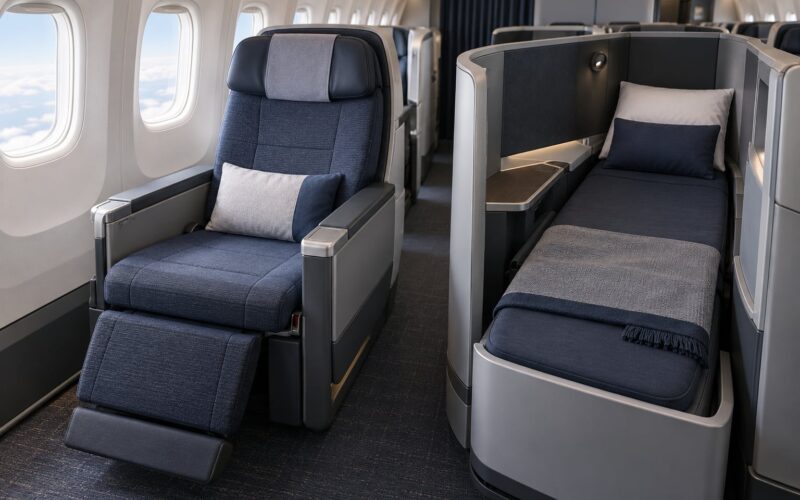
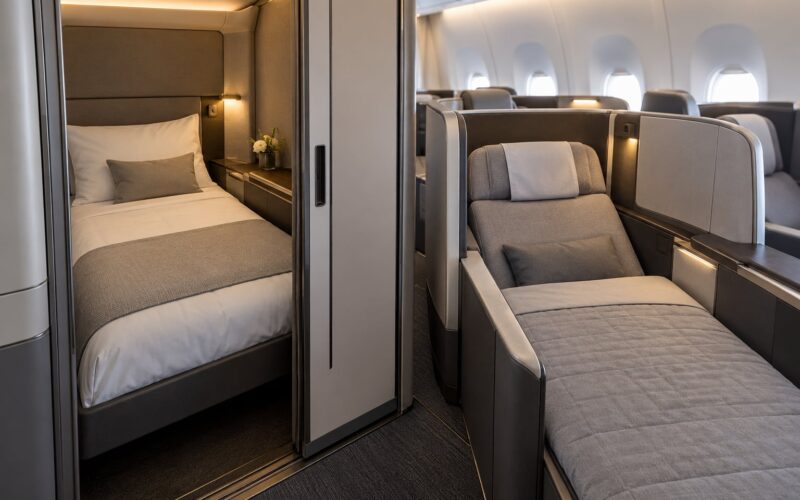
Yes, on most long-haul flights, and much better than in economy, but it is still an angled seat rather than a bed. Roughly twice the recline, a wider seat, a leg rest and fewer people in the row are enough to get real rest on a six-to-twelve-hour flight. A lie-flat bed starts in business class.
What helps most is the bedding rather than the inches. Premium long-haul cabins usually bring a blanket and a small pillow or a compact sleep kit. Ask for a pillow early, because crews hand out a limited number, and use the headrest wings if the seat has them.
The overnight case is the strongest argument for the upgrade. A red-eye where you land and have to work is exactly when the extra recline and foot rest get used, and exactly when economy leaves you stiff and sore.
What Economy vs Premium Economy Changes On Board
Beyond the seat itself, the day-to-day difference is cabin density and service intensity. Seven seats across a row means wider armrests and fewer people elbows-deep in the same space, and most carriers staff the premium cabin with a dedicated flight attendant, which shows up as faster drink refills and less waiting between services.
Seat controls are the other change travelers notice first. A premium seat usually has a real recline handle or a button instead of a fixed backrest, and on many aircraft the shell is hinged so you can raise the seat back a few inches to sit up without losing the leg rest. On a ten-hour leg that control is worth more than the extra two inches of width.
Some upgrades do almost nothing. A bigger seatback screen matters if you watch two movies, not if you sleep. Free alcohol is a nice touch on a five-hour hop and irrelevant at noon. Priority boarding saves you twenty minutes of standing. Judge each perk on the length of your flight, not on the brochure.
How Do Meals and Drinks Compare?
The meal upgrade is usually a change of choice and presentation, not a change of portion. Premium economy on a long-haul route typically adds a second or third option, hot dishware instead of paper trays, a pre-order meal on some carriers, and complimentary drinks served from the cart rather than bought by the glass.
Forum travelers are consistent about this. On r/BritishAirways one poster put it plainly: the seats are a little more comfortable and the cabin is smaller and quieter, but the uplift in food is marginal at best. On r/emirates, regulars say the reason to move up is leg room and advise against paying extra just for the food.
Short routes rarely show a difference at all. Under about four hours most carriers serve a snack in both cabins, and sometimes the premium snack is the same box economy passengers get.
What Are the Differences in Boarding and Service?
Premium economy usually includes earlier check-in, priority security, a dedicated check-in counter on international carriers, and an earlier boarding group. On top of that, many fares add one free checked bag and expedited bag delivery on arrival, which quietly saves you fifteen minutes at the carousel.
What you almost never get is lounge access. It is the most common misunderstanding I see, and users ask it constantly. Unless your fare is a branded premium product from an airline that explicitly bundles lounge entry, plan on paying for a day pass or using your own lounge card.
Seat selection is another trap worth knowing about. Some low-cost premium fares assign your seat at check-in rather than at booking, which matters most for couples and families who want to sit together. Check the fare rules before paying, not after.
United Premium Plus vs Delta Premium Select vs American Premium Economy
The three US carriers each sell their own branded product, and the names confuse people more than they should. United calls its true premium economy Premium Plus and sells a separate Economy Plus that is only extra legroom. Delta uses Premium Select for the real cabin and Comfort+ for the extra-legroom seat in economy. American keeps the name plain, with Premium Economy as a separate cabin above its Extra Legroom Seats.
Travellers on r/unitedairlines and r/delta hit the same wall repeatedly: they book an extra-legroom fare expecting a premium cabin and arrive to find a slightly wider economy seat. On r/DeltaAirlines, the overnight flight is what pushes people toward the real premium product rather than the extra-legroom one, because being able to sleep through the leg of the trip is the deciding factor.
Four things premium economy does not give you
First, no lie-flat bed. Second, no lounge access in almost every case. Third, no guaranteed leg and foot rest, because some aircraft in the premium economy cabin are fitted without one. Fourth, no dramatic meal upgrade. Forum posters in r/StarluxAirlines keep asking how far the footrests actually raise, which tells you how unclear this is from the outside.
Airline apps also misreport recline amounts, and at least one passenger on r/emirates found the in-app figure did not match the seat in front of them. Check the seat map and the aircraft rather than trusting the app number.
Which Amenities Are Usually Better?
Power and screens come down to the aircraft, not the cabin. On the same widebody, a premium seat often has a larger screen and a guaranteed outlet, while economy rows behind the galleys may have neither. If you plan to work, look up whether your specific seat has a plug rather than assuming the cabin has power.
Noise-canceling headphones are common in premium economy on carriers such as Iberia and several Asian and Middle Eastern airlines, and a decent amenity kit with an eye mask and earplugs arrives on many long-haul premium cabins. Both are absent in economy.
The amenity that changes an overnight flight most is the blanket and pillow, because the flight is six hours or more and you are trying to sleep. Everything else is a bonus on top of that.
Is Premium Economy Worth the Extra Cost?
Use a simple multiple. Premium economy is usually about 1.4 to 2 times the economy fare. Under roughly 1.5 times on an overnight long-haul flight, most travelers who have done it say yes. Closer to double the economy fare, stay in economy and save the money or spend it on a better seat selection in economy instead.
You can run the same test in inches. Take the fare gap and divide it by the extra inches of pitch. On a transatlantic route that can work out to a sizable amount per extra inch, which is why people grumble about carriers charging a lot for a cabin that is only an inch or two wider than economy. On some European carriers the premium seat genuinely is barely wider, and the Rick Steves community reports exactly that experience.
Other things push the fare gap up. Premium economy is only around eight to ten percent of the seats on a widebody, so the cheapest premium fares sell out long before the economy cabin fills. Peak travel weeks and the last few seats before a flight make it worse.
Getting premium economy for less
If the gap is too wide at booking, there are three cheaper routes. Check-in standby upgrades are offered when the premium cabin has empty seats, and the price is often lower than the pre-booked upgrade. Miles and status upgrades are free or nearly free on several carriers for high-tier flyers. And check what you are actually buying: an extra-legroom economy seat in a 3-3-3 layout can match a mediocre premium economy seat for far less.
Which Should You Choose?
Stay in economy when the flight is under four hours and in daylight, when you are buying the lowest workable fare, or when the premium fare is more than double the economy one. Those are the cases where the extra space goes unused.
Upgrade when the flight runs six hours or more and crosses your bedtime, when you are tall or broad-shouldered and economy is genuinely tight, when you need to land and work or present, or when two checked bags would otherwise cost you the difference anyway.
A few final checks before you pay: look up the aircraft on the seat map, confirm your seat has a leg rest, read whether the fare includes a free bag and priority boarding, and verify whether lounge access is bundled. The same airline sells a barely upgraded premium economy on one aircraft and a genuinely good one on another.
Frequently Asked Questions
Is premium economy always worth the extra cost?
No. Premium economy tends to cost about 1.4 to 2 times the economy fare, and it pays off mainly on long or overnight flights where you will actually use the space and the bedding. On a short daytime trip, or when the upgrade costs more than double the economy fare, most travelers are better off staying in economy and picking a good seat there.
Does premium economy give you a lie-flat seat?
Almost never. Premium economy reclines further than economy and usually adds a leg and foot rest, which makes sleeping possible, but the seat remains upright at an angle. A true lie-flat bed starts in business class on most carriers. Some premium economy seats use a fixed shell that slides forward instead of reclining backward.
How much more legroom do you get in premium economy?
Typically six to eight more inches of seat pitch and one to two more inches of width, with roughly twice the recline depth of economy. That comes from building the cabin seven seats across instead of nine. Specific figures vary by airline and aircraft, so check the seat map for the exact flight you are booking.
Are meals and drinks included in premium economy?
Yes, on long-haul routes meals are included in both cabins. Premium economy usually adds more choice, better dishware, sometimes a pre-order option, and a complimentary drinks service with the usual bar items free. On routes under about four hours the two cabins often get the same snack, and travelers regularly describe the food upgrade as marginal.
How can I tell exactly what premium economy includes?
Check the fare rules on the airline site before you book, and confirm the aircraft on the seat map. Look for priority boarding, the free checked bag allowance, lounge access if it is bundled, and whether your specific seat has a leg rest. Some low-cost premium fares assign seats at check-in, which matters for couples and families.
Conclusion
The choice comes down to hours in the air and the size of the fare gap. Under about 1.5 times the economy fare on an overnight flight, the extra pitch, deeper recline, foot rest and bedding are worth it. Above that, or on a short daytime route, economy is the sensible buy. Before you commit, check the seat map for the exact aircraft, read what the fare includes, and confirm your seat has the leg rest you are paying for.