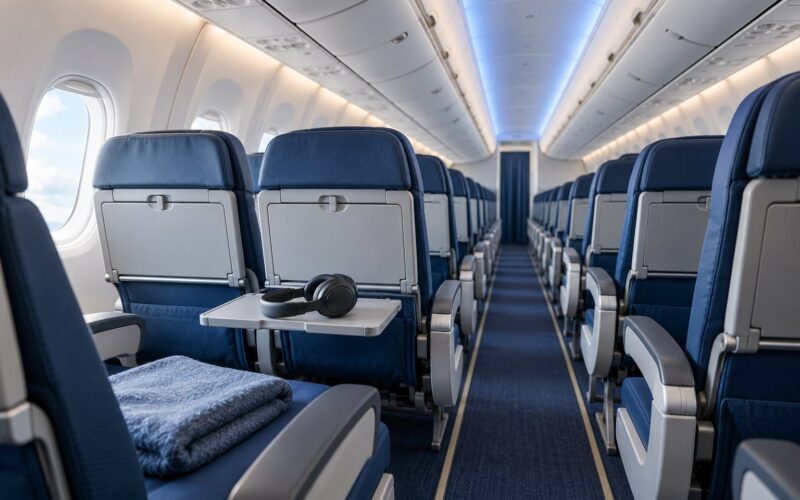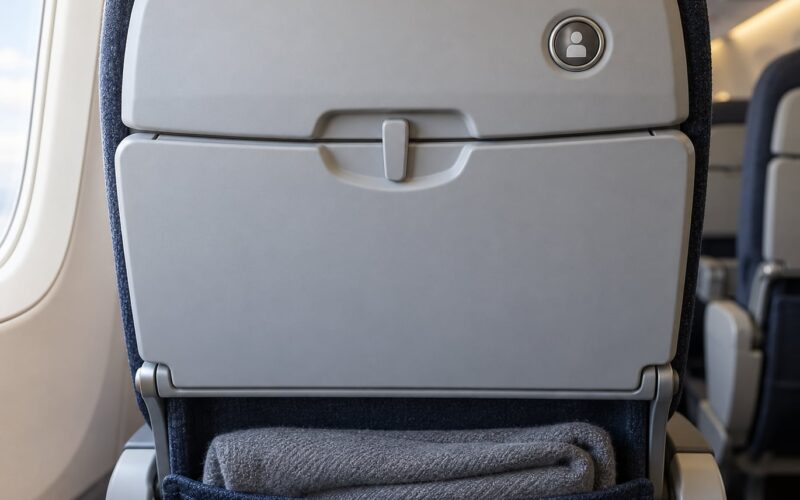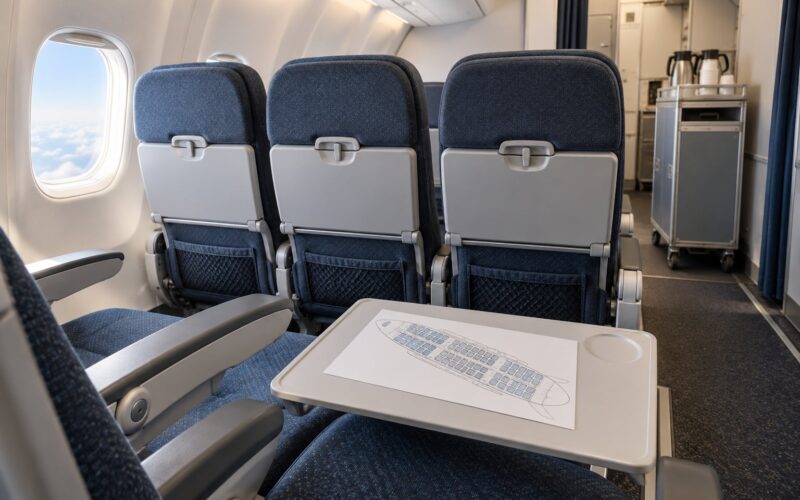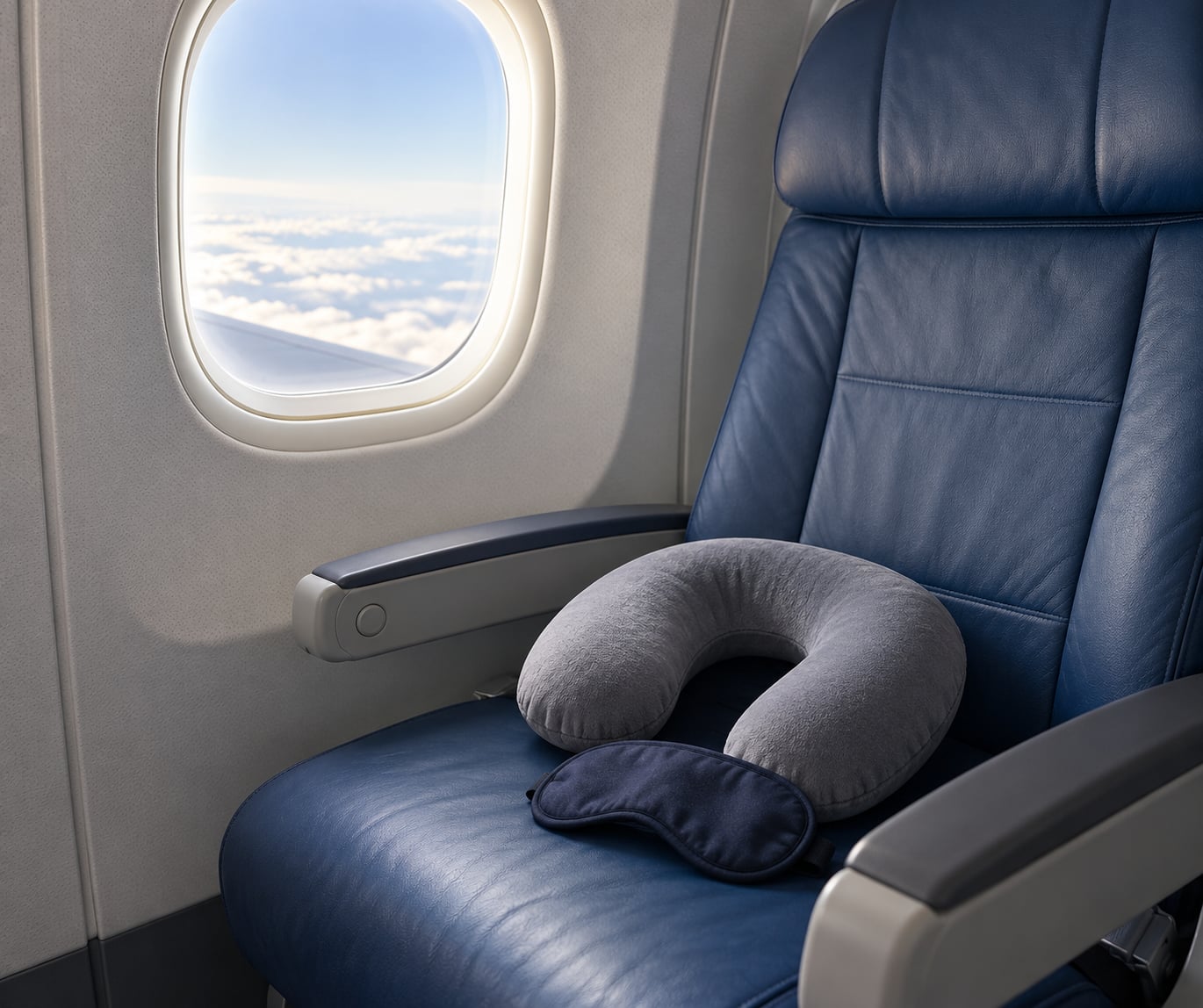
Window seats are better for sleeping because the cabin wall gives your head something solid to lean against, and nobody has to climb past you at 3 a.m. to reach the lavatory. Those two things do most of the work. Everything else, from light control to temperature, is a bonus on top.
I fly red-eyes often enough that I have opinions about this, and the honest version is more useful than the usual window-seat cheerleading. A window seat wins on head support, aisle traffic and control of your own space. It loses on freedom of movement, and on long flights it loses badly if you need the toilet regularly.
Table of Contents
- Why Window Seats Are Better for Sleeping on Planes
- What Makes a Window Seat Easier to Sleep In?
- Lateral support and reduced neck flexion
- How recline changes things
- Window Seats and Sleep Quality: The Main Benefits
- A headrest that does not move
- Nobody walks past you at 3 a.m.
- You control the light and the blanket
- A small room of your own
- Which benefit matters most, and to whom
- How to Get Comfortable in a Window Seat for Sleeping
- Pick the right window row, not just any window row
- Set up the seat before take-off
- Build a red-eye sleep kit
- Book it, then defend it
- Window vs. Aisle Seats for Sleeping
- Is a window seat really better for sleeping on planes?
- When an Aisle Seat May Be Better
- Frequently Asked Questions
- Which seat is best for sleeping on a plane?
- Is it better to have a window seat on a plane?
- What seat to avoid on an airplane?
- Why avoid seat 11A on a plane?
- What is the 3 seat economy trick?
- How do I keep my window seat if someone takes it?
- Why window seats are better for sleeping on planes than aisle seats, in short
- Bottom Line
Why Window Seats Are Better for Sleeping on Planes
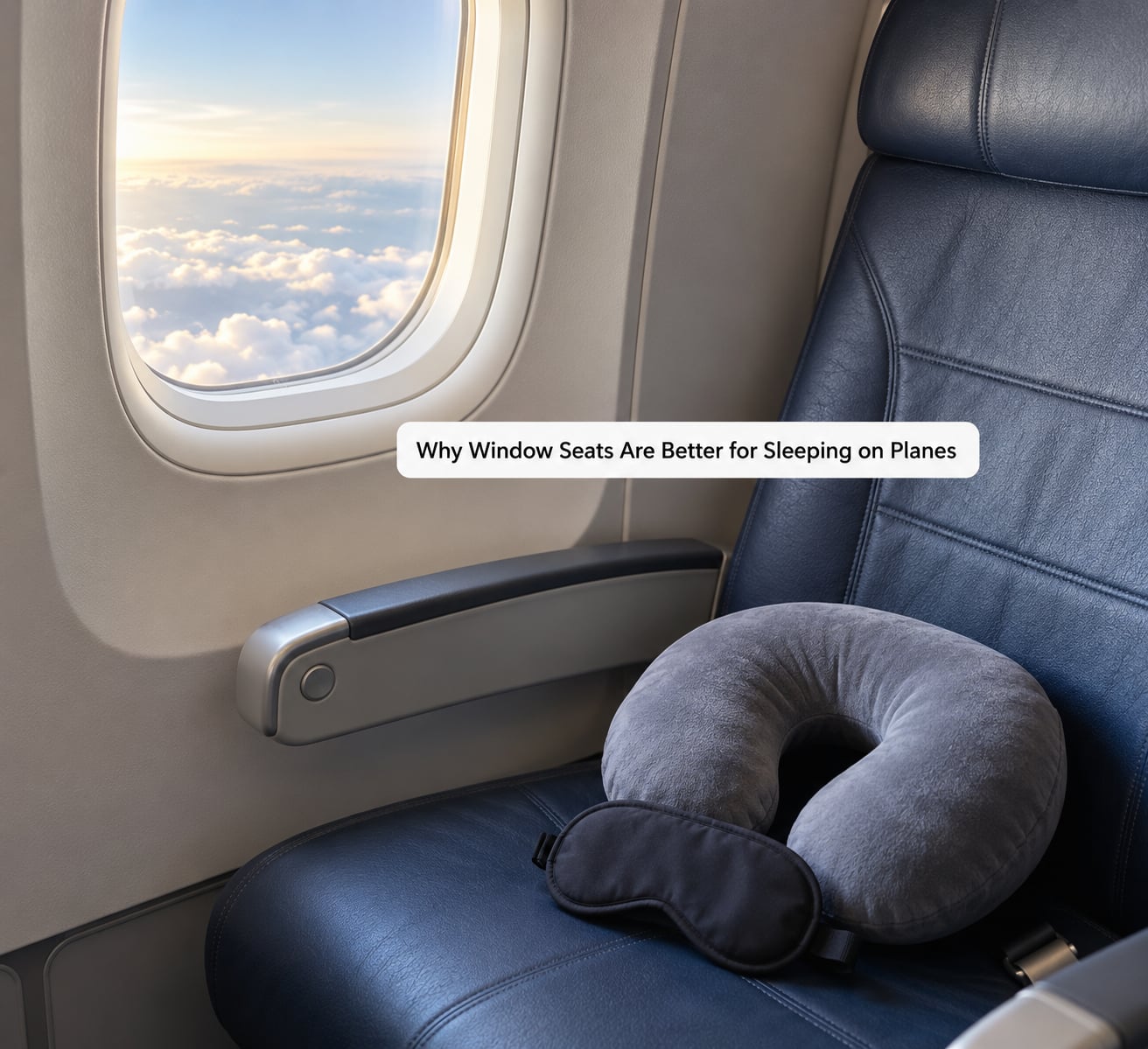
Window seats are better for sleeping on planes for one main physical reason: you can rest your head against a fixed surface instead of holding it upright. Secondary reasons follow from that one. A window seat is out of the walking route, it is at the edge of the cabin where foot traffic thins out, and you are the only person controlling the light on your side.
- The cabin wall works as a headrest, so your neck does not have to hold your head up unsupported for eight hours.
- Nobody walks past your seat to reach the aisle, so you are not woken by elbows, bags and late-night lavatory queues.
- You control the window shade on your side of the cabin, so you can block light without a word to a stranger.
- You define the boundaries of your space, because there is no seatmate on the aisle side to spread into it.
- You are closer to the window wall, so cabin noise and service cart traffic are further away.
- You settle in during boarding and can stay settled for the whole flight, which matters more than people expect.
- On a night flight, having a view gives your eyes something steady to rest on when you are not asleep.
There is a catch that most of these lists skip. All of it depends on where in the cabin the window seat is, and on the aircraft. A window seat next to the galley or the lavatories can be a worse sleep than an aisle seat in the middle of the cabin. The section on picking the right row covers that in detail.
What Makes a Window Seat Easier to Sleep In?
An aircraft economy seat does not recline flat, so the position you sleep in is not a lying position. It is a slumped sitting position held for many hours, and that is a genuinely uncomfortable thing to do with your neck. The sidewall changes the geometry of the problem.
Lateral support and reduced neck flexion
Without a wall, your head is unsupported. Your neck muscles have to work continuously to keep your skull balanced, and a side tilt or a forward drop wakes you up because the muscles suddenly have to catch it. That is the part nobody explains: it is not only that leaning is pleasant, it is that leaning removes a small but constant effort.
With a window, the wall takes some of that load. You can let your head rest against it at a slight angle and stay there without correcting yourself. Holding a head upright is work. Leaning on a fixed surface is not. The practical version of this advice is that you still want a neck pillow or a rolled jacket, because the cabin wall curves away and most window panels sit lower than a person’s temple.
How recline changes things
On a night flight, the seat in front of you is probably going to recline, whether the person in it intends to or not. The seat reclines, your usable space shrinks, and any head support you had changes shape. Window seats do not shield you from that, but they do give you one more thing to brace against when it happens.
Aircraft type matters more than most people expect. On a widebody the footwell is deeper, so you can stretch your legs out in a way that a narrowbody 3-3 layout does not allow. On a narrowbody, the wall next to you is closer and the cabin feels tighter. Business class or first class layouts in 1-2-1 or 2-2 change the calculation again, because the window seat in those cabins is often a fully flat bed.
Window Seats and Sleep Quality: The Main Benefits
Not every benefit applies equally to every sleeper, so here is what each one actually does and who feels it most.
A headrest that does not move
This is the reason the window seat wins, and everything else is a rounding error. Airplane seats are not built to hold a sleeping adult; a window is the only fixed surface in the cabin that is roughly head-height. Frequent flyers on the One Mile at a Time forum describe the same thing in different words: the wall is the difference between sleeping and dozing.
Nobody walks past you at 3 a.m.
An aisle seat puts you in the traffic lane. On the One Mile at a Time forum, the most repeated complaint about aisle seats is not legroom, it is being bumped by passengers and by cabin crew working the carts. Add the 3 a.m. lavatory queue, because most passengers who wake up at night need the toilet, and the aisle seat becomes a bad place to be unconscious.
You control the light and the blanket
Shade is the one variable a window passenger controls unilaterally. In a window seat you can black out completely, and cabin lights reflecting off a screen will wake you. The flip side is courtesy. Forum regulars on One Mile at a Time and Airliners.net both raise the same point: an open shade in a dark cabin lights up the whole row, so a window passenger who wants to sleep still has to close it without a confrontation.
A small room of your own
There is a psychological component to the sidewall. A space with a visible boundary reads as private, and a defined space makes it easier to relax into sleep. For nervous flyers the same boundary cuts both ways. Some people find an enclosed seat worse, not better, because of the enclosed feeling, while others find the visible ground and horizon outside the window calming on a long flight over water or at night.
Which benefit matters most, and to whom
If you sleep lightly, aisle traffic is your biggest enemy and the window seat is the obvious answer. If you are a light sleeper who wakes with noise, the wall helps less than the distance does, so a rear window seat in a quieter section beats a front one. If your main problem is a stiff neck, only the wall fixes it. If you are a restless sleeper who moves around, none of this matters much and the aisle may suit you better.
How to Get Comfortable in a Window Seat for Sleeping
Choosing the seat is half the work. The other half is what you bring and how you set it up before the seat belt sign comes on.
Pick the right window row, not just any window row
Not all window seats are equal, and the ones most people grab by accident are the worst in the cabin.
| Row type | What it means for sleep | Verdict |
|---|---|---|
| Galley row | Nearest the food and drink carts, and crew working the cabin | Avoid |
| Lavatory-adjacent row | Queue, door, light under the door, and noise all night | Avoid |
| Attendant jumpseat row | The seat opposite the jumpseat is often blocked outside take-off and landing, so it stays empty | Target row |
| Bulkhead window | Extra legroom and a short walk to the lavatory, but no recline in front of you | Mixed |
| Misaligned window row | The window does not line up with the seat, so the wall sits at the wrong angle for your head | Avoid |
| Rear cabin, away from galley and lavs | Farthest from the noise and the queues, and the wall is usually well shaped | Best target |
The misaligned window deserves a specific mention. On some widebody and retrofitted aircraft the window panel does not sit opposite the seat, so you end up leaning forward into a gap instead of back into a wall. It is a recurring complaint in the r/mildlyinfuriating crowd and it is genuinely hard to predict from a booking screen.
Check the aircraft type and the seat map before you pay. SeatGuru and the airline’s own seat map both show the layout, and reviews of the specific aircraft type will often mention whether the window lines up. Window seat 11A comes up constantly in listicles of seats to avoid, and the pattern is not mysterious: it is usually a misaligned window plus a lavatory nearby.
Set up the seat before take-off
Get settled in the first ten minutes. Adjust the headrest, and if the seat has a headrest wing use it, because the gap between seat back and headrest is where most of the discomfort comes from. Then stop fiddling, because a passenger who is still adjusting at take-off is a passenger who will be uncomfortable at hour nine.
Keep water within reach before you settle, not after you have already drifted off. Once you are asleep, getting up means waking your seatmate and climbing back over them.
Build a red-eye sleep kit
Seat choice does the heavy lifting. A short kit does the rest:
- A neck pillow, or a rolled jacket or sweater if you would rather not carry one. The wall curves away and you will still need something filling the gap.
- A blackout eye mask, which matters as a second line of defence if a passenger opens the shade.
- Foam earplugs, or noise-cancelling headphones if you have them. Cabin noise at cruise is constant, and it is mostly low-frequency hum that masks sleep lightly rather than waking you outright.
- Loose layers rather than jeans or a stiff waistband. Tight clothing and heavy fabrics restrict movement, and you will be sitting in them for the entire flight. This is the reason flight comfort guides keep telling people not to wear jeans.
- A plan for hydration, because dry cabin air plus an overnight flight is a headache factory, and a headache wakes you up.
Skip the sleep-aid advice you have read online. Nothing over the counter is safe to mix with alcohol on a flight, and grogginess at altitude with a full bladder is a worse outcome than mild jet lag.
Book it, then defend it
Window seats go first, so choose one at booking rather than hoping. Seat selection opens roughly 24 hours before departure on most airlines, and if your fare includes a free seat, take the window when it is offered.
If someone is already sitting in your window seat when you board, do not start by arguing quietly in the aisle. Find a flight attendant, give them your booking reference and seat number, and ask them to sort it out. That is the whole procedure, and it is more reliable than any conversation you can have yourself. If no attendant is free, wait until one passes. Once you are seated and settled, boarding traffic generally stops being a problem.
Window vs. Aisle Seats for Sleeping
The honest comparison has two columns and no winner, because the table flips depending on the flight and the traveler.
| Factor | Window seat | Aisle seat | Middle seat |
|---|---|---|---|
| Sidewall head support | Yes, the main advantage | No | No |
| Aisle traffic and bumping | None | Constant risk from passengers and crew | None from the aisle |
| Lavatory access | Slow, must climb over seatmates | Immediate | Slow |
| Light control | Full control of your side | Shared cabin lighting | Shared |
| Noise distance | Further from the aisle | Closest to cabin noise | Middle distance |
| Seat width and armrests | Narrower, wall on one side | Narrower, but often the widest on a 3-3 | Two armrests shared |
| Recline and getting up | Seats in front may recline into you; slow exit | Fast exit, aisle in front of you | Trapped both sides |
| Best for | Light sleepers, solo travelers, red-eyes under about 6 hours | Frequent restroom breaks, limited mobility, long hauls over 6 hours | Nobody, unless the middle seat is empty |
Is a window seat really better for sleeping on planes?
On a flight of about six hours or less, for most people, yes. The head support and the lack of aisle traffic outweigh everything, and that is the case most of the internet agrees on. Past six hours, forum consensus gets more divided, because restroom needs start to matter more than sleep quality. A commenter on the Rick Steves community forum put it plainly: a window seat is ideal, except that getting up a lot makes it a trap.
One more thing the table hides: aircraft type and cabin class can override the whole comparison. In a 1-2-1 premium cabin the window seat is a bed, and the aisle seat is only a bed with a curtain. In a narrowbody 3-3 economy row, a middle seat next to an empty window seat can be the best sleeper’s arrangement in the entire row.
When an Aisle Seat May Be Better
There are honest cases for the aisle seat, and they come up in forum threads about this question more than any other.
Restroom frequency is the big one. If you expect several bathroom visits on a long flight, an aisle seat beats a window seat outright, and no amount of neck support compensates for climbing over two sleeping strangers at 4 a.m. Older travelers and anyone with a medical reason to need frequent access fall into this group.
Mobility is the second. Anyone who struggles to get up from a low seat, or who walks with support, needs an aisle seat. Trapping yourself against the cabin wall at 70 years old is a different proposition from doing it at 30.
Some plus-size flyers prefer the aisle on purpose. The footwell is where the extra inches are, and on a narrowbody the window position can mean losing headspace against the curve of the fuselage. That trade is worth taking deliberately rather than by accident.
Finally, there is the honesty rule. If you know you will need to get up often and you book a window seat anyway, you have bought yourself a string of apology speeches. The people on the One Mile at a Time forum who describe waking their seatmates say the same thing from the other side: they would rather have a window seat and manage, than an aisle seat and no sleep.
And if you end up in an aisle seat by mistake, it is not hopeless. Block light with a sleep mask instead of a shade, use a neck pillow and lean into the headrest rather than the sidewall, accept that you will be bumped, and do not plan to sleep deeply. Most people get a few broken hours, which is the realistic ceiling in economy anyway.
Frequently Asked Questions
Which seat is best for sleeping on a plane?
For most people on flights of about six hours or less, a window seat in the rear cabin, away from the galley and lavatories, is the best seat for sleeping. The sidewall supports your head and nobody walks past you. Past six hours, or if you need the lavatory often, an aisle seat sleeps better in practice.
Is it better to have a window seat on a plane?
Yes, if your main goal is sleep and you do not need to get up often. A window seat gives you a fixed surface to lean your head against, keeps aisle traffic away from you, and puts the window shade under your own control. The trade-off is that leaving your seat means climbing over your seatmate.
What seat to avoid on an airplane?
Avoid the bulkley and lavatory rows next to the bulkhead, the attendant jumpseat row if you want the seat beside it free, and any row where the window is misaligned with the seat. On narrowbodies the lavatory queue is the main sleep killer, so a row two or three away from the bathroom is a better pick than the closest possible one.
Why avoid seat 11A on a plane?
Seat 11A is called out because of what usually sits near it. On many aircraft that row is close to a lavatory and sometimes has a misaligned window, so you get both night-time queue noise and no usable sidewall. Check the seat map and aircraft type for your specific flight before treating any numbered seat as automatically good or bad.
What is the 3 seat economy trick?
The three-seat economy trick is about the middle seat in a 3-3 or 3-4-3 row: if the aisle or window seat beside you is unoccupied, the middle seat gives you an armrest on one side and a seatmate escape route on the other. It is a better arrangement than a window seat next to a stranger, not a reason to book middle on purpose.
How do I keep my window seat if someone takes it?
Do not argue in the aisle. Find a flight attendant, give them your booking reference and seat number, and ask them to resolve it, since boarding is a documented mess and they know who is assigned where. If none is free, wait until one passes. This is why window seats are worth selecting at booking rather than assuming you will get one.
Why window seats are better for sleeping on planes than aisle seats, in short
A window seat beats an aisle seat for sleep because the cabin wall supports your head, you are out of the walking route, and you control the light. An aisle seat wins only when you need to move: frequent restroom visits, limited mobility, or flights longer than about six hours.
Bottom Line
A window seat is usually the better sleep choice because the cabin wall supports your head, you sit out of the aisle traffic, and you control your own light. Book it at check-in rather than at boarding, pick a row well away from the galley and the lavatories, and bring a neck pillow and an eye mask.
Then check yourself honestly. If you expect several bathroom visits, if getting out of a seat is hard, or if the flight runs past six hours, take the aisle instead. The best seat is the one that matches how you actually sleep, not the one that wins an argument.